


Polio viruses detected in wastewater in England and the United States: Santé publique France remains vigilant
Following the detection of poliovirus in wastewater from densely populated metropolitan areas in several countries where the poliovirus no longer circulates, Santé publique France remains vigilant in light of this unusual situation.

Polio
thematic dossier
Although polio has been eliminated in the WHO European Region since 2002, high vaccination coverage must be maintained to achieve the eradication of the disease.
In June 2022, Santé publique France published an update and a risk analysis following the prolonged detection of type 2 vaccine-derived poliovirus (VDPV2) in wastewater samples collected at the Beckton wastewater treatment plant, which serves a population of 4 million people in northeast London.
Since then, a case of VDPV2 polio was reported by the CDC on July 18, 2022, in an unvaccinated adult living in New York State, and the detection of genetically related poliovirus was retrospectively confirmed in wastewater from the patient’s county of residence. The Governor declared a state of emergency on September 9, 2022.
Both of these events are unusual and concerning, as each indicates prolonged silent circulation of VDPV2 in communities where polio vaccination coverage is low.
What are VDPVs?
VDPVs are poliovirus strains derived through genetic mutation from Sabin vaccine strains contained in the oral polio vaccine (OPV). These strains can become virulent again and cause cases of polio just like wild polioviruses. Just like the viruses in the oral vaccine, they are shed in the stool of vaccinated or infected individuals. As a result, they can spread to people who are not properly vaccinated against polio and cause the disease.
In France, as in many countries, polio vaccination relies on the use of the inactivated vaccine (IPV), which does not pose this risk of mutation. The oral vaccine has not been used in France since 1982.
Poliovirus: What Do We Know About the Situation in England?
An update on the situation
Between February and May 2022, several viruses with a genetic profile characteristic of vaccine-derived poliovirus type 2 (VDPV2) were detected in wastewater at the Beckton treatment plant in London.
Every year, isolated detections of poliovirus are observed as part of wastewater surveillance in the United Kingdom. However, for the first time, surveillance data suggest the circulation of VDPV2 within an under-vaccinated community, originating from a recently vaccinated individual who had traveled from a country using the oral vaccine in its immunization campaigns. The oral vaccine has not been used in the United Kingdom since 2004.
The viruses have been detected only in wastewater samples, and no cases of paralysis have been reported to date. Authorities consider the risk of spread to the general population to be low, although there is a risk of transmission in under-vaccinated communities. In Great Britain, 3-dose vaccination coverage for vaccines including polio for infants was estimated at 86.6% at 12 months and 87.0% at 24 months in London.
What are the authorities’ recommendations?
English authorities have reiterated the importance of checking and updating the vaccinations of people residing in London, and decided in early August, in addition to the catch-up campaign, to organize a vaccination campaign in London for young children aged 1 to 9 years, regardless of their background, using the inactivated vaccine (IPV), including for children who are already fully vaccinated, to limit the spread of the virus.
Poliovirus: What Do We Know About the Situation in the United States?
An update on the situation
On July 18, 2022, a case of poliomyelitis caused by a vaccine-derived poliovirus type 2 (cVPDV2) was reported in New York State in an unvaccinated young adult3. This is the second case resulting from the circulation of a vaccine-derived poliovirus (cVPDV type 1 in 2005) since the last reported case of poliomyelitis caused by a wild poliovirus in the United States in 1979.
Retrospectively, VDPV2 sequences genetically related to the case strain were detected in 50 environmental samples collected between May and July 2022 in Rockland County (the county of residence of the polio patient; 31 positive samples) and 3 neighboring counties (Orange, Sullivan, Nassau; 19 positive samples, suggesting transmission and circulation of VDPV2 within under-vaccinated communities4.
These sequences are also genetically related to the strains detected in environmental samples collected in London.
Furthermore, 4 samples collected in New York City also contain type 2 poliovirus sequences derived from type 2 vaccine poliovirus, but these sequences are not linked to the sequence from the polio patient.
According to New York State’s immunization reporting system5, the 3-dose vaccination coverage rate for infants under 24 months was 67.0% in July 2020 in Rockland County and decreased to 60.3% in August 20223, it was 58.8% in Orange County, 62.3% in Sullivan County, and 79.15% in Nassau County in August 2022.
What are the authorities’ recommendations?
New York State authorities have declared a state of emergency6 and reiterated the need for every unvaccinated or under-vaccinated resident of New York State (including children as young as 2 months old, pregnant women, and adults who have not previously received a complete vaccination series) to update their polio vaccination status without delay. They also encourage a booster dose for those at higher risk of infection, such as certain healthcare workers.
Poliovirus: What Is the Global Situation?
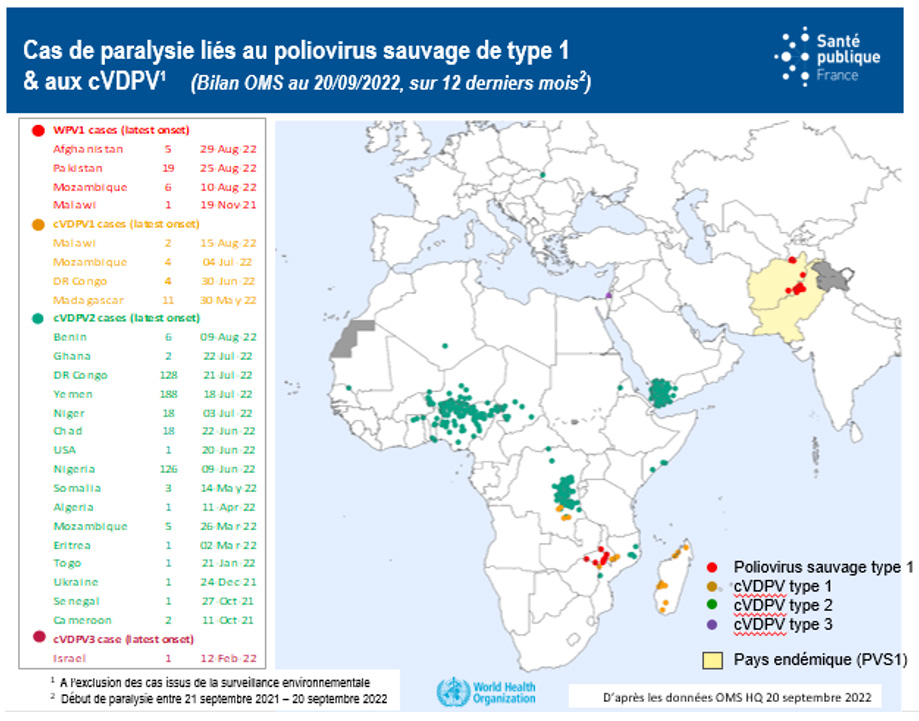
Although Europe has been officially declared a region free of wild poliovirus by the WHO since 2002, Santé publique France remains vigilant regarding possible reintroductions of poliovirus and monitors developments in the international situation as part of the global initiative to eradicate polio. Indeed, endemic outbreaks linked to wild poliovirus type 1 persist worldwide (Pakistan and Afghanistan). Furthermore, VDPV2 is circulating epidemically in many countries around the world (Africa, Yemen, Afghanistan, Pakistan, Ukraine).
In the WHO European Region, rare cases of paralysis caused by the circulation of vaccine-derived poliovirus (cVDPV) were recently reported in Ukraine in October and December 2021 and in Israel in February 2022, with respective isolations of cVDPV2 and cVDPV3. Regarding Ukraine, on April 28, 2022, the WHO reported 2 cases of paralysis linked to cVDPV2, and 19 contacts in their social circles who tested positive, leading to the implementation of an OPV (oral polio vaccine) vaccination campaign, which was significantly impacted by the war in Ukraine in the spring of 2022.
The risk of cVDPV importation linked to people arriving from Ukraine must be taken into account. Given suboptimal vaccination coverage in Ukraine, estimated at approximately 80% in 2021,8 vaccinating refugees, infants, and young children, as well as providing booster doses for adults, is a priority.
Polio Surveillance: What Is the Situation in France?
A very low risk in sufficiently vaccinated populations
Given the risk of poliovirus importation, the challenge is therefore to maintain high vaccination coverage until the disease has been eradicated.
Indeed, there is no treatment for polio. The main preventive measures involve hygiene and vaccination, which have reduced the incidence of wild poliovirus-related polio by more than 99% worldwide.
What is the vaccination coverage in France?
France has very high vaccination coverage against polio (inactivated polio vaccine): 99% for the primary series and 96% for the booster dose among infants in 2019. These figures have always been very high, as the vaccine was mandatory up to age 12 until 2018. Furthermore, vaccination is mandatory for infants born in 2018 or later.
This excellent coverage is reassuring, providing very good protection against the disease in the event of exposure; the risk of cases and/or clusters emerging within the French population therefore remains extremely low.
However, variations in primary vaccination coverage cannot be ruled out in certain regions or specific population groups with lower utilization of the healthcare system (National and Regional Public Health Vaccination Bulletin – April 2022).
Catch-up vaccination in unvaccinated or under-vaccinated population groups is therefore important to prevent the emergence of transmission clusters from imported cases. The HAS recommends that migrant children arriving in France receive a booster dose with a trivalent inactivated polio vaccine (IPV)9, even if they have been properly vaccinated with the oral polio vaccine but have not previously received a dose of inactivated polio vaccine.
Active surveillance to identify the presence of the poliovirus
The last case of wild poliomyelitis was reported in France in 1995. Since the establishment of the enterovirus surveillance network in 2000, apart from a vaccine-derived poliovirus detected in 2018 following accidental exposure in an industrial setting, one VDPV2 and about fifteen imported vaccine-derived polioviruses have been incidentally detected in patients without clinical signs of poliomyelitis.
Health authorities in France remain vigilant regarding the risk of introducing vaccine-derived poliovirus strains linked to individuals arriving from countries where the oral polio vaccine is still in use. Clinical and biological surveillance coordinated by the CNR for Enteroviruses and Parechoviruses enables the detection of any clinical suspicion requiring rapid action to limit the risk of transmission.
Given recent events, a communication campaign targeting healthcare professionals is underway to raise awareness of this risk and remind them of the procedures to follow in the event of any suspected polio case, particularly the virological testing to be conducted by the CNR.
To access the latest surveillance data: Poliomyelitis (santepubliquefrance.fr)
For more information
Action plan established in 1998 (revised in 2000) by the National Commission for the Certification of Polio Eradication (see BEH 2000;46-47), then in 2019 (HCSP opinion of October 18, 2019)
Procedures to follow in the event of any clinical suspicion or detection of the virus in the environment (HCSP opinion of October 18, 2019)
Vaccination strategy in the event of a polio case or detection of poliovirus in the environment (HAS opinion of November 2019)
1https://www.bmj.com/content/377/bmj.o1578 - https://www.gov.uk/government/publications/polio-detection-of-vdpv2-in-london-sewage-samples/immediate-actions-in-response-to-detection-of-vaccine-derived-polio-virus-type-2-vdpv2-in-london-sewage-samples
3Link-Gelles R, Lutterloh E, Schnabel Ruppert P, Backenson PB, St George K, Rosenberg ES, Anderson BJ, Fuschino M, Popowich M, Punjabi C, Souto M, McKay K, Rulli S, Insaf T, Hill D, Kumar J, Gelman I, Jorba J, Ng TFF, Gerloff N, Masters NB, Lopez A, Dooling K, Stokley S, Kidd S, Oberste MS, Routh J; 2022 U.S. Poliovirus Response Team. Public Health Response to a Case of Paralytic Poliomyelitis in an Unvaccinated Person and Detection of Poliovirus in Wastewater - New York, June-August 2022. MMWR Morb Mortal Wkly Rep. 2022 Aug 19;71(33):1065-1068. doi: 10.15585/mmwr.mm7133e2. PMID: 35980868.
4Wastewater Surveillance. Department of Health. New York State. Data as of September 9, 2022.
5Polio Vaccination Rates By County. Department of Health. New York State. August 2022.
6Press release dated September 9, 2022. Governor of New York State.
7Letter to healthcare professionals. HEALTH ADVISORY: Update #2 Regarding Poliovirus in New York State. August 19, 2022.
8WHO Ukraine Crisis. Public Health Situation Analysis – Refugee-Hosting Countries, March 17, 2022.
9Vaccination recommendation. Catch-up vaccination for individuals with incomplete, unknown, or partially known vaccination status in the general population and among newly arrived migrants. Haute Autorité de santé. December 2019.
Vaccination Information Service
What are vaccines for? How do they work? At what age should children be vaccinated? Vaccination-info-service.fr answers the most frequently asked questions about vaccination. A separate...












