Visuel d'un poliovirus

Detection of the poliovirus in wastewater in England: an analysis by Santé publique France

Following the detection of poliovirus in wastewater samples from a treatment plant in London, Santé publique France is continuing to monitor the situation. Learn more about polio surveillance in France and around the world.

Vaccination Information Service

What are vaccines for? How do they work? At what age should children be vaccinated? Vaccination-info-service.fr answers the most frequently asked questions about vaccination. A separate...

On Wednesday, June 22, the World Health Organization (WHO) confirmed the detection of vaccine-derived poliovirus (VDPV) type 2 in wastewater samples collected as part of routine surveillance. The wastewater treatment plant is located in London and serves a population of 4 million people.

A vaccine-derived poliovirus (VDPV) is an attenuated strain of poliovirus that was originally included in the oral polio vaccine (OPV) and has evolved over time through genetic mutation to become virulent and behave more like a wild virus. As a result, it can be transmitted to people who are not properly vaccinated against polio and cause the disease, primarily in countries using the oral vaccine. Just like the viruses contained in the oral vaccine, they are shed in the stool of vaccinated individuals.

In France, as in many countries, polio vaccination relies on the use of the inactivated vaccine (IPV), which does not pose this risk.

Santé publique France is monitoring the situation and, in May, published the latest surveillance data on polio in France and worldwide.

What is known about the situation in England?

Between February and May 2022, several viruses with a profile consistent with vaccine-derived poliovirus type 2 (VDPV2) were isolated from wastewater in London. Unlike what is typically observed for polioviruses isolated from wastewater in the United Kingdom (several detections in recent years), these recent viruses appear genetically related and suggest an episode of transmission within an under-vaccinated community, originating from a recently vaccinated individual from a country that uses the oral vaccine in its vaccination campaigns (the UK has not used the oral vaccine since 2004). The viruses have been detected only in wastewater samples; no cases of paralysis have been reported to date, and authorities consider the risk of spread within the population to be low, even though there is a risk of transmission in under-vaccinated communities1. In Great Britain, vaccination coverage for vaccines including polio for infants was estimated at 86.6% in London. English authorities have reiterated the importance of verifying and updating the vaccinations of people residing in London, particularly young children regardless of their origin.

Cases of paralysis linked to a derivative of the poliovirus vaccine have already been identified in Europe, but they are very rare

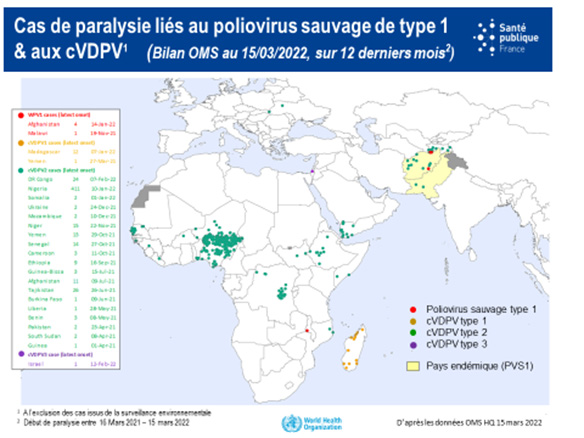
In addition, cases of paralysis caused by circulating vaccine-derived poliovirus (cVDPV) were recently reported in Ukraine in October and December 2021 and in Israel in February 2022, with isolates of cVDPV2 and cVDPV3, respectively. Regarding Ukraine, on April 28, 2022, the WHO reported 2 cases of paralysis linked to cVPDV2, and 19 contacts in their social circles who tested positive, leading to the implementation of an OPV (oral polio vaccine) vaccination campaign, which was significantly impacted by the war in Ukraine in the spring of 2022.

A very low risk in populations with sufficient vaccination coverage

There is no treatment for polio. The main preventive measures involve hygiene and vaccination, which have reduced the incidence of wild poliovirus-related polio by more than 99% worldwide.
France has very high vaccination coverage against polio (inactivated polio vaccine): 99% for the primary vaccination and 96% for the booster dose among infants in 2019, and these vaccination coverage rates have always been very high, as the vaccine was mandatory up to age 12 until 2018. Furthermore, vaccination is mandatory for infants born in 2018 or later.

This excellent coverage is reassuring and must be maintained and consistent across all populations nationwide. It provides very good protection against the disease in the event of exposure; therefore, the risk of cases and/or clusters emerging within the French population remains very low.

In France, active surveillance is conducted to detect the presence of the poliovirus

Despite the elimination of polio from the European region, high vigilance regarding the possible reintroduction of poliovirus is necessary. Indeed, endemic outbreaks linked to wild poliovirus persist worldwide (Pakistan and Afghanistan). The challenge is therefore to maintain high vaccination coverage until the disease has been eradicated.

Santé publique France has established a polio surveillance program based, on the one hand, on mandatory reporting (in place since 1936) and, on the other hand, on enhanced enterovirus surveillance since 2000, in collaboration with the National Enterovirus Reference Center and supported by a network of volunteer laboratories.

Since the establishment of the enterovirus surveillance network in 2000, only vaccine-derived polioviruses and a type 2 cVDPV—all imported and without a return to virulence—have been detected in clinical samples, with no clinical signs suggestive of polio in the patients from whom the samples were taken.

Health authorities in France remain vigilant regarding the risk of introducing vaccine-derived poliovirus strains linked to individuals arriving from countries where the oral polio vaccine is still in use. Clinical and biological surveillance coordinated by the CNR for Enteroviruses and Parechoviruses enables the detection of any clinical suspicion requiring rapid action to limit the risk of transmission. Catch-up vaccination in unvaccinated or under-vaccinated population groups is also important to prevent the emergence of transmission clusters from imported cases.

Polio

thematic dossier

Although polio has been eliminated in the WHO European Region since 2002, high vaccination coverage must be maintained to achieve the eradication of the disease.