




Data
Global Epidemiological Situation of Polio
The entire Americas region has reported no cases of wild poliovirus since 1991 and was certified polio-free by a WHO commission in 1994. The last case of paralysis caused by wild poliovirus (WPV) endemic to the Western Pacific Region (including China) was reported in Cambodia in 1997, and elimination was certified there in 2000.
In the WHO European Region, where an average of 200 cases per year were observed in the 1990s, a few outbreaks occurred: in 1992–1993 in the Netherlands, within a religious community that refused vaccinations, and in 1995–1996 in Albania. Following the implementation of regional vaccination days, only 7 cases were reported in 1997 for the entire region, and 26 in 1998, all in Turkey. No cases were reported in 1999, but in 2000, 2 imported cases occurred in Bulgaria. Elimination was declared on June 21, 2002.
More recently, the WHO African Region was also declared free of wild poliovirus, with the last case of paralysis resulting from WPV1 occurring in Nigeria in 2020.
More than 30 years after the launch of the Global Polio Eradication Initiative, the number of endemic countries has fallen from 125 in 1988 to 2 in 2022 (Afghanistan and Pakistan). Since 1999, no wild poliovirus type 2 (WPV2) has been isolated, and its eradication was declared in September 2015. No poliovirus type 3 has been detected since November 2012, and its eradication was declared in October 2019.
However, the eradication target has had to be pushed back several times, currently to 2026, due to the potential export of cases from endemic countries, with a risk of renewed transmission (an imported case of WPV1 was reported in November 2021 in Malawi, with the strain originating from Pakistan).
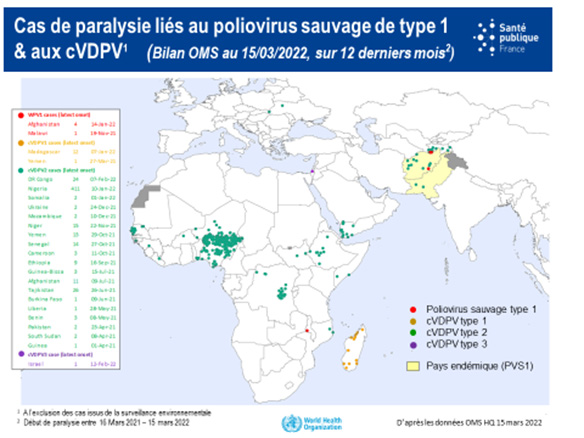
Furthermore, the emergence of outbreaks linked to the circulation of vaccine-derived poliovirus (cVDPV) strains that have become virulent through genetic mutation underscores the need to remain extremely vigilant and to apply to these outbreaks the same international recommendations originally designed for poliovirus-endemic countries. Two countries in the WHO European Region have recently reported cases of paralysis following cVDPV: Ukraine in December 2021 and Israel in February 2022, with respective isolations of cVDPV2 and cVDPV3 (see map).
2
endemic countries in 2022 (Afghanistan and Pakistan) compared to 125 in 1988, more than 30 years after the launch of the Global Polio Eradication Initiative.
In 2022, five of the six WHO regions have eliminated polio. The only region that has not achieved elimination is Africa and the Eastern Mediterranean, with Afghanistan and Pakistan still endemic.
As part of the final phase of the disease’s eradication, maintaining high vaccination coverage is essential.
Epidemiological Situation of Polio in France
The polio surveillance system established by Santé publique France is based on enterovirus and DO surveillance, which allows for the study of epidemiological trends, as well as on monitoring polio vaccination coverage.
The last case of indigenous polio dates back to 1989 and the last imported case to 1995, both involving adults, and the last isolation of wild poliovirus in a person who had not traveled recently also dates back to 1989.
Acute Poliomyelitis in France from 1949 to 2021
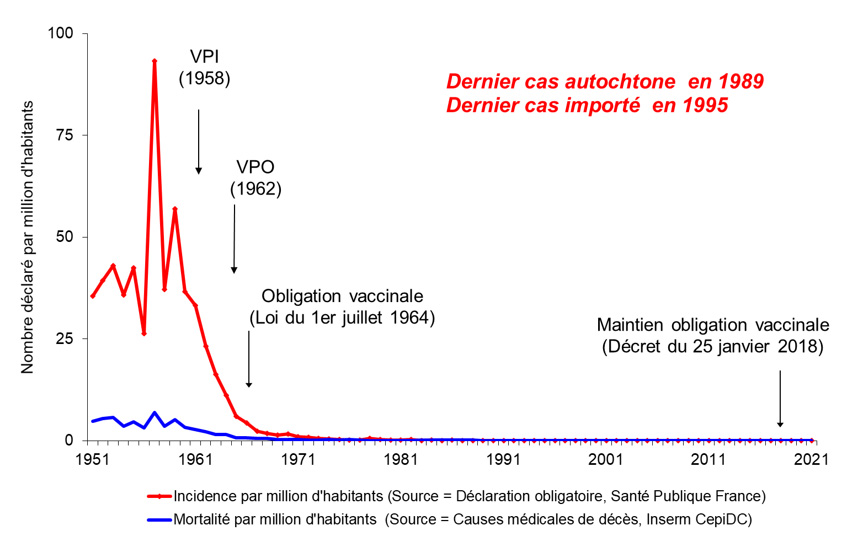
Extreme vigilance is required regarding the possible reintroduction of poliovirus, given the persistence of endemic outbreaks worldwide. This is the primary risk to be considered in our country. The earliest possible identification of such an occurrence is now ensured by enhanced surveillance of enteroviruses in humans, in addition to the mandatory reporting of polio cases. The National Commission for the Certification of Poliomyelitis Elimination established an action plan in 1998, revised in 2000 (see BEH 2000;46-47), and again in 2019 (HCSP Opinion of October 18, 2019). Since 2000, this surveillance has identified, in addition to enteroviruses circulating in humans, 15 vaccine-derived Sabin-like polioviruses (PV-SL) (5 PV-1SL, 6 PV-2SL, and 4 PV-3SL), as well as one type 2 cVDPV without virulence recovery, all of which were imported. No PVS has been identified.
Learn more
The results of enhanced surveillance for enterovirus infections are the subject of regular reports:
Update as of October 16, 2018
Update as of July 25, 2017
Update as of June 20, 2017
Update as of December 9, 2016
Update as of June 20, 2016
Update as of July 15, 2015
Update as of August 7, 2013
Update as of June 12, 2013
Update as of August 10, 2012
Update as of June 29, 2012
Update as of September 15, 2011
Update as of July 5, 2011
Furthermore, following the certification of polio elimination in the WHO European Region in June 2002, a plan for the containment of polioviruses in laboratories was implemented in France.

In relation to

Vaccination
thematic dossier
Contagious diseases most often affect children at a very young age. Because children are particularly vulnerable, they are a priority target for vaccination programs.











