



Prevalence of Hepatitis C
Declining prevalence in the general population
In 2004, the national prevalence survey of hepatitis B and C conducted among the general adult population in metropolitan France estimated:
the prevalence of anti-HCV antibodies at 0.84% (95% CI: 0.65–1.10). This corresponded to 367,055 people (95% CI: 269,361–464,750) who had been infected with HCV. Among these individuals, 57% (95% CI: 43–71) were aware of their anti-HCV antibody-positive status,
with HCV RNA prevalence at 0.53% (95% CI: 0.40–0.70). This corresponded to 232,196 people (95% CI: 167,869–296,523) with chronic infection.
The factors most strongly associated with positive HCV antibody test results were:
injecting drug use at least once in a lifetime,
being between 60 and 69 years old,
being born in a country with high HCV prevalence.
Other factors such as nasal drug use, a history of blood transfusions prior to 1992 or tattoos, being over 29 years of age, and living in precarious circumstances were also associated with positive antibody status.
In 2011, the prevalence of hepatitis C was estimated through modeling in the general metropolitan population aged 18–80:
0.75% [95% credibility interval (CI): 0.62–0.92] for anti-HCV antibodies, corresponding to 344,500 [95% CI: 287,373–423,549] people who had been infected with HCV;
0.42% [95% CI: 0.33–0.53] for HCV RNA, corresponding to 192,700 [150,935–246,055] people with chronic infection.
In 2016, the “Barotest” virological component of the 2016 Health Barometer estimated the prevalence of HCV RNA in the general adult population (ages 18–75) living in metropolitan France at 0.30% (95% CI: 0.13–0.70), corresponding to 133,466 people (95% CI: 56,880–312,616) with chronic hepatitis C. Among these individuals, 80.6% (95% CI: 44.2–95.6) were aware of their infection.
Due to differences in the methods used, comparisons of these estimates of chronic hepatitis C prevalence should be made with caution. Nevertheless, a decrease in prevalence was observed between 2004 and 2016 (non-significant). This is certainly linked to the decrease in the number of people infected through transfusion prior to 1992, to the direct-acting antivirals available since late 2013, as well as to the decline in HCV incidence.
Finally, the data for 2004 and 2016 are derived from general population surveys, with a likely underrepresentation of certain populations particularly exposed to HCV, leading to a possible underestimation of prevalence at the national level.

article
24 September 2019
Prevalence of chronic hepatitis C and B and history of screening in the general population in 2016: a contribution to a new screening strategy, Santé publique France-BaroTest Barometer
article
24 September 2019
Acceptability and Feasibility of Home-Based Self-Testing for HIV, HBV, and HCV Infections in the General Population in France in 2016: The BaroTest Study
article
6 September 2019
An innovative approach to improving HIV, hepatitis B, and hepatitis C testing in the general population: protocol for an acceptability and feasibility study (BaroTest 2016)
Prevalence data in specific populations
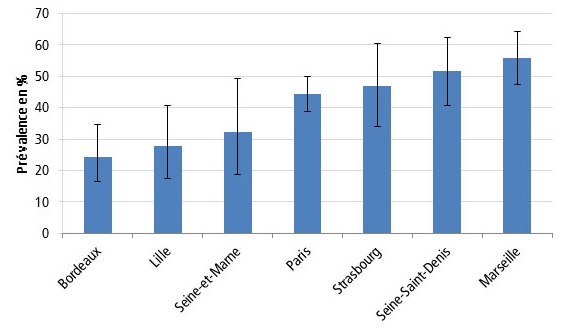
Among drug users attending treatment and harm reduction facilities, the 2011 ANRS-Coquelicot survey estimated the prevalence of anti-HCV antibodies at 44% [95% CI: 39–48]. Prevalence was higher in Marseille (56%) and Seine-Saint-Denis (52%) than in Bordeaux (24%) or Lille (28%).
The overall prevalence of chronic hepatitis C was estimated at:
30% [95% CI: 26–33] among users who had injected at least once in their lifetime;
35% [95% CI: 30–41] among those who had injected in the past month.

Estimating the Prevalence of HIV and Hepatitis C Among People Who Use Drugs in France – Initial Results from the 2011 ANRS-Coquelicot Survey
article
6 September 2019
Hepatitis C virus and HIV seroprevalence, sociodemographic characteristics, behaviors, and access to syringes among drug users: a comparison of geographical areas in France, ANRS-Coquelicot 2011 survey
article
6 September 2019
A Comparison of Profiles, Practices, and Hepatitis C Status Among Russian- and French-Speaking Drug Users in Paris. ANRS-Coquelicot Survey, 2011–2013.
Prevalence of anti-HCV antibodies among people who use drugs in the urban areas and departments surveyed (ANRS-Coquelicot 2011)
Among men who have sex with men who frequent gay social venues, the prevalence of chronic hepatitis C was estimated at 0.7% [95% CI: 0.3–1.5], based on the 2015 Prévagay survey. Among HIV-positive MSM, the estimated prevalence was 3.0% [1.5–5.8].
Learn more

Among the hospitalized population, an analysis of data from the Program for the Medicalization of Information Systems (PMSI) estimated that 0.33% of hospitalized patients had chronic hepatitis C as their primary, related, or associated diagnosis in 2010 and 2011.
Learn more
article
6 September 2019
Prevalence, Morbidity, and Mortality Associated with Chronic Hepatitis B and C Among Hospitalized Patients in France, 2004–2011
In relation to

Hepatitis B and D
thematic dossier
Viral liver infections can be very severe; hepatitis B and D are transmitted through sexual contact, blood, and from mother to fetus. Vaccination and screening are the cornerstones of prevention.

HIV/AIDS
thematic dossier
HIV, or Human Immunodeficiency Virus, is a sexually transmitted human retrovirus. It weakens the immune system, and if left untreated, leads to AIDS.

Illegal drugs
thematic dossier
The use of illicit drugs exposes individuals to various health, social, and legal risks. In light of this major public health issue, prevention is essential.












