



The disease
The hepatitis C virus (HCV) is one of the five viruses (A, B, C, D, and E) responsible for viral hepatitis. It was identified in 1989 as the causative agent of most cases of hepatitis previously referred to as “non-A, non-B hepatitis.”
Acute hepatitis C virus infection occurs after an incubation period of 7 weeks on average (ranging from 2 weeks to 6 months) following exposure to the virus. In most cases, acute hepatitis C is asymptomatic. When symptoms are present, the most common are fatigue and jaundice.
If it goes unnoticed and is not treated, hepatitis C can become chronic (HCV RNA carriage, in 60% to 90% of cases). Chronic infection can remain asymptomatic for a long time and, in 10% to 20% of cases, progress to cirrhosis (after 20 to 30 years). This progression to cirrhosis is exacerbated by excessive alcohol consumption. Liver cancer (hepatocellular carcinoma) is the final stage of the disease.
See also
Care for People Infected with the Hepatitis C Virus. 2016 Recommendations Report.
France has a low prevalence of hepatitis C, but given the potential for the infection to progress to severe liver disease (cirrhosis, liver cancer), hepatitis C represents a public health challenge.
Effective treatments are now available for hepatitis C that can cure the disease, making the elimination of hepatitis C by 2030 a realistic goal. To achieve this goal, it is essential that people with chronic hepatitis C are aware of their infection, hence the importance of screening.
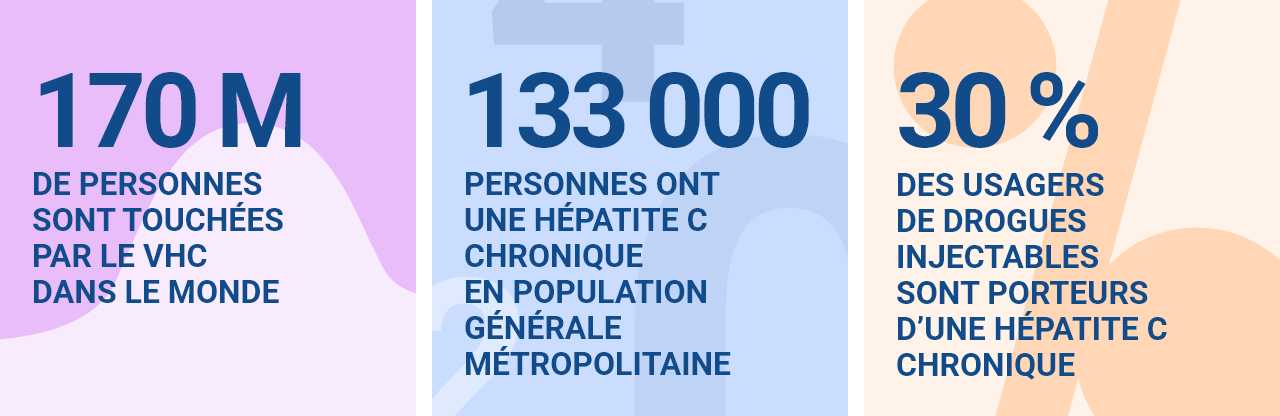
Key Statistics on Hepatitis C
Transmission through direct or indirect contact with infected blood
The hepatitis C virus is transmitted primarily through direct or indirect contact with infected blood (through the sharing of injection equipment among people who use drugs, or through tattooing or piercing with non-disposable equipment, etc.). The risk of transmission during medical procedures (injections, dialysis, certain endoscopic procedures), while it appears to have played a role in HCV transmission until the late 1990s, is now rare due to improved adherence to universal aseptic precautions. Since the introduction of routine screening of blood donations, the residual risk of transmission through transfusion is negligible.
The risk of sexual transmission, considered extremely low among stable heterosexual couples, may be increased in cases of rough sex, particularly among men who have sex with men and are HIV-positive.
The risk of mother-to-child transmission is approximately 5%, but increases fourfold if the mother is co-infected with HIV.
Drug users particularly affected by hepatitis C
In “developed” countries, intravenous drug use—through the sharing of syringes or preparation equipment (spoons, filters, water)—remains the primary mode of hepatitis C virus transmission. Other modes of drug use can, however, lead to HCV transmission. Intranasal drug use, which can cause damage to the mucous membrane, can also lead to HCV transmission if straws are shared.
Smoking drugs (sharing a crack pipe) is also a high-risk practice for HCV transmission if there are cuts on the hands from preparing crack (using a utility knife and handling copper electrical wires) or bleeding from the lips due to regular use (using a glass measuring cup that breaks easily).
Different prevention methods
There is no vaccine against hepatitis C. However, there are various means of prevention:
Harm reduction strategies for drug users: providing sterile injection equipment and, more broadly, safer-use equipment (for crack users, for example), support and education on injection-related risks, safer-use consumption rooms, access to opioid substitution therapy...
Adherence to universal precautions for disinfection and asepsis (known as standard precautions) to prevent transmission during medical care, as well as during procedures such as tattooing or piercing.
The screening of blood and organ donors and testing for hepatitis C on every donation (see the thematic dossier on epidemiological surveillance of blood donors)
The importance of screening
Hepatitis C screening should be offered to those most at risk. The goal is to provide care for people with chronic infection so they can quickly receive treatment that will cure their hepatitis C. Screening and treatment are therefore beneficial not only to the individual but also to the community, as they help limit the risk of transmission to others.
Recommendations for screening for hepatitis C virus (HCV) infection in France currently target only those at risk of infection. This strategy, dating from 2001, is currently being reevaluated by the French National Authority for Health (HAS). Nevertheless, the 2016 recommendations report advocates offering hepatitis C screening to all adults at least once in their lifetime.
Treatments that lead to a cure
Hepatitis C treatment relies on direct-acting antivirals (DAAs), which have been available since 2014 and are now recommended for all infected individuals. They enable a cure for over 95% of patients. Care must nevertheless be comprehensive and multidisciplinary, particularly to address comorbidities (alcohol use, obesity, diabetes, etc.). It is also important to ensure long-term follow-up regarding the risk of hepatocellular carcinoma and the risk of reinfection, which should not be overlooked in patients particularly exposed to HCV.
Regional Disparities
At the national level, several regions appear to be more affected than others. These include the Provence-Alpes-Côte d’Azur region, Île-de-France, and Occitanie.
Internationally, there are areas with higher prevalence of chronic hepatitis C, notably the Middle East, Africa, Asia, the Pacific, the Indian subcontinent, and Eastern Europe.
In relation to

Hepatitis B and D
thematic dossier
Viral liver infections can be very severe; hepatitis B and D are transmitted through sexual contact, blood, and from mother to fetus. Vaccination and screening are the cornerstones of prevention.

HIV/AIDS
thematic dossier
HIV, or Human Immunodeficiency Virus, is a sexually transmitted human retrovirus. It weakens the immune system, and if left untreated, leads to AIDS.

Illegal drugs
thematic dossier
The use of illicit drugs exposes individuals to various health, social, and legal risks. In light of this major public health issue, prevention is essential.












