




The flu, a seasonal epidemic
In mainland France, the epidemic occurs every year, generally between November and April, usually beginning in late December or early January. It lasts an average of 10 to 11 weeks.
Having the flu or flu-like symptoms does not necessarily mean the same thing. The flu is an acute respiratory infection caused by the influenza virus, whereas flu-like symptoms can be caused by many other respiratory viruses that circulate from fall through the end of winter: rhinoviruses, respiratory syncytial virus, etc.
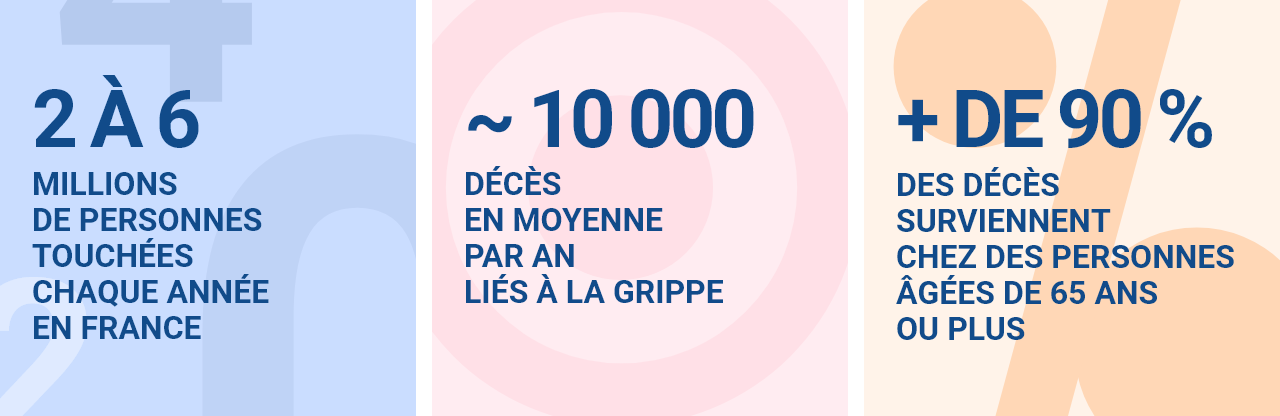
In mainland France, the epidemic occurs every year, generally between November and April, most often starting in late December or early January. It lasts an average of 10 to 11 weeks. Based on historical data on influenza epidemics since 1984, the Sentinelles network estimates that between 788,000 and 4.6 million people seek medical care for flu-like symptoms during influenza epidemics. Between 25% and 50% of these visits involve children under the age of 15
Influenza viruses are primarily divided into two types: A and B, which are themselves subdivided into two subtypes (A(H3N2) and A(H1N1) pdm09) or lineages (B/Victoria and B/Yamagata). Type A influenza viruses circulate among many animal species (ducks, chickens, pigs, horses, seals, etc.), whereas type B influenza viruses circulate primarily among humans. Type A and B viruses cause seasonal epidemics in humans, but only type A viruses have been responsible for pandemics to date. Influenza viruses are characterized by significant genetic variability, with mutations occurring more or less frequently depending on the virus. This genetic evolution occurs:
either through drift during seasonal epidemics, which can result in reduced vaccine efficacy over the course of a season;
or through "shift." This latter phenomenon is thought to affect only type A viruses. It is responsible for the emergence of new viruses against which the population is not necessarily protected and which can trigger an influenza pandemic.
Key Facts About the Flu
The Flu, a Contagious Viral Infection
Influenza viruses spread easily from person to person through respiratory secretions when someone sneezes or coughs. They can also be transmitted through contact with contaminated objects or by touching surfaces and then touching the face. Crowded, enclosed spaces (subways, buses, schools, etc.) are ideal for the transmission of these viruses.
The flu virus survives:
a few minutes on the skin
a few hours in dried respiratory secretions, and on tissues, clothing, paper, etc.
for up to several days on inanimate surfaces (door handles, countertops, etc.). The time between infection and the onset of symptoms (incubation period) averages 1 to 3 days, but can be as long as five days. During this time, the infected person can be contagious
The spread of the flu in temperate-climate countries like France is facilitated by cold, dry weather conditions.
Preventing the flu
Hygiene measures
Certain simple hygiene measures can help limit person-to-person transmission:
For those who are sick, as soon as symptoms appear, it is recommended that they:
limit contact with others, especially vulnerable individuals (infants, pregnant women, the elderly, or those with certain chronic conditions or obesity);
wear a disposable mask when in contact with others, especially these vulnerable individuals;
cough or sneeze into the crook of the elbow or into a tissue;
blow their nose into disposable tissues and dispose of them in a trash can, preferably one with a lid;
spit only into a disposable tissue and dispose of it in a trash can, preferably one with a lid.
All of these actions should be followed by handwashing with soap and water; if soap and water are not available, use a hand sanitizer.
For those around the sick person, it is recommended to:
avoid close contact with sick people, especially if you are vulnerable;
wash your hands with soap and water after contact with the sick person or items used by the sick person;
clean items commonly used by the patient.
In a senior care facility during a flu outbreak, hygiene and care measures are detailed in the HCSP report “Guidelines for Managing One or More Acute Respiratory Infections in Senior Care Facilities” (July 2012 report, available on the HCSP website).
See also
July 2012 Report: Guidelines for Managing One or More Acute Respiratory Infections in Senior Care Facilities
Flu Vaccination
Vaccination is the best way to protect against the flu. It should be administered at least two weeks before the start of flu season (as winter approaches). The vaccination must be repeated every year. This is because the vaccine’s protection tends to wane after a few months, particularly due to the constant genetic changes in certain flu viruses.
The composition of the flu vaccine may vary from season to season. Each year, the World Health Organization (WHO) issues a recommendation on the viral strains that should be included in the vaccine. The vaccine is formulated using the strains that were most prevalent during the previous winter and are most likely to be present during the coming winter.
Vaccination is available for everyone six months of age and older. However, it is recommended for people at risk of complications:
people aged 65 and older;
people (adults and children) with certain chronic conditions;
pregnant women;
obese individuals with a body mass index (BMI) of ≥40 kg/m²;
people residing in a long-term care facility or a residential medical-social facility, regardless of age.
Flu vaccination is also recommended for people in contact with those at risk of complications and likely to spread the virus:
healthcare professionals or any professionals in regular and prolonged contact with at-risk individuals;
family members of infants under 6 months of age with risk factors for severe influenza: people living in the same household, the nanny, and all regular contacts of the infant;
crew members on cruise ships and airplanes, and travel industry staff accompanying groups of travelers.
The flu vaccine also offers benefits for anyone wishing to avoid the personal or professional inconvenience caused by the flu.
The composition of the 2019/2020 flu vaccine selected for the Northern Hemisphere differs from that of the 2018/2019 season. The quadrivalent vaccine is now the most widely used in France and contains:
a strain A(H1N1)pdm09 similar to Brisbane/02/2018
an A(H3N2) strain similar to A/Kansas/14/2017
a B/Colorado/06/2017 strain (B/Victoria/2/87 lineage)
a B/Phuket/3073/2013 strain (B/Yamagata/16/88 lineage)
Although less common, the trivalent vaccine remains available for the 2018/2019 season and includes:
a strain A(H1N1)pdm09 similar to Brisbane/02/2018
a strain A(H3N2) similar to A/Kansas/14/2017
a B/Colorado/06/2017 strain (B/Victoria/2/87 lineage)
See also

magazines/revues
6 July 2026
Weekly Epidemiological Bulletin, June 2, 2022, Special Issue: Health Recommendations for Travelers, 2022 (for healthcare professionals)
Antiviral prophylaxis
Antiviral treatments may also be prescribed prophylactically to prevent individuals who have been in contact with flu cases from developing the disease. Specific
recommendations are provided by the High Council for Public Health.
The use of antivirals for prophylaxis is not a substitute for flu vaccination.
Downloadable publication
Opinion of the High Council for Public Health on the Prescription of Antiviral Drugs for Seasonal Influenza, dated March 16, 2018.
The Flu: A Sudden Onset of Symptoms
Seasonal flu typically begins abruptly with a high fever, intense fatigue, body aches, and headaches. Most people recover within one to two weeks without medical treatment. This is considered “mild” flu.
However, the flu can lead to serious complications in at-risk individuals (the elderly or those weakened by a chronic illness, pregnant women, or premature infants). Flu-related deaths primarily affect the elderly.
These complications are caused by the viruses themselves, but also by bacterial superinfections (pneumonia) they may trigger or by the exacerbation of an underlying chronic condition (diabetes, asthma, heart disease, kidney failure, etc.).
In cases of flu-like illness not caused by the flu, symptoms may resemble those of the flu but are generally less severe. While the flu “confines you to bed,” striking suddenly with a high fever and intense fatigue, flu-like illness weakens you but usually allows you to continue your daily activities.
Treatment and Management
Treatment for the flu is primarily aimed at managing symptoms: medications for fever, pain, cough, or a stuffy nose.
There is also a specific treatment based on so-called “antiviral” drugs, but their use is recommended only in cases where there is a risk of serious complications related to the flu. When taken early, it reduces the duration and severity of symptoms. Antiviral treatment is not a substitute for the flu vaccine.
Recommendations for the use of antivirals in cases of seasonal flu are regularly updated and available on the website of the High Council for Public Health (HCSP).
Reference materials
In relation to

thematic dossier
The First 1,000 Days
The period from conception through the first two years of life is critical for a child’s development and the health of the adult they will become. That is why it is essential to prioritize the...

thematic dossier
Aging Well
People over the age of 60 could account for one-third of the population by 2050. The priority today is no longer to extend life expectancy but to improve the quality of life for older adults.
Vaccination
thematic dossier
Contagious diseases most often affect children at a very young age. Because children are particularly vulnerable, they are a priority target for vaccination programs.











