




Health Issues
In France, a heat wave is defined as a period during which the average of the minimum and maximum temperatures over at least three consecutive days exceeds the thresholds set for each department. These thresholds range from 17°C to 24°C at night and from 32°C to 36°C during the day, depending on the department.
Below these thresholds, the weather is considered to be hot.
When it is very hot, body temperature tends to rise. To regulate its temperature and maintain it at 37°C, the body must activate several mechanisms.
Mechanisms of thermoregulation
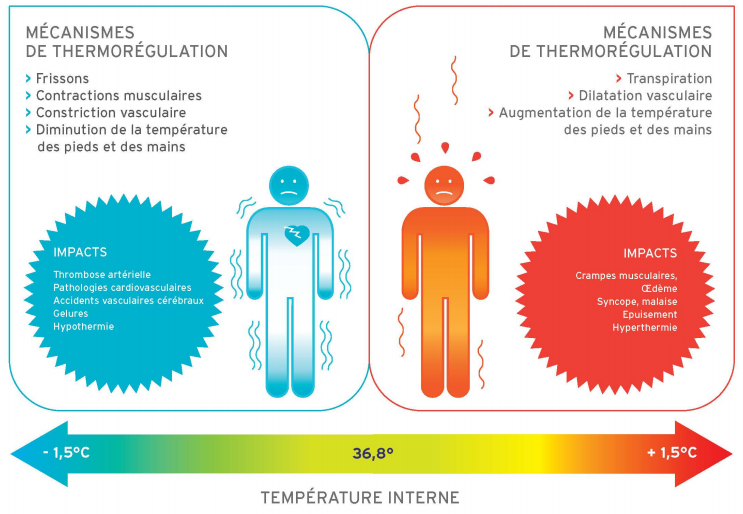
However, extreme heat can quickly worsen the health of the most vulnerable individuals and even lead to premature deaths. This is a major public health issue, particularly in light of global warming, which is already underway and will worsen in the coming years. In this context, Santé publique France is studying the actual health impact of heat waves.
In relation to

Climate change
thematic dossier
Climate change is rapidly and profoundly altering the environment. The health impacts of climate change are numerous and varied.

UV
thematic dossier
Ultraviolet radiation, which is everywhere, is emitted naturally by the sun or by artificial sources. It is responsible for various health conditions, including certain types of skin cancer.

Extreme cold
thematic dossier
Cold weather increases the risk of cardiovascular and respiratory conditions and can lead to hospitalizations and death. This impact is observed within 3 to 21 days of exposure to the cold.











