




What We Do
The risks associated with illicit drugs represent a major public health issue that can affect people of all ages. Santé publique France’s objectives are to generate knowledge useful for preventive measures, design effective prevention initiatives, and inform the public about the harmful effects of illicit drug use. Santé publique France’s work is part of the 2018–2022 National Action Plan Against Addiction led by Mildeca.
Monitoring the levels and characteristics of illicit drug use in France
Santé publique France conducts and disseminates descriptive studies on the levels and characteristics of illicit drug use to define or adjust its prevention initiatives. Analyses are often carried out in partnership, particularly with the OFDT (French Observatory on Drugs and Addictive Trends). Santé publique France also promotes effective intervention strategies and conducts pilot studies. Among these studies:
The Santé publique France Health Barometer: This periodic survey, conducted for nearly 30 years, aims to better understand the knowledge, attitudes, beliefs, and behaviors of French adults regarding health. This survey allows for the questioning of nearly 11,000 people aged 18–64 about their cannabis use.
Studies of specific populations:
The Priminject study conducted between October 2010 and March 2011. Objective: to characterize the profiles and practices of new injectors in France.
The Coquelicot study. The second edition took place in 2011. Objectives: to describe the profiles and practices of drug users, and to estimate the seroprevalence of HIV and HCV.
The OFDT also conducts quantitative and qualitative surveys among young people to assess levels and patterns of drug use among adolescents, notably the Enclass survey (middle and high school students) and the Escapad survey (17-year-olds participating in the Defense Preparation Call-up Day). The OFDT’s TREND and SINTES field monitoring systems enable the observation of usage trends in the field and the analysis of the composition of products circulating as close as possible to users.
Initiatives to Prevent Illicit Drug Use
The initiatives of the illicit drug use prevention program implemented by Santé publique France aim to prevent, limit, and delay the onset of drug use, reduce the associated risks, and encourage cessation of use. These initiatives are aimed specifically at young people and their families, on the one hand, and at drug users, on the other. Santé publique France’s prevention program is part of the 2018–2022 National Action Plan Against Addiction, led by Mildeca.
Furthermore, as part of its efforts to reduce risks in the field of addiction, Santé publique France responds favorably, within a strict framework, to partnership requests it receives. In this regard, it has notably applied its assistance and support system, Drogues Info Service, to the THC and multi-substance self-tests produced by AAZ Laboratories.
Strengthening the psychosocial skills of children and youth
Santé publique France identifies, tests, evaluates, and supports the dissemination of proven field interventions aimed at developing children’s psychosocial skills. Strengthening these skills in children and young people promotes a range of health-promoting behaviors, particularly regarding addictions—such as the ability to say no, manage emotions, and communicate effectively.
These interventions often take place in school settings. International programs such as Unplugged have been adapted and evaluated in France: they show promising results regarding cannabis use in particular.
Parenting support tools
Santé publique France evaluates and supports the rollout of parenting support programs, identifies promising initiatives, and designs and disseminates tools to promote the development of parenting support.
- For example, the U.S. Parenting and Family Support Program (PSFP) has been adapted and evaluated in France. The guide “Promoting Health from Early Childhood” contains knowledge and practices related to early childhood, parenting, and health promotion. This support tool is intended for professionals in early childhood, health, social services, or education who wish to undertake initiatives combining health promotion and parenting support.
- PANJO’s strategy is based on supporting parents from pregnancy through the child’s first 12 months. PMI pediatric nurses conduct 6 (minimum) to 12 home visits to expectant and new parents. What sets these home visits apart is the systematic allocation of significant time to observing parent-child attachment bonds and supporting parents in developing secure bonds with their baby. These interventions are conducted exclusively by PMI professionals who have undergone a specific program to standardize practices (PANJO training, intervention guidelines, and supervision).
A remote service offering: Drogues Info Service
Drogues Info Service is the national remote assistance service for drugs and addiction. It operates based on principles of anonymity, confidentiality, neutrality, and non-judgment in its work to inform, advise, support, and guide the public. It is intended for users of illicit substances, their families and friends, and the general public.
You can speak with a professional:
- at 0 800 23 13 13 (anonymous and free, 7 days a week from 8 a.m. to 2 a.m.)
- via chat (anonymous and free, 7 days a week from 8 a.m. to midnight)
- via the “Your Questions – Our Answers” section (anonymous, response within 48 hours)
Discussion forums are also available for internet users, and the “Useful Addresses” section provides a national directory of organizations specializing in addiction treatment.
It wasn’t until 1986 that the first mass media campaigns on drugs appeared in France. This was followed by several statements from public authorities on the subject. The tone and messages of these communication campaigns evolved with the times: initially more prescriptive, even moralizing, they later shifted toward an approach focused on public education and outreach, offering help, harm reduction advice, and support to users and their families and friends.
In 2015, a public awareness campaign promoting the CJC program was launched twice by the former INPES, MILDECA, and the Ministry of Health. It targeted parents of adolescents aged 14–17 who had concerns about their child’s substance use.
Beyond raising awareness, this campaign aimed to demystify the use of CJCs (often mistakenly identified as treatment centers for drug addicts rather than as places that welcome young people and families), to encourage dialogue about addictive behaviors within families, and to shift the focus of the discussion toward ways to prevent or overcome addiction. To facilitate the early identification of addictive behaviors, this campaign also aimed to promote the “CJC reflex” among healthcare and medical-social professionals, as well as educational and sports professionals in contact with young people.
Beyond raising awareness and
demystifying the use of CJCs, this campaign also helped to foster: open communication, dialogue within families, the development of parenting skills, and the recognition of frontline professionals.
New materials were produced in 2015 to extend this initiative: posters and brochures, which continue to be very successful and are regularly updated.
The “Amis Aussi la nuit” campaign, launched in the fall of 2019, aims to reduce the risks and harm associated with heavy alcohol and cannabis use among young people aged 17 to 25 in party settings.
The strategy to encourage behavioral change is based on reinforcing protective behaviors among peers and encouraging reduced consumption. This strategy is illustrated throughout the campaign by the slogan “Taking care of your friends means doing it at night, too.”
The media campaign was primarily digital (web banners, stories on Instagram/Snapchat/YouTube, videos by web influencers on Konbini), but also included a poster component (3 posters displayed in bars and sent to partners) and a radio component (NRJ spot). A website (www.amisaussilanuit.fr) was created, bringing together content from the youth sections of Alcool info service and Drogues info service, as well as content created with media partners.
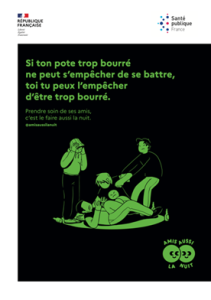
The campaign was relaunched in 2020, introducing a dedicated Instagram account and featuring new content created with media partners to maximize the campaign’s visibility and expand the reach of prevention advice to increase its impact.
In 2021, the campaign was revamped to highlight more concrete harm reduction advice through new visuals (e.g., a poster illustrating protective behavior) and content developed with media partners.
An evaluation of this campaign was conducted in 2019 in collaboration with the University of Bordeaux, using a mixed-methods approach: a qualitative study and a quantitative post-test.
Launched in 2021, this campaign aims to improve the understanding among cannabis users and healthcare professionals of the harms associated with cannabis use, some of which remain little known. The campaign primarily targets occasional or regular users, encouraging them to take a step back and assess their use so they do not develop problematic habits. It is organized into two parts:
A first component aimed at cannabis users
Without demonizing or trivializing cannabis use, the campaign called “Stories of Joints” gives a voice to cannabis users through illustrated audio testimonials or “voice notes” based on real-life stories. From these real-life experiences, six themes were selected: sleep disorders, lung disorders, mental health disorders, bad trips, cognitive disorders, and other disorders and risk factors (product composition, cardiovascular disorders, etc.).
Complementing these stories, short videos provide educational content on the various topics covered. Laurent Karila (psychiatrist and addiction specialist at AP-HP) and Jean-Michel Delile (psychiatrist and president of the Fédération Addiction) thus address the questions and misconceptions raised in the testimonials: “Does smoking cannabis help you sleep better?”; “Is smoking a joint less dangerous than smoking a cigarette?”; “Can cannabis cause schizophrenia or bipolar disorder?”; “How does a ‘bad trip’ on cannabis start?”; “What are the effects of cannabis on the brain?”; “Is cannabis natural and therefore safe for your health?”
A second section for healthcare professionals
In addition to the resources for consumers, useful content for healthcare professionals has been developed in partnership with the Journal International de Médecine and What’s Up Doc magazine.
An “update” article adapted into a podcast on the health consequences of cannabis,
2 practical guides on EBI (Early Identification and Brief Intervention) and existing resources for identifying and supporting problematic use,
3 interviews addressing issues related to cannabis use in general practice, in the workplace, and in academic settings,
2 interactive formats: a resource module to address common misconceptions about cannabis and a quiz to test knowledge about cannabis use.
In addition, to reach the next generation of doctors, a 3-minute summary video featuring psychiatrist Jean-Michel Delile was produced in collaboration with What’s Up Doc magazine, titled “La Consult’—Jean-Michel Delile’s Spin-off.”
For healthcare professionals
Content produced in partnership with the Journal International de Médecine (JIM.fr)
How can we combat the main misconceptions about cannabis? [Analysis]
The impact of cannabis on health: a review of current knowledge [Update]
Test your knowledge of cannabis use in France and Western countries [Quiz]
Problematic cannabis use: tools and resources for detection and support [Fact Sheet]
Further reading:
In relation to

Alcohol
thematic dossier
Alcohol is deeply rooted in French culture. Its consumption remains a major cause of death and illness in France.

Tobacco
thematic dossier
Despite a slight decrease compared to 2015, tobacco remains responsible for more than 68,000 premature deaths in 2023—accounting for 11% of total mortality—making it still the leading cause of...

Sexual health
thematic dossier
Santé publique France focuses in particular on four areas of sexual health: sexually transmitted infections, including HIV; contraception; combating discrimination; and violence.











