




Data
In this article
Data on the prevalence and patterns of illicit drug use in the general population are drawn from the Santé publique France Health Barometer (among adults aged 18–64) and analyses conducted by the OFDT (Observatory of Drugs and Drug Trends). In France, cannabis is by far the most commonly used illicit substance, with nearly 5 million people (aged 11–64) having used it in the past year, followed by cocaine (600,000) and MDMA/Ecstasy (400,000). Regardless of the substance, men use drugs more than women.
Cannabis
Cannabis remains the most commonly used illicit drug
In 2021, cannabis remains widespread among the population: 47% of adults have tried it at least once. One in 10 adults has used cannabis at least once in the past year. France is one of the European countries with the highest proportion of users aged 15–34, according to the 2021 EMCDDA report (European Monitoring Centre for Drugs and Drug Addiction).
In 2021, usage levels remain two to three times higher among men than among women, particularly given that consumption is intensive.
Learn more: Cannabis use levels in France in 2021 (OFDT)
Stabilization of cannabis use
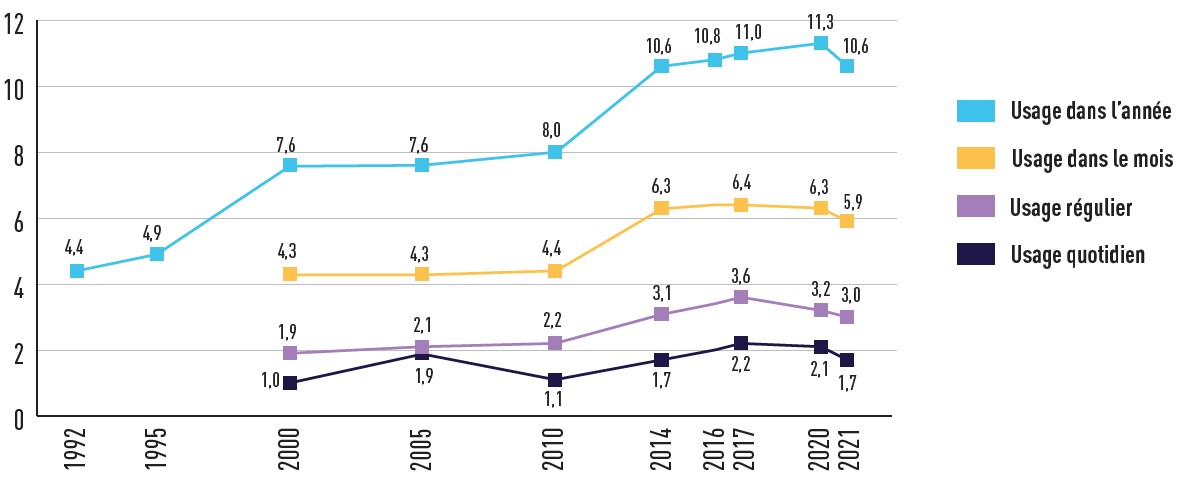
After a nearly constant increase since 1992, the stabilization of current cannabis use that began in 2014 is confirmed in 2021.
Changes in cannabis use rates between 1992 and 2021 among people aged 18–64 (in %)
Consumption is declining among younger people, who nevertheless remain the primary users
Use over the past year decreases gradually with age, falling from 26.3% among young adults aged 18–25 to 16% among adults aged 26–34, 10% among those aged 35–44, and 2% among older adults (55–64). Use in the past month, whether regular (3.0%) or daily (1.7%), remains predominant among younger people despite the decline observed in 2021.
More frequent cannabis use among those over 30
The majority of those who have tried cannabis are now over 30, and annual use increasingly involves people in their 30s and 40s. This trend suggests that some of the first generations of users have not stopped using cannabis as they have aged.
As a result, the average age of annual cannabis users continues to rise: it increased from 25.1 years to 32.8 years between 1992 and 2021.
At the regional level
Levels of cannabis experimentation and use vary across regions, but a pattern emerges showing that the southern half of France generally has higher levels of use than the northern half.
In the overseas departments and regions (DROM), the proportion of users is lower than in mainland France but characterized by more frequent and intensive consumption.
Problematic cannabis use
In 2017, the proportion of users in the past year at high risk of problematic use or dependence had been increasing since 2014, rising from 21% to 25%. These at-risk users accounted for nearly 3% of all 18- to 64-year-olds in 2017.
While the high risk of problematic use peaks at 28% among users aged 26 to 44, this level varies little by age. In fact, among those aged 45 to 64, more than 20% of users also present a high risk of problematic use.
SEE ALSO
Other illicit psychoactive substances
Note: The available data on the prevalence of use of illicit drugs other than cannabis in the general population are from the 2017 Santé publique France Health Barometer.
Levels of experimentation with other illicit drugs
As with cannabis, levels of experimentation with other illicit drugs vary considerably depending on the gender and age of individuals.
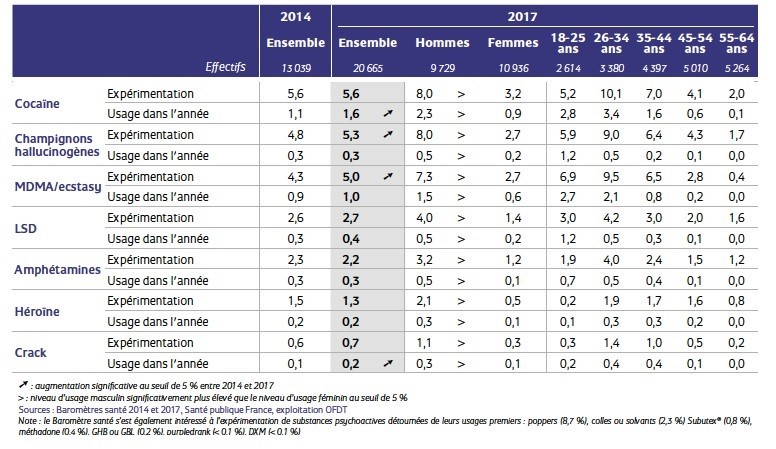
Prevalence of illicit psychoactive substance use (excluding cannabis) by age and gender among people aged 18–64 in 2017 (in %)
Source: Levels of illicit drug use in France in 2017 (OFDT)
Cocaine
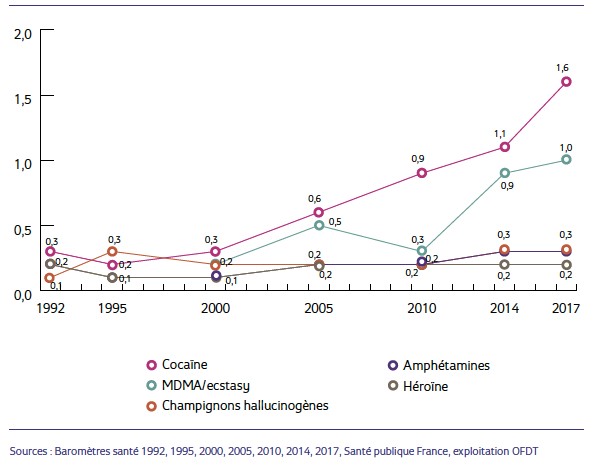
Cocaine experimentation appears to be stabilizing (1.2% in 1995 vs. 5.6% in 2014 and 2017) although annual use continues to rise, increasing from 0.2% in 1995 to 1.6%, making this substance the second most commonly used illicit drug in the past year after cannabis.
MDMA / Ecstasy
Experimentation with MDMA / Ecstasy increased slightly between 2014 and 2017, rising from 4.3% to 5.0%. This increase is driven by those aged 35 and older. Experimentation with crack (cocaine base prepared for smoking) remained relatively stable in 2017 (0.7% vs. 0.6% in 2014), as did annual use, which remains at a very low level in the general population (0.2%)
Hallucinogenic mushrooms
Slightly up from 2014 (4.8%), experimentation with hallucinogenic mushrooms affects 5.3% of respondents.
Other illicit substances
Among other illicit substances, experimentation rates are below 3%. They have not changed between 2014 and 2017. LSD remains at 2.7% of users among 18- to 64-year-olds, amphetamines at 2.3%, and heroin at 1.3%. Use of these substances is very rare in the general population (0.2% to 0.3%).
Changes in annual use of the main illicit drugs other than cannabis between 1992 and 2017, among 18- to 64-year-olds (in %)
In relation to

Alcohol
thematic dossier
Alcohol is deeply rooted in French culture. Its consumption remains a major cause of death and illness in France.

Tobacco
thematic dossier
Despite a slight decrease compared to 2015, tobacco remains responsible for more than 68,000 premature deaths in 2023—accounting for 11% of total mortality—making it still the leading cause of...

Sexual health
thematic dossier
Santé publique France focuses in particular on four areas of sexual health: sexually transmitted infections, including HIV; contraception; combating discrimination; and violence.











