



The disease
A Preventable Cancer
Colorectal cancer develops from the cells lining the inner wall of the colon or rectum. Most often, these malignant tumors originate from a benign tumor, called an adenomatous polyp, which grows slowly and eventually becomes cancerous.
It is a common cancer in both men and women and is the second leading cause of cancer death across all genders. The mortality rate (age-standardized) from colorectal cancer has been declining since the 1990s, while the incidence rate (age-standardized) has remained stable in women and is decreasing in men.
Survival rates for people with colorectal cancer have improved over time. Colorectal
cancer can be detected at an early stage through screening for fecal occult blood. An organized screening program is offered in France to all individuals aged 50 to 74.
Several modifiable risk factors related to lifestyle (alcohol consumption, smoking, a sedentary lifestyle, physical inactivity, overweight and obesity, a diet low in fiber and high in red meat or processed meats) have been identified, and these cancers are therefore partly preventable: for example, in 2015, it is estimated that in mainland France, approximately 21.0% of colorectal cancers (excluding anal cancers) among people over 30 were attributable to alcohol consumption [IARC, 2019].
In this context, Santé Publique France’s priorities are:
to participate in the epidemiological surveillance of colorectal cancer
to evaluate the performance of the national organized colorectal cancer screening program
to promote efforts to combat preventable risk factors
Key Statistics on Colorectal Cancer
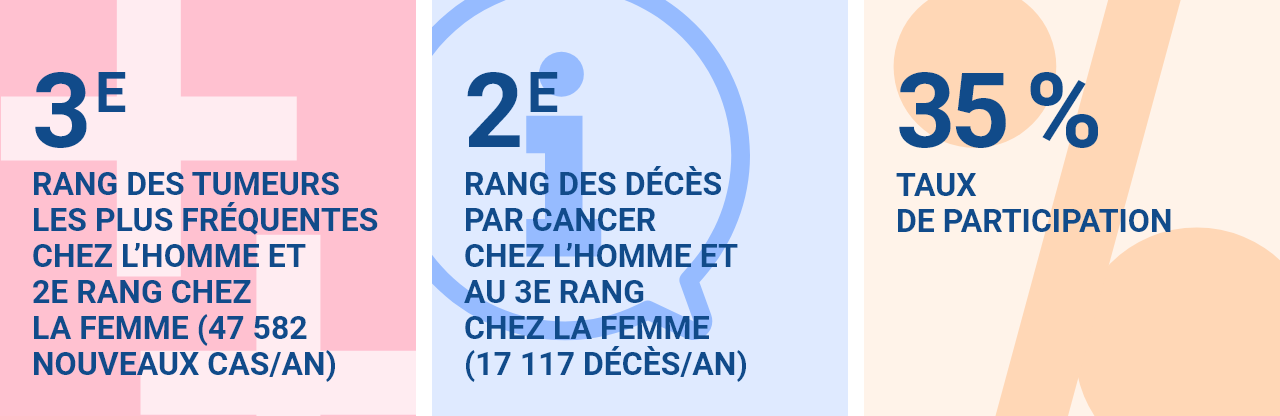
Key figures provided by the agency and its partners:
(Francim Cancer Registry Network, Hospices Civils de Lyon, National Cancer Institute, Regional Cancer Screening Coordination Centers)
Incidence |
Mortality |
Prevalence (all cases) |
Prevention / Screening |
|
47,582 new cases per year |
17,117 deaths per year |
63% at 5 years |
152,000 cases diagnosed in the last 5 years and still alive |
As part of the organized screening program: - 28.9% of people aged 50 to 74 screened - 67,902 advanced adenomas detected - 17,100 cancers detected |
Mainland France, |
Metropolitan France, |
Metropolitan registry area, people diagnosed, |
Metropolitan France, |
All of France, |
Modifiable risk factors
The main modifiable risk factors for colorectal cancer are:
being overweight or obese
a diet low in fiber and high in red meat or processed meats
Organized screening
Colorectal cancer most often develops from a benign tumor that grows slowly and eventually becomes cancerous.
The prognosis depends largely on the stage at diagnosis. The chances of recovery are better if the cancer is detected at an early stage.
Screening increases the chances of recovery by detecting and treating this cancer at an early stage. It also helps prevent certain cancers by detecting precancerous lesions. It has been demonstrated that screening for occult blood in stool reduces mortality from colorectal cancer*. Launched in 2002 in 23 pilot departments, the organized colorectal cancer screening program was expanded nationwide starting in 2008. All French departments have been covered since 2010, with the exception of Mayotte.
The program offers a fecal occult blood test every two years to all individuals aged 50 to 74 who are at moderate risk for this cancer, in accordance with the recommendations of the Consensus Conference. A full colonoscopy must be performed systematically in the event of a positive test result. Since its implementation, organized screening has been based on the guaiac test (Hemoccult® II). By order of September 23, 2014, the Directorate General of Health approved the replacement of the guaiac test (Hemoccult® II) with an immunological test (OC-Sensor®), which is easier to use, more sensitive for detecting advanced adenomas and cancers, and offers greater reliability and reproducibility.
Program Coordination
Since January 1, 2019, the program has been coordinated at the regional level by the Regional Cancer Screening Coordination Centers (CRCDC).
At-risk populations
Individuals with a colorectal condition requiring scheduled endoscopic monitoring, those with a personal history of colorectal adenomas, those with a first-degree relative diagnosed with colorectal cancer before age 65, or those with at least two first-degree relatives diagnosed with the disease are at higher risk for colorectal cancer. They should be offered a colonoscopy starting at age 45 or 5 years before the age at which the affected parent was diagnosed. Individuals with severe extraintestinal conditions (for ethical reasons) and those for whom screening is temporarily inappropriate (e.g., depression) should not undergo the screening test.
Program Management at the National Level
The Directorate General for Health and the National Cancer Institute jointly manage the program at the national level. A set of specifications published in 2006, then revised in 2013, 2018, 2020, and 2024, describes its organization. Santé publique France is responsible for epidemiological evaluation and produces various indicators based on data regularly collected from the CRCDC. An initial evaluation of the pilot programs was conducted in 2006; indicators are regularly updated and published on our website.
Geographic Disparities in Mortality
Within France, regional and departmental disparities in colorectal cancer incidence are not very pronounced, whereas disparities in mortality are more pronounced.
SEE ALSO

dossier thématique
Regional and departmental estimates of cancer incidence and mortality in France, 2007–2016
*Faivre J, Dancourt V, Lejeune C, Tazi MA, Lamour J, Gerard D, Dassonville F, Bonithon-Kopp C. Reduction in colorectal cancer mortality through fecal occult blood screening in a French controlled study. Gastroenterology. June 2004;126(7):1674-80
In relation to

Alcohol
thematic dossier
Alcohol is deeply rooted in French culture. Its consumption remains a major cause of death and illness in France.

Tobacco
thematic dossier
Despite a slight decrease compared to 2015, tobacco remains responsible for more than 68,000 premature deaths in 2023—accounting for 11% of total mortality—making it still the leading cause of...

Nutrition and Physical Activity
thematic dossier
Nutrition and physical activity are two major determinants of health that contribute to improving the health of the population and are key priorities in public health policy.












