



What We Do
Colorectal cancers, which are common in both men and women, are partly preventable, as modifiable risk factors have been identified. They can also be screened for.
In this context, Santé publique France’s efforts focus on epidemiological surveillance, evaluating the organized screening program, and promoting efforts to combat preventable risk factors.
Epidemiological Surveillance of Colorectal Cancer
The monitoring of the health status of the French population is entrusted to Santé publique France. It is within this framework that the epidemiological surveillance of cancers is carried out. This surveillance:
Helps prioritize actions and guide and evaluate measures for cancer prevention and care
Is carried out through a scientific and financial partnership involving the Francim cancer registry network, the Biostatistics and Bioinformatics Department of the Hospices Civils de Lyon (HCL), Santé publique France, and the National Cancer Institute (INCa).
These four partners have defined a work program aimed in particular at:
Develop initiatives to facilitate the recording of cancers in registries (access to data sources) as well as the systematic collection of new variables
Regularly produce and make available essential epidemiological indicators (incidence, mortality, survival, prevalence)
Develop thematic projects, particularly in conjunction with Santé publique France’s departments
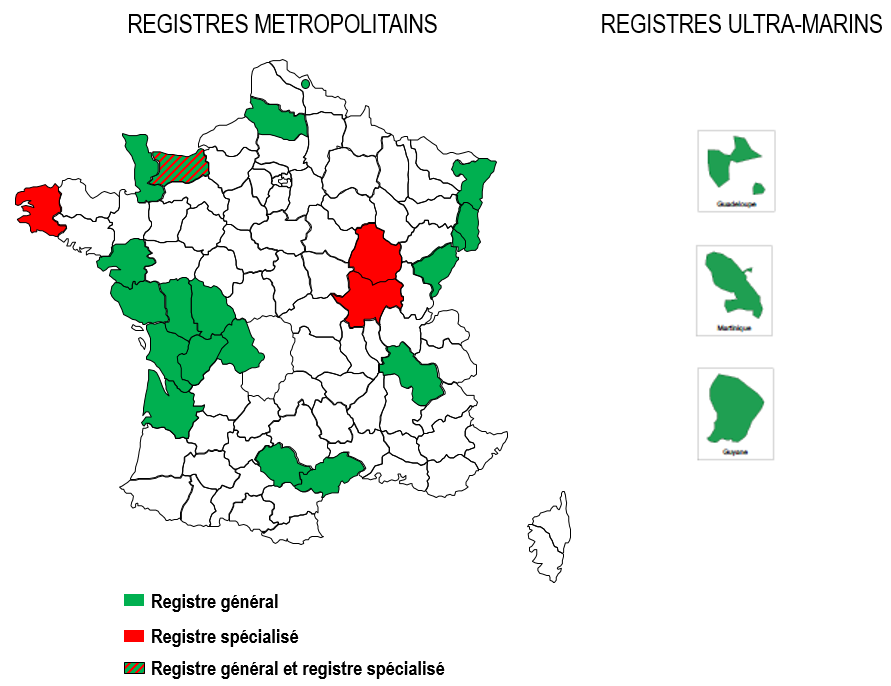
Map of departments covered by a general or specialized cancer registry (registries whose data are used for colorectal cancer surveillance, June 2019)
Evaluation of the performance of the organized colorectal cancer screening program at the national, regional, and departmental levels
Santé publique France is responsible for evaluating the performance of the colorectal cancer screening program. This evaluation is based on data submitted annually to Santé publique France by the departmental entities responsible for organizing screening, using data extraction modules integrated into their database management software. Two types of data are submitted:
data aggregated at the departmental level, by sex and 5-year age groups, enabling the calculation of program participation indicators. This data is submitted in the first quarter following the reference year evaluated for all departments. It includes:
the number of people who underwent a screening test,
the number of people excluded from screening for medical reasons,
the number of people who tested positive during the evaluation period,
the number of people who had an unanalyzable test that was not retaken during the evaluation period.
non-identifiable, standardized individual data, which enable the calculation of other indicators related to program performance. These are submitted two years after the reference year being evaluated. This timeframe allows for the collection of high-quality and as comprehensive as possible information, particularly regarding the results of examinations conducted following a positive screening result. They include, among other things:
variables on sociodemographic characteristics (age, sex, municipality of residence, social security system),
history of organized screening (date and number of previous screenings),
all results of the screening in question (dates and results of FIT tests, examinations performed and results, final diagnosis, treatment),
characteristics of the cancer detected, if applicable (tumor type, size, lymph node involvement, metastases, grade).

article
11 June 2019
Number and Proportion of Cancers Attributable to Lifestyle and Environmental Factors in Metropolitan France in 2015: Key Findings

Cancers attributable to lifestyle and environmental factors in mainland France
Santé publique France, in collaboration with the National Cancer Institute, conducts surveys of the general population to assess public attitudes and behaviors regarding:
cancer risk factors,
prevention and screening methods,
perceptions of the disease and the quality of care.
Based on the Health Barometers model established in 1992 by the French Committee for Health Education, these Cancer Barometers have been in existence since 2005 and are conducted every five years. In addition to the methodology, the 2015 edition presents findings on several topics, including cancer and alcohol, and cancer and tobacco. Results related to screening will also be published.
A preventive initiative
Santé publique France promotes efforts to combat various identified risk factors:
Alcohol consumption: the alcoholinfo-service.fr platform, public awareness campaigns, and resources for healthcare professionals
Overweight, sedentary lifestyles, and dietary habits via the mangerbouger.fr website
Smoking: the tabac-infoservice.fr platform, public outreach, and tools for healthcare professionals
In relation to

Alcohol
thematic dossier
Alcohol is deeply rooted in French culture. Its consumption remains a major cause of death and illness in France.

Tobacco
thematic dossier
Despite a slight decrease compared to 2015, tobacco remains responsible for more than 68,000 premature deaths in 2023—accounting for 11% of total mortality—making it still the leading cause of...

Nutrition and Physical Activity
thematic dossier
Nutrition and physical activity are two major determinants of health that contribute to improving the health of the population and are key priorities in public health policy.












