



The Disease
Campylobacter Infections in France
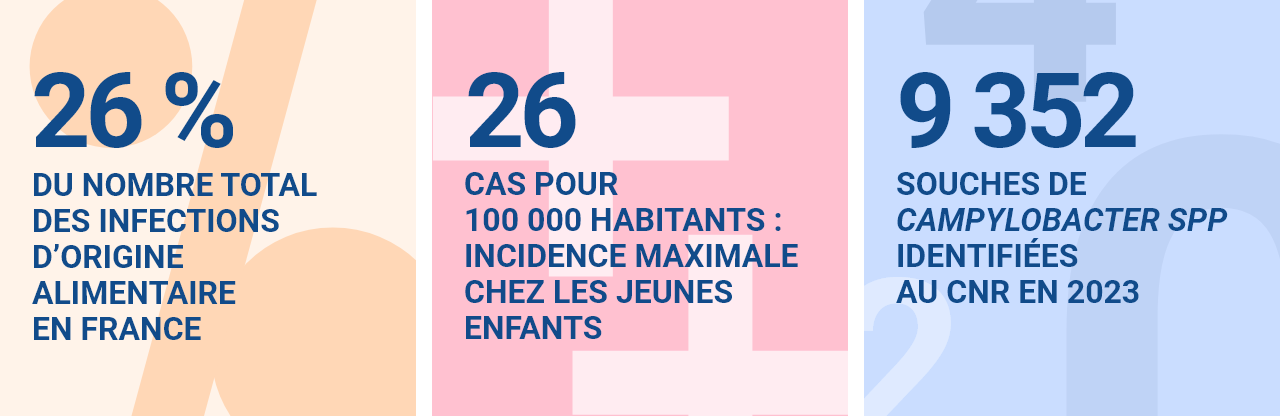
Campylobacter is one of the most common causes of bacterial gastroenteritis in developed countries. The average annual number of symptomatic Campylobacter cases is estimated at 493,000 (90% CI: 273,000–1,080,000), of which 392,000 (90% CI: 215,000–863,000) are foodborne*. Campylobacter accounts for 26% of all foodborne infections in France (Van Cauteren et al., 2018). Campylobacter infections are predominantly isolated cases.
* Figures from a study on morbidity and mortality associated with foodborne infections in France between 2008 and 2013.
Key statistics on Campylobacter infections
A transmission route primarily associated with food
Campylobacter is a natural part of the digestive tract flora in animals. As a result, this bacterium can be transmitted to humans through contaminated, undercooked food, primarily poultry (chicken), but also pork or beef.
Cross-contamination between raw poultry or meat and uncooked foods is common. It can occur during food storage or meal preparation (via hands after handling raw meat, cutting boards, knives, etc.).
Unpasteurized milk, untreated water contaminated with the bacteria, and infected or sick animals are also sources of contamination. Human-to-human transmission linked to poor hygiene practices is also possible, but appears to be less common than foodborne transmission.
Prevention Based on Hygiene
Preventing Campylobacter infections relies on good hygiene practices in the kitchen. These measures aim to prevent cross-contamination with Campylobacter:
Hand washing
Cleaning kitchen surfaces and utensils after handling poultry or raw meat
Storing raw poultry or meat in the refrigerator separately from foods eaten raw or prepared dishes.
Thorough cooking (cooked through, > 65°C) of poultry, beef, and pork destroys Campylobacter
Special care must be taken when barbecuing

Campylobacteriosis – ANSES Report
10 Tips for Avoiding Food Poisoning – Infographic from ANSES
Symptoms of acute gastroenteritis
After an incubation period of 2 to 5 days, the symptoms generally observed are those of acute gastroenteritis, which is usually mild and resolves spontaneously within a week. Diarrhea is usually accompanied by fever in about half of cases. Other symptoms such as abdominal pain (cramps), bloody diarrhea, and nausea may also occur.
Complications associated with Campylobacter infection are rare, as are deaths (<0.1%), and occur mainly in vulnerable individuals (children, the elderly, and immunocompromised patients). Less severe complications include mesenteric lymphadenitis, pancreatitis, and appendicitis (particularly in children and young adults) or, in 1% of cases, reactive arthritis. Guillain-Barré syndrome is the most severe complication (5% mortality), but it remains uncommon (0.2 to 1 case per 1,000 confirmed Campylobacter infections).
Diagnosis and Treatment
The diagnosis of a Campylobacter infection is based on a stool culture. Antibiotic treatment may be warranted in cases of severe infection, but this is at the discretion of a physician.
Links
In relation to

Outbreaks of foodborne illness
thematic dossier
A foodborne illness outbreak is defined as the occurrence of at least two cases with similar symptoms—typically gastrointestinal—that can be traced to a single food source. In France, such...












