



Data
The Campylobacter infection surveillance system tracks epidemiological trends in the infection. A comprehensive surveillance report is published annually on the Santé publique France website.
Confirmation of the characteristics of Campylobacter infections in France
In 2023, surveillance of Campylobacter infections in France confirmed the epidemiological and biological trends already observed in recent years:
a predominance of the C. jejuni species;
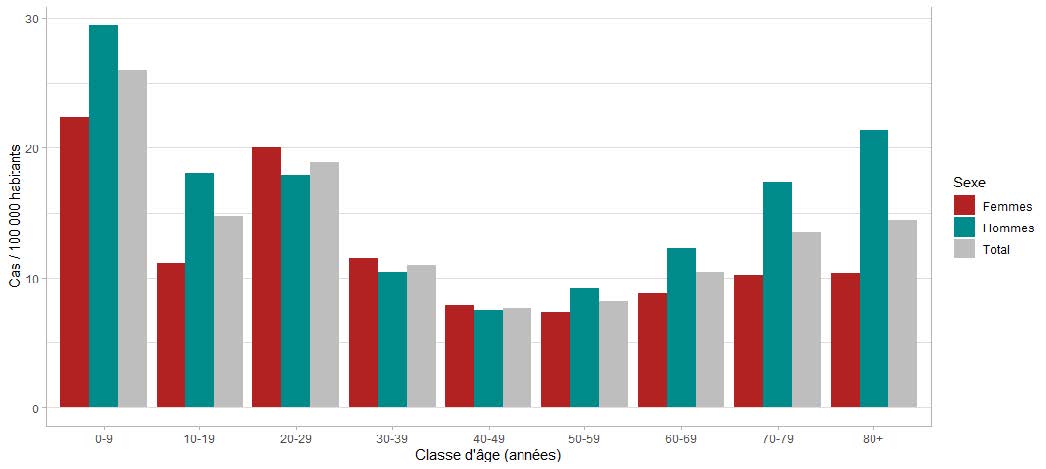
a higher reported incidence among children under 10 and among men;
an increase in cases of infection during the summer months;
high rates of resistance to fluoroquinolones and tetracyclines, which have remained stable in recent years;
low rates of combined resistance to fluoroquinolones and tetracycline;
no significant increase in resistance rates to routinely tested antibiotics.
Distribution of C. jejuni and C. coli strains according to their resistance phenotypes to five antibiotics (ampicillin, tetracycline, ciprofloxacin, erythromycin, gentamicin), France, 2023
| Resistance phenotypes | C. jejuni (n=5,609*) |
C. coli (n=892*) |
|---|---|---|
| Susceptibility to the five antibiotics tested | 1,326 (23.6%) | 94 (10.5%) |
| Resistance to ciprofloxacin and erythromycin | 26 (0.5%) | 62 (7.0%) |
| Resistance to all five antibiotics tested | 0 (0.0%) | 10 (1.1%) |
*strains tested for all five antibiotics
Number of reported Campylobacter cases per 100,000 population by age group and sex, France, 2023
Download

bulletin national
26 September 2024
Report on Campylobacter infection surveillance in France in 2023.
In relation to

Outbreaks of foodborne illness
thematic dossier
A foodborne illness outbreak is defined as the occurrence of at least two cases with similar symptoms—typically gastrointestinal—that can be traced to a single food source. In France, such...












