


Monitoring of HBs antigen (Ag) screening activity at anonymous and free screening clinics (CDAG) in France, 2013–2015
Key Points
Among the 224 CDAGs that continuously participated in monitoring hepatitis B screening activity (HBs antigen [Ag]) between 2013 and 2015:
Screening activity increased by nearly 5% between 2013 and 2015, rising from 147,760 to 155,150 screening tests performed.
The majority of tests were performed on men (56%), 68% of whom were aged 20 to 39.
The women tested were younger than the men, with 75% of them under the age of 30 (vs. 62% of men).
The HBsAg test positivity rate (the ratio of positive tests to total tests performed) was 0.9%:
twice as high among men as among women (1.17% vs. 0.55%, respectively)
nearly twice as high in the French overseas departments as in metropolitan France (1.66% vs. 0.87%, respectively)
the positivity rate was highest in the 30–39 age group (1.68%), among both men (1.90%) and women (1.26%)
Overall, the population tested for hepatitis B in CDAGs between 2013 and 2015 was a young population with a predominance of males.
The positivity rate for HBsAg tests performed in CDAGs was close to that estimated in 2013 for public and private clinical laboratories (0.8%) based on the LaboHep2013 survey.
The data presented cover the 224 CDAGs (excluding prisons) that participated continuously in the surveillance of HBsAg screening activity between 2013 and 2015.
HBsAg screening activity in CDAGs
Figure 1 - Distribution by year and by sex of the number of people tested for HBsAg in CDAGs that participated continuously in surveillance between 2013 and 2014
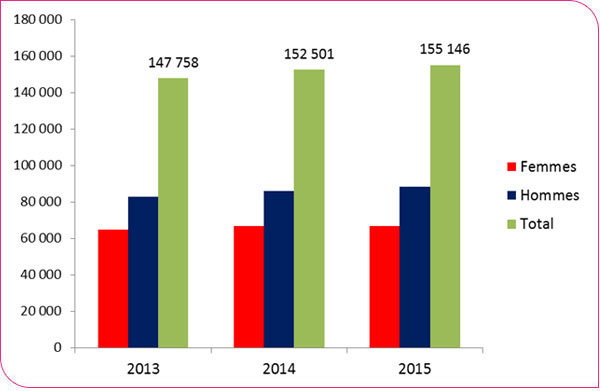
The total number of HBsAg screening tests performed by the 224 CDAGs participating continuously in surveillance over the period rose from 147,758 tests in 2013 to 155,146 tests in 2015, representing a 5% increase over the period.
More than half of the tests (56%) were performed on men.
Figure 2 - HBsAg screening activity in the 224 CDAGs that participated continuously in surveillance, by age and sex, 2013–2015
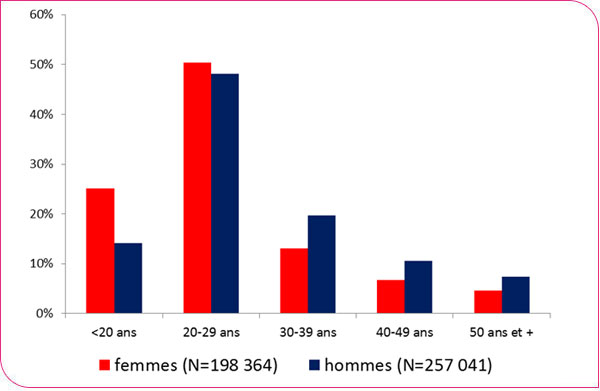
The majority of men tested were aged between 20 and 29 (48%) and 30 and 39 (20%)
The women tested were younger than the men: 50% of them were between 20 and 29 years old, and 25% of them were under 20 years old. This difference could be explained by HBsAg screening being performed more frequently in young women as part of mandatory hepatitis B screening during pregnancy.
Positive HBsAg screening test results in CDAGs
Figure 3 - Distribution by age group and sex of individuals diagnosed as HBV-positive in the 224 CDAGs that participated continuously in the surveillance program, France, 2013–2005
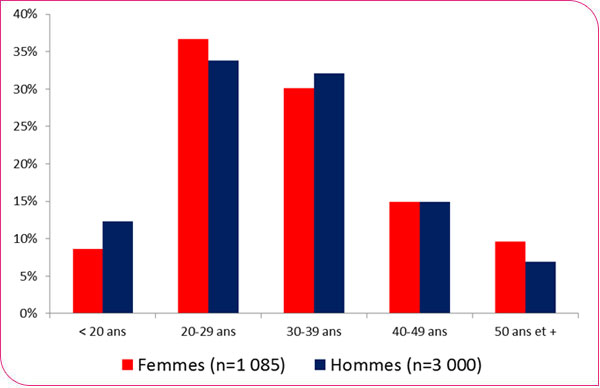
Among the 455,405 HBsAg tests performed in the 224 CDAGs that participated continuously in the surveillance program between 2013 and 2015:
4,085 tests (0.9%) were positive
the majority of HBsAg-positive tests were in men (73%). This proportion increased over the period, rising from 71.5% in 2013 to 76.2% in 2015.
Positive HBsAg tests were predominantly among people aged 20–29 and 30–39, both among women (37% and 30%, respectively) and among men (34% and 32%, respectively). These results reflect the profile of CDAG patients and the tests performed.
HBsAg test positivity rates by age group and sex in CDAGs
Between 2013 and 2015, the HBsAg test positivity rate was 0.9% in the 224 CDAGs that participated in the surveillance every year between 2013 and 2015.
Number of HBsAg screening tests performed, number of positive HBsAg tests, and positivity rate by age group among women in the 224 CDAGs that participated continuously in the surveillance between 2013 and 2015 | |||
Age group |
Number of tests performed |
Number of positive tests |
Positivity rate |
(a) |
(b) |
(b/a) |
|
Under 20 |
49,888 |
94 |
0.19% |
20–29 |
99,916 |
398 |
0.40% |
30–39 |
26,042 |
327 |
1.26% |
40–49 |
13,311 |
162 |
1.22% |
50 and older |
9,207 |
104 |
1.13% |
Total |
198,364 |
1,085 |
0.55% |
Number of HBsAg screening tests performed, number of positive HBsAg tests, and positivity rate by age group among men in the 224 CDAGs that participated continuously in the surveillance between 2013 and 2015 | |||
Age group |
Number of tests performed |
Number of positive tests |
Positivity rate |
(a) |
(b) |
(b/a) |
|
Under 20 |
36,482 |
370 |
1.01% |
20–29 |
123,664 |
1,013 |
0.82% |
30–39 years |
50,634 |
962 |
1.90% |
40–49 |
27,188 |
448 |
1.65% |
50 and older |
19,073 |
207 |
1.09% |
Total |
257,041 |
3,000 |
1.17% |
Positivity rate = number of positive tests / number of tests performed
HBsAg test positivity rate
higher among men (1.17%) than among women (0.55%).
Higher among both men and women in the 30–39 age group (1.90% and 1.26%, respectively) and the 40–49 age group (1.65% and 1.22%, respectively)
For both sexes, rates increase up to age 30–39 and then tend to decrease among those over 39.
HBsAg test positivity rates, by region, in the CDAGs
Figure 4 - HBsAg test positivity rates by new region in the 224 CDAGs that participated continuously in surveillance from 2013 to 2015
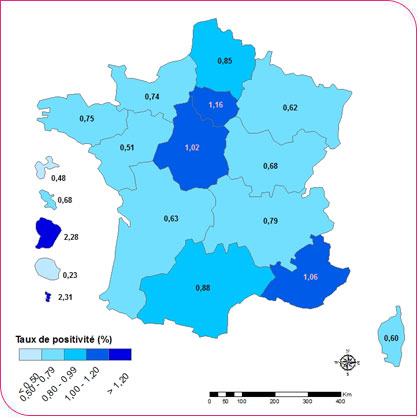
Positivity rate = number of positive tests / number of tests performed
HBsAg positivity rate
higher in the French overseas departments (1.66%) than in metropolitan France (0.87%)
in the French overseas departments: the highest rates are in Mayotte (2.31%) and French Guiana (2.28%)
In mainland France: the highest rate is in Île-de-France (1.16%)
Given the low number of CDAGs participating in surveillance in certain new regions and the potential for variability in the profile of patients seen at CDAGs, comparisons of HBs antigen positivity rates between new regions should be interpreted with caution
For more information: regional indicators












