




The disease
The acronym HIV stands for "Human Immunodeficiency Virus." This virus gradually destroys certain immune cells in infected individuals. The infection may remain asymptomatic for several years. In such cases, only a serological test—which detects antibodies against the virus in the blood—can diagnose the infection. The person is said to be HIV-positive.
Over time, and in the absence of treatment, the immune system becomes less and less effective. Diseases can then develop. Some of these are called “opportunistic infections” because they take advantage of the weakened immune system to develop. When a person has one or more such diseases, they have AIDS (Acquired Immunodeficiency Syndrome).
HIV is transmitted through sexual contact or blood, as well as from mother to child during pregnancy. In France, HIV transmission is primarily sexual.
As significant public health challenges, HIV and AIDS are monitored by Santé publique France and are the focus of prevention and screening programs tailored to the various high-risk populations.
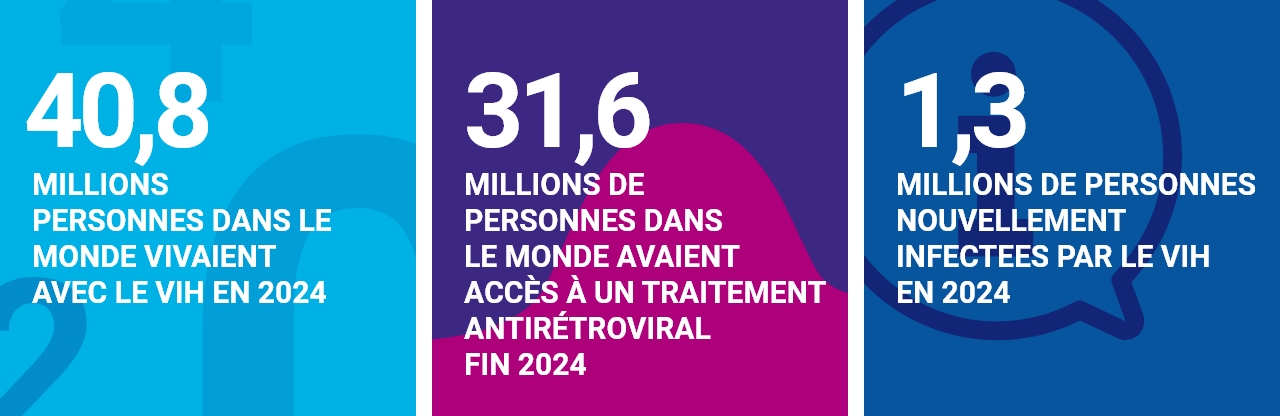
Key Statistics on HIV Infections and AIDS
Three Routes of Transmission
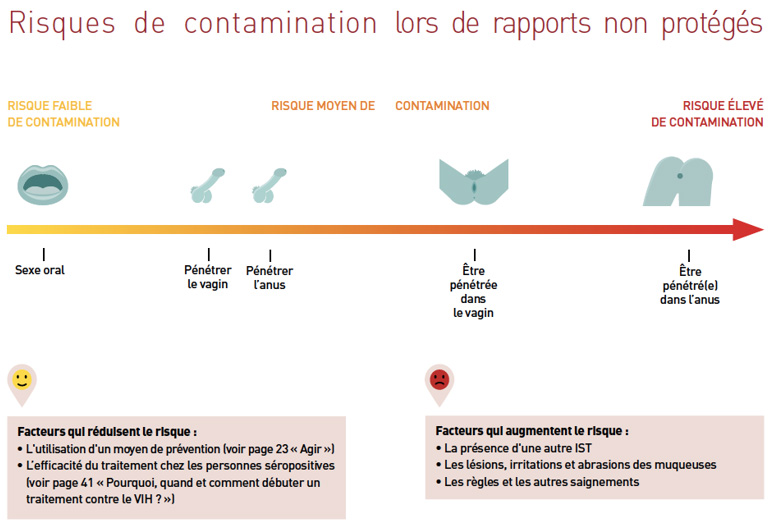
The virus that causes AIDS (HIV) is most commonly transmitted during unprotected sexual intercourse involving vaginal or anal penetration. Oral sex (fellatio) carries a low risk of HIV transmission. HIV can also be transmitted through significant contact with contaminated blood when sharing injection equipment or in the event of accidental needle sticks (among healthcare workers). If a mother living with HIV is not receiving treatment, HIV can be transmitted from mother to child during pregnancy, childbirth, or breastfeeding.
However, HIV is not a contagious disease that spreads without direct contact, like the flu. The virus is not transmitted through swimming, kissing, hugging, sneezing, coughing, insect bites, sharing a glass or clothing, etc.
Risk of infection during unprotected sex
HIV can be transmitted from mother to child
If the mother is HIV-positive, the virus can be transmitted from mother to child:
during pregnancy
during childbirth
through breast milk if she breastfeeds her baby
How can HIV transmission to the child be prevented?
Today in France, with effective antiretroviral treatment (undetectable viral load) and close medical monitoring, the risk of HIV transmission from mother to child is virtually zero (less than 0.5%).
Breastfeeding is possible under certain strict conditions, including strict viral load control, rigorous medical monitoring, and prophylaxis for the child throughout the breastfeeding period.
Progression of the Infection
As early as 15 days after exposure, certain symptoms may appear temporarily: fever, rash, fatigue, and diarrhea. This is followed by a long period with no apparent symptoms, during which the virus remains in the body and, if left untreated, can be transmitted.
The only way to diagnose an HIV infection is therefore to take a screening test. HIV testing options in France are varied and tailored to individual needs (testing at a medical laboratory with or without a doctor’s prescription, or at a screening center (CeGIDD), self-tests sold at pharmacies, or rapid diagnostic tests (TROD)). Testing is essential to enable infected individuals to access effective treatments and to prevent transmission of the virus to sexual partners.
Without appropriate treatment, HIV progressively weakens the immune system. Acquired immunodeficiency syndrome (AIDS) is the advanced stage of HIV infection. It corresponds to the onset of an opportunistic infection linked to the weakening of the immune system.
Antiretroviral treatments
The medications used are combinations of antiretrovirals. They prevent the virus from multiplying, but they do not eliminate it from all cells in the body.
Starting treatment is recommended for all people living with HIV. The sooner treatment begins after infection, the better the infection is controlled.
These treatments must be taken for life and require regular clinical and laboratory monitoring. If taken properly, they allow people living with HIV to live like everyone else—to work, have romantic relationships, make plans, and have children.
For more information: AIDS Info Service at 0800 840 800.
Diverse prevention strategies to protect against HIV
There is no vaccine against HIV. However, several prevention options are available, known as diversified prevention:
condom use for both HIV-negative and HIV-positive individuals;
regular testing for those most at risk, to ensure they can quickly access treatment if an HIV infection is diagnosed;
for HIV-negative individuals: PrEP (pre-exposure prophylaxis) or post-exposure prophylaxis (PEP);
for HIV-positive individuals: TasP (treatment as prevention) or PMTCT (prevention of mother-to-child transmission).
Male (external) and female (internal) condoms provide protection against HIV and other sexually transmitted infections (STIs) during sexual intercourse. They can be purchased at pharmacies, supermarkets, certain convenience stores, and vending machines.
Testing is the only way to diagnose HIV infection. If the result is positive, it allows you to receive appropriate care and treatment to prevent the infection from progressing to AIDS and to significantly reduce the risk of transmitting the virus. Testing can be performed:
at a medical laboratory. The test is 100% covered by health insurance with a doctor’s prescription. Since January 2022, it has also been possible to visit a laboratory without a prescription to receive an HIV test at no upfront cost (the HIV-Test program, expanded since September 2024 to include 4 other STIs under the name Mon test IST);
at a free screening center (CeGIDD), a sexual health center, or a Maternal and Child Health (PMI) center;
through an organization offering rapid diagnostic tests (TROD);
using a self-test kit purchased at a pharmacy.
PrEP (“pre-exposure prophylaxis”) is a preventive treatment that can be taken by HIV-negative individuals to reduce their risk of HIV infection. This method is intended for HIV-negative individuals who do not consistently use condoms and who are particularly at risk of HIV, including:
men who have sex with men;
trans men and women;
people engaged in sex work;
people from regions where HIV is highly prevalent (sub-Saharan Africa, French Guiana, etc.);
people who inject drugs;
people with multiple sexual partners.
Post-exposure prophylaxis (PEP) is an emergency treatment that, when taken quickly after exposure to HIV, significantly reduces the risk of HIV infection, though it does not completely eliminate this risk. PEP must be administered as quickly as possible, within 4 hours of exposure, and no later than 48 hours afterward. PEP is available in hospital emergency departments. Its appropriateness is assessed on a case-by-case basis by the physician depending on the nature of the HIV exposure.
Antiretroviral treatment for HIV-positive individuals, when properly administered, not only improves their health by preventing progression to AIDS and increasing their life expectancy, but also eliminates the risk of an HIV-positive person transmitting the virus to their sexual partner(s). This is known as Treatment as Prevention (TasP).
Learn more about surveillance.
See also
Are you sure you know everything there is to know about HIV and AIDS?
Sida Info Service website: https://www.sida-info-service.org/
Other sources of information in France and internationally
Health insurance: https://www.ameli.fr/assure/sante/themes/vih
Epi-phare: https://www.epi-phare.fr/rapports-detudes-et-publications/suivi-prep-vih-2025/
National HIV Reference Center: https://www.chu-tours.fr/etre-soigne-et-rendre-visite-a-un-patient/joindre-le-chru/liste-des-services/centre-national-de-reference-du-vih-cnr-vih/
European Centre for Disease Prevention and Control (ECDC): https://www.ecdc.europa.eu/en/hiv-infection-and-aids
UNAIDS: https://www.unaids.org/fr/resources/documents/2025/UNAIDS_FactSheet
In relation to

Hepatitis C
thematic dossier
Hepatitis C is a viral infection primarily transmitted through blood. Screening for the disease is crucial to ensuring that infected individuals receive the treatments that can now lead to a cure.

Sexual health
thematic dossier
Santé publique France focuses in particular on four areas of sexual health: sexually transmitted infections, including HIV; contraception; combating discrimination; and violence.
Blood donation
thematic dossier
Santé publique France coordinates the epidemiological surveillance of blood donors and helps assess the risk that a blood donation may be infected with a pathogen transmissible through transfusion.











