


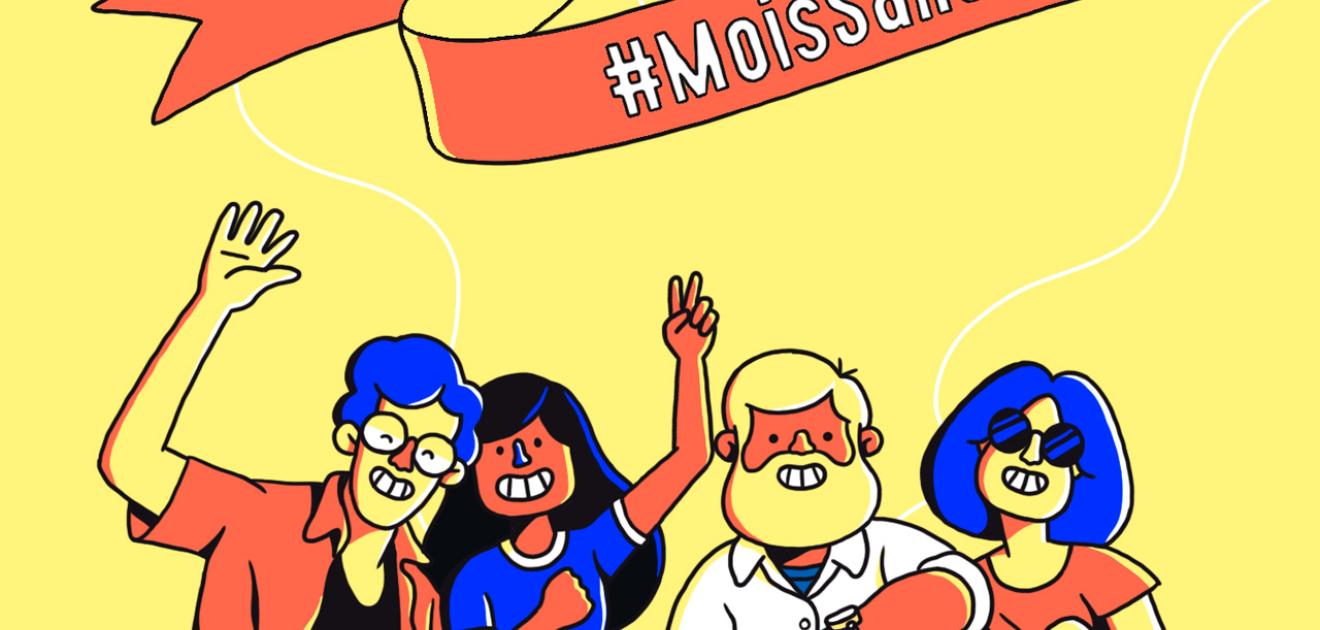
From “Stoptober” to “Smoke-Free Month”: How to Adapt a Social Marketing Campaign.
Tobacco use is the leading cause of premature death and preventable disease worldwide. Although France has seen a sharp decline in smoking rates since 2016, it remains one of the European countries with a high prevalence of smoking.
In 2016, Santé publique France launched the first “Mois sans tabac” campaign. This initiative is one of the measures under the 2014–2019 National Tobacco Control Program (including tobacco price increases and reimbursement for nicotine replacement therapies, etc.). “Moi(s) sans tabac” is a social marketing campaign inspired by the “Stoptober” campaign promoted by PHE (Public Health England) since 2012, which proved effective in the UK with 350,000 additional attempts to quit smoking in October during its first year, compared to previous years.
In France, since 2016, the proportion of daily smokers among adults has fallen from 29.4% to 25.4% in 2018.
A recent article in the Journal of Social Marketing describes the respective British and French initiatives and the specific features of “Mois sans tabac” compared to Stoptober. This study* was conducted in collaboration with Karine Gallopel-Morvan (School of Advanced Studies in Public Health, EHESP) and Matthew Walmsley (Public Health England).

3 questions for Romain Guignard, Directorate of Prevention and Health Promotion
The "Month Without Tobacco" campaign is a social marketing initiative in that it relies not only on a large-scale communication campaign designed to promote smoking cessation, but also on the provision of free tools (the Tabac Info Service program, smoking cessation kits) designed to reduce costs and barriers to adopting this new behavior, and on the involvement of stakeholders at the national and local levels to engage directly with the target audiences. The “Month Without Tobacco” initiative is also a social marketing program in the sense that it is grounded in scientific evidence, whether through the study of smoking-related behaviors based on representative surveys (such as the Public Health France Barometers), qualitative studies aimed at identifying barriers and enablers to smoking cessation among smokers, or analyses of the scientific literature.
The goal of the “Month Without Tobacco” campaign is to encourage smokers to quit smoking for 30 days in November, a period after which withdrawal symptoms are significantly reduced, increasing the chances of permanent success fivefold. The principle of the collective challenge is based on the theory of social contagion. Numerous studies have demonstrated the influence of interpersonal networks on the adoption of behaviors that are either beneficial or harmful to health, including smoking. The approach used in the Smoke-Free Month campaign is deliberately positive and inclusive, and setting a time-limited goal (quitting smoking for 30 days) helps overcome certain barriers to quitting mentioned by smokers: the fear of quitting “forever” or the fear of failure.
Finally, the “Month Without Tobacco” campaign draws inspiration from a campaign that has proven its effectiveness: the Stoptober campaign launched in the United Kingdom in 2012, based on the same principle of a collective challenge to quit smoking for one month. However, it was necessary to take into account specific French circumstances.
The Stoptober and Mois sans tabac campaigns share certain common elements, including their underlying principle, strategy, and target audience. Thus, the first phase of both initiatives consists of a major communication campaign across traditional and digital media aimed at encouraging smokers to take part in the challenge and register online for the campaign. The second phase of the initiative is the challenge month (October in the UK and November in France), during which tools to help people quit smoking are made available (in France, primarily the Tabac Info Service: a helpline, website, mobile app, Facebook page, as well as a smoking cessation kit inspired by the British experience) and local awareness-raising or smoking cessation support initiatives (in healthcare settings or workplaces, for example). The primary target audience for both campaigns is smokers aged 20 to 49, the age group with the highest smoking prevalence, with particular attention paid to the significant social health inequalities present in both countries.
Nevertheless, certain contextual differences between the two countries have led to significant adaptations in the implementation of Tobacco-Free Month. For instance, in 2016, smoking prevalence was twice as high in France (34.5%) as in the United Kingdom (16%), implying that smoking had been less successfully denormalized in France and thus potentially leading to greater resistance to prevention messages among French smokers. Cultural differences were also observed regarding risk perception. Particular attention to the content of the messages was therefore necessary to carry out Smoke-Free Month.
Furthermore, high-quality and virtually free smoking cessation services are available throughout the UK, particularly in the most disadvantaged areas (these are the NHS Stop Smoking Services), which is not the case in France. In the United Kingdom, smoking cessation support can be provided by any healthcare or social services professional who has received training, whereas in France it is primarily provided by tobacco specialists. These differences led Santé publique France to build a network of regional ambassadors, in collaboration with the Regional Health Agencies, to implement the program at the local level. Partnerships with healthcare professionals and facilities, local governments, public institutions or agencies, associations, and private companies had to be established to reach smokers directly in their communities (this was also the case in the United Kingdom, though to a lesser extent). In particular, a partnership with the French Order of Pharmacists was established, enabling the distribution of smoking cessation kits in nearly 18,000 pharmacies. A partnership with Pôle Emploi was also formed to reach the unemployed, one of the populations most affected by smoking according to general population surveys, with nearly one in two daily smokers. Finally, the National Health Insurance issued a call for proposals that funded local projects to support smoking cessation among the most disadvantaged smokers.
The significant decline in smoking prevalence observed in France since 2016 can be attributed both to a portion of smokers quitting and to fewer young people taking up smoking. Regarding the “quitting” aspect of tobacco use, the “Month Without Tobacco” campaign, combined with other regulatory measures such as the introduction of plain packaging, the increase in reimbursement rates for nicotine replacement therapies followed by their inclusion in the standard list of reimbursable medications, and price hikes, may have contributed to the favorable trend in prevalence. Previously published results indicated that 380,000 quit attempts were directly attributable to the first edition of “Mois sans tabac” in the fourth quarter of 2016. Process evaluation results, particularly the quantitative and qualitative post-tests conducted following each edition of the initiative, have enabled the annual optimization of this social marketing program, which will be renewed in 2019. Tobacco control efforts remain a priority in France, where smoking prevalence continues to be among the highest in Western countries. Engaging healthcare professionals and addressing social health inequalities remain major challenges. A detailed analysis of the design of “Mois sans tabac,” inspired by a campaign already implemented in another country, may be useful to other countries wishing to implement a similar initiative, combining resolutely positive messaging with a rollout across various geographic levels.
For more information:
On the evaluation of the “Moi(s) sans tabac” initiative
Guignard R, Richard J-B, Pasquereau A, Andler R, Arwidson P, Smadja O, et al. Attempts to quit smoking in the last quarter of 2016 and the link to “Moi(s) sans tabac”: initial results observed in the 2017 Health Barometer. Bull Epidémiol hebd. 2018;(14-15):298-303.
Guignard R, Andler R, Pasquereau A, Smadja O, Wilquin J-L, Gall B, et al. Contributions and limitations of post-tests in evaluating media campaigns: the example of Smoke-Free Month. Weekly Epidemiological Bulletin. 2018;(14-15):304-9.
About Stoptober
Fenton K. Stoptober: Supporting smoking cessation in England. Weekly Epidemiological Bulletin. 2016;(30-31):496-8.
On smoking prevalence in France
Andler R, Richard J-B, Guignard R, Quatremère G, Verrier F, Gane J, et al. Decline in the prevalence of daily smoking among adults: results from the 2018 Santé publique France Barometer. Weekly Epidemiological Bulletin. 2019;(15):271-7.
[1] Djian A, Guignard R, Gallopel-Morvan K, Smadja O, Davies J, Blanc A, Mercier A, Walmsley M, Nguyen-Thanh V. From "Stoptober" to "Moi(s) Sans Tabac": how to adapt a social marketing campaign. J Soc Mark. 2019-07-01;(forthcoming):1-14.
* This study was conducted as part of an end-of-studies internship at AgroParisTech, carried out by Auriane Djian under the supervision of Romain Guignard.












