


Psychoactive Substance Use and the Workplace: Variations in Practices Across Sectors
CP_barometre_2017_substances_psychoactives_milieu _professionnel_040521.pdf
Download (PDF - 237.62 KB)
Press Contacts
Santé publique France
presse@santepubliquefrance.fr
Stéphanie Champion: 01 41 79 67 48
Marie Delibéros: 01 41 79 69 61
Camille Le Hyaric: 01 41 79 68 64
Santé publique France has released the results of its Health Barometer survey on the use of psychoactive substances in the workplace. The findings reveal disparities in usage across different sectors and underscore the importance of addiction prevention in the workplace.
The use of psychoactive substances such as tobacco, alcohol, cannabis, or other illicit drugs has harmful effects on health. The short- and long-term health and social problems associated with psychoactive substance use (PSU) make it one of the leading causes of preventable mortality in France.
Santé publique France has published the results of its Health Barometer focused on psychoactive substance use in the workplace. Updating findings from 2010, this study highlights disparities in use across different occupational sectors. By contributing to a better understanding of workplace health promotion and occupational risk prevention, these results underscore the importance of addiction prevention initiatives in the workplace.
Higher rates of use in certain occupational sectors than in others
Based on a sample of over 25,000 people, including 14,604 employed individuals aged 18–64, the Santé publique France Health Barometer¹ mapped psychoactive substance use by occupational sector.
The results suggest higher-than-average levels of use in the accommodation and food services sector, and in the arts, entertainment, and recreation sector for virtually all substances (excluding daily alcohol consumption), among both men and women. Among the sectors studied, some have a higher proportion of legal drug users. The construction sector is notably characterized by particularly high levels of tobacco and alcohol use among men, as are agriculture, forestry, and fishing, as well as real estate activities. The arts, entertainment, and recreation sector, meanwhile, is associated with more frequent experimentation with illicit substances among both men and women, and higher rates of monthly heavy drinking episodes (API) among men.
Other sectors are associated with below-average consumption levels depending on the product, particularly among men. These include public administration (tobacco, cannabis within the year), education (tobacco, BVA), human health and social work (daily alcohol), information and communication (tobacco, daily alcohol consumption), electricity, gas, steam, and air conditioning supply (daily alcohol consumption, MDMA/ecstasy/amphetamines), and professional, scientific, and technical activities (tobacco).
Summary table of results
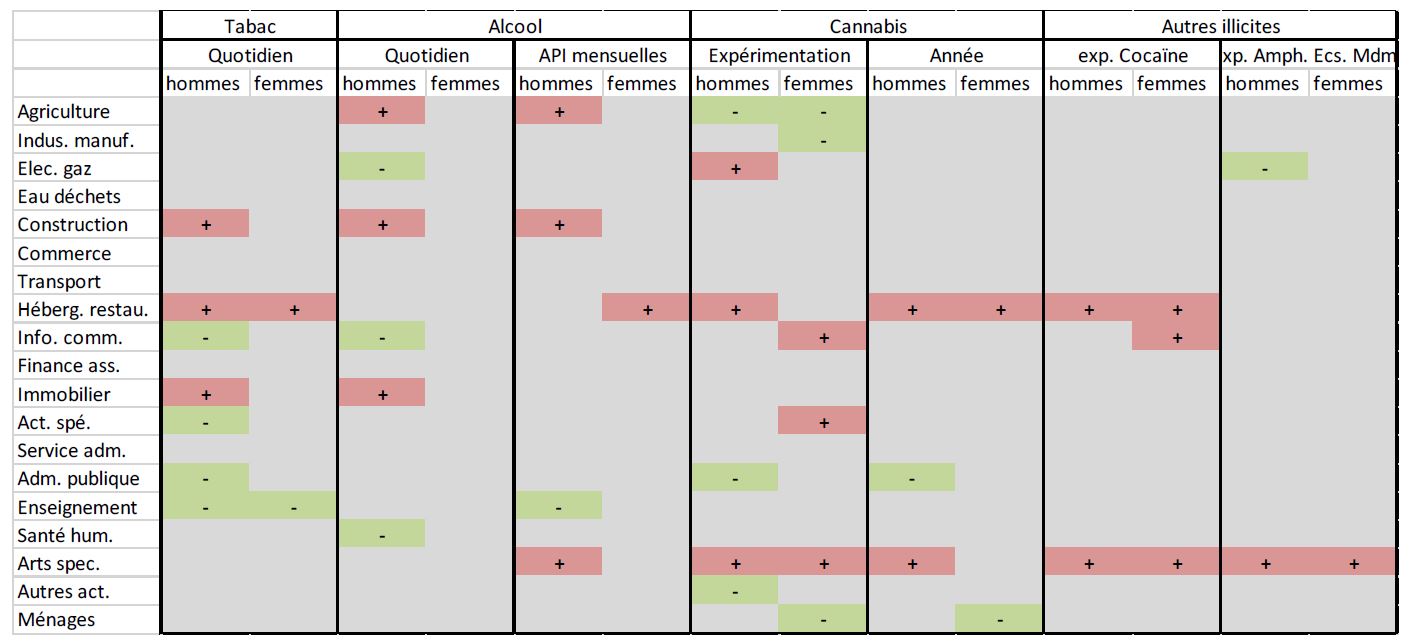
Many of these observations had already been made in 2010; nevertheless, a few new findings emerged: more frequent tobacco and alcohol use in the real estate sector, while use in the manufacturing (alcohol, tobacco) and trade (tobacco) sectors is closer to the average.
Alcohol consumption at work: workplace culture and practices that vary by sector
Among employed individuals, 12% (14% of men and 9% of women) report that alcohol consumption at work is part of their workplace culture. For both men and women, these proportions are higher in the agriculture, forestry, and fishing; construction; accommodation and food services; and arts, entertainment, and recreation sectors, and lower in the education and human health and social work sectors.
Certain sectors stand out from others in terms of drinking alcohol at lunch on workdays at least once a month. Indeed, this practice is more widespread in the agriculture, forestry, and fishing sectors, construction, financial and insurance activities, as well as professional, scientific, and technical activities, and is conversely less common in the manufacturing, transportation and warehousing, education, and human health and social work sectors.
Our findings reveal disparities across sectors, highlighting increased risks within certain sectors for the purpose of potential targeted prevention. Our prevention programs are for everyone. We develop numerous information and prevention tools that can support companies in their prevention efforts. Our remote assistance services—Tabac Info Service, Alcool Info Service, and Drogues Info Service—can also serve as resources for everyone.
However, it should be noted that the majority of employed individuals reported never consuming alcohol during lunch on workdays: 62% of men and 78% of women, while 22% and 77% respectively reported drinking at least once a month, and 16% of men and 15% of women less than once a month.
Furthermore, 89% of men and 95% of women reported never consuming alcohol during work hours (excluding meals and after-work gatherings), with 6% and 4% doing so less than once a month and 5% and 1% doing so more often.
Finally, among men, consuming alcohol during work hours (excluding meals and social gatherings) at least once a month is more common in the agriculture, forestry, and fishing; construction; accommodation and food services; and arts, entertainment, and recreational activities; sectors where it is less common include manufacturing, transportation and warehousing, and human health and social work. Among women, this behavior is more frequently observed in the accommodation and food services sector and in other service activities.
Dr. Nicolas Prisse, President of MILDECA (Interministerial Mission for the Fight Against Drugs and Addictive Behaviors), states:
“These new data usefully supplement those published a few weeks ago by MILDECA based on analysis of the INSERM CONSTANCES cohort and provide employers and public authorities responsible for public health and occupational health with a clear picture of addictive behaviors among the working population.
The dissemination of scientific data to companies aims to raise awareness of the importance of psychoactive substance use and its implications, particularly among executives and HR directors, in order to provide appropriate and consistent responses to improve worker safety and health, quality of life at work, and organizational performance.
This awareness is all the more necessary given that work habits have been disrupted for over a year and certain vulnerabilities have emerged within the workforce. Addictive behaviors are not merely a personal issue; their prevention is also a managerial challenge that must enable employees and staff to perform their work under the best possible conditions, without jeopardizing their health and safety through the use of drugs and alcohol to cope at work, improve performance, manage stress, etc.
Download
enquêtes/études
7 July 2021
Use of psychoactive substances and the workplace. Results of the 2017 Santé publique France Barometer
1 The 2017 Health Barometer survey was conducted from January 5 to July 18, 2017, among a representative sample of the population aged 18–75 residing in metropolitan France and speaking French. A total of 25,319 adults were surveyed, including 14,604 who were under 65 and employed (apprentices, individuals in paid internships, and students working at least part-time for at least six months a year are included).
2 Consumption of six or more drinks on a single occasion, at least once a month.
Our prevention websites

Alcohol
thematic dossier

Tobacco
thematic dossier
surveys/studies
Public Health France Barometers
The Santé publique France Health Barometer: a survey of health-related behaviors, opinions, and knowledge designed to guide public health prevention and education policies.
Our latest news

news
Call for Nominations for the Renewal of the Scientific Advisory Board of the...

news
Growing Up with Screens. A special report in *La Santé en action* No. 474,...

news












