


New campaign against discrimination and violence faced by LGBT+ people: “In the face of intolerance, it’s up to us to make a difference”
CP_discriminations_lgbt_170521_v2.pdf
Download (PDF - 868.91 KB)
Press Contacts
Santé publique France
presse@santepubliquefrance.fr
Vanessa Lemoine: 01 55 12 53 36
Cynthia Bessarion: 01 71 80 15 66
Stéphanie Champion: 01 41 79 67 48
Marie Delibéros: 01 41 79 69 61
Charlène Charbuy: 01 41 79 68 64
Office of the Minister Delegate for Gender Equality, Diversity, and Equal Opportunity
presse-efh@pm.gouv.fr
01 42 75 62 75
To mark the International Day Against Homophobia, Transphobia, and Biphobia on May 17, 2021, Olivier Véran, Minister of Solidarity and Health, Élisabeth Moreno, Minister Delegate to the Prime Minister in charge of Gender Equality, Diversity, and Equal Opportunity, the Interministerial Delegation for the Fight Against Racism, Anti-Semitism, and Anti-LGBT Hate (DILCRAH), and Santé publique France are joining forces to launch a campaign to combat discrimination based on sexual orientation and gender identity and its impact on health.
This campaign, the first phase of the National Action Plan for Equal Rights and Against Anti-LGBT+ Hate and Discrimination, launched on October 14, 2020, aims to reduce acts of discrimination and violence against LGBT people and to promote greater acceptance of sexual minorities within society: “In the face of intolerance, it’s up to us to make a difference.”
An encouragement toward tolerance and a step toward full acceptance
While outrage over discrimination may be emotionally stirring, it is no longer enough to change perceptions and behaviors. That is why public authorities are now launching a broad campaign with a positive and inclusive approach. Its goal is to highlight the diversity of sexualities and gender identities and to promote their acceptance in order to garner greater support from all segments of the public. Starting May 17 and running for three weeks, the campaign “In the Face of Intolerance, It’s Up to Us to Make a Difference” will be rolled out across all channels (TV, out-of-home advertising, billboards, print, and digital with the hashtag #JeFaisLaDifférence) with the aim of reaching all French people.
The creative concept behind the campaign film draws on the song "Nous les amoureux," an anthem to the repressed love of same-sex couples. In 120 seconds, the film depicts society’s progress on the issue of diverse sexualities and celebrates the daily lives of LGBT+ people living in an accepting France (watch the video). At the end of the spot, a message invites viewers to visit the new website Questionsexualité.fr, which provides access to authoritative information on sexuality and addresses issues of discrimination.
For digital platforms, a series of podcasts titled “Et alors” has been produced for distribution on social media. These podcasts feature testimonials illustrating how the journey of close family members toward accepting an LGBT+ person can be more or less rapid or more or less complicated. In every case, it is crucial for the individuals involved.
The initiative will be complemented by partnerships reaching diverse audiences and sectors: healthcare professionals, the workplace, family circles, and through impactful initiatives in schools, universities, and the sports community.
Because the health consequences of discrimination are severe and harmful to society as a whole, it is essential to take action: “In the face of intolerance, it is up to us to make a difference.”
Discrimination: A Public Health Issue
Today, despite progress in terms of rights and greater social acceptance, experiences of discrimination and violence based on sexual orientation or gender identity remain widespread. In 2019, 35% of LGBT people experienced at least one form of discrimination during their lifetime due to their sexual orientation or gender identity1. This discrimination and violence affect the overall health (both physical and mental) of those who experience it.
Santé publique France has now compiled an overview of the health impacts of this discrimination based on a literature review and a special issue of the BEH, and the findings are clear. The consequences are numerous, including psychological and identity-related disorders, substance use, compromised sexual health, difficulties communicating with healthcare professionals, and avoidance of care.
Élisabeth Moreno, Minister Delegate to the Prime Minister in charge of Gender Equality, Diversity, and Equal Opportunity, states: “Discrimination, invisibility, violence, and anti-LGBT+ hatred remain unacceptable realities in our country. Working toward a more inclusive and protective society requires, among other things, a shift in attitudes. The result of cooperation between Santé Publique France and DILCRAH, the campaign we are launching today, on the occasion of the International Day Against Homophobia, transphobia, and biphobia, aligns with the awareness-raising objective set by the Government through the 2020–2023 National Action Plan for Equal Rights, Against Anti-LGBT+ Hate and Discrimination. Through this diverse public-facing campaign, focused on health issues, our goal is to contribute to respect for lesbian, gay, bisexual, and transgender people by ensuring they receive proper recognition and a rightful place in our society, with the aim of ensuring they are full citizens.”
Sophie Elizeon, Interministerial Delegate for the Fight Against Racism, Anti-Semitism, and Anti-LGBT Hate, states: “The campaign, ‘In the Face of Intolerance, It’s Up to Us to Make a Difference,’ was both long-awaited and necessary. DILCRAH proudly supports it. This first national campaign helps strengthen solidarity, which is our best ally against anti-LGBT hate and violence. It is up to each of us to embrace it and make a difference.”
Prof. Geneviève Chêne, Director General of Santé Publique France, states: “Discrimination has harmful and lasting repercussions on people’s physical and mental health in terms of psychological and identity-related disorders, substance use, compromised sexual health, difficulties communicating with healthcare professionals, and avoidance of care. This is a major public health and equality issue; it is essential that we all take action. That is the whole point of our campaign: ‘In the face of intolerance, it’s up to us to make a difference.’”
Some facts and figures
Lesbians, gays, and bisexuals experienced twice as many major depressive episodes (MDE) and three times as many suicide attempts in the past 12 months compared to heterosexuals. See the 2017 Santé publique France Barometer.
More than half (56%) of transgender people surveyed via social media in 2014 reported having experienced depression following transphobic acts, and 18% reported a suicide attempt.
The family’s lack of acceptance of homosexuality and bisexuality contributes to the deterioration of the mental health of cisgender homosexual or bisexual women.
The issue of sexual orientation is rarely addressed in general medical consultations: 49% of lesbians and 40% of gay men have never discussed their sexual orientation with their doctor. This lack of communication prevents healthcare providers from addressing the specific needs of LGBT individuals, such as screening and vaccination.
One in four people reported having avoided seeing a doctor in the past 12 months for fear of being discriminated against because of their “transgender identity.”
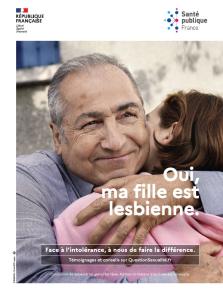
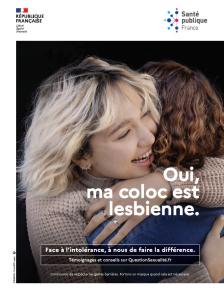
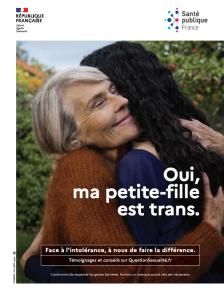
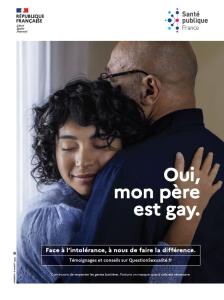
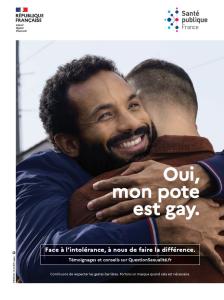
"In the face of intolerance, it’s up to us to make a difference": check out the campaign
Posters to download:
See also

magazines/revues
2 June 2021
Weekly Epidemiological Bulletin, May 17, 2021, No. 6-7 Stigmatization of sexual minorities: a key determinant of their health (International Day Against Homophobia, Transphobia, and Biphobia, May 17)
See also

synthèse rapide des connaissances
17 May 2021
Weekly Epidemiological Bulletin, May 17, 2021, No. 6-7 Stigmatization of sexual minorities: a key determinant of their health (International Day Against Homophobia, Transphobia, and Biphobia, May 17)
1 Society at a Glance 2019: OECD Social Indicators. Chapter 1. The LGBT Challenge: How to Improve the Inclusion of Sexual and Gender Minorities? OECD, 2019. https://www.oecd.org/fr/els/soc/SaG2019-chapitre1-Eclairage-LGBT.pdf
Check out the QuestionSexualité website
Everything you need to know about sexuality.

Sexual health
thematic dossier
Social and Regional Health Inequalities
Check out our page on social and regional health inequalities.
Our latest news

news
Call for Nominations for the Renewal of the Scientific Advisory Board of the...

news
Growing Up with Screens. A special report in *La Santé en action* No. 474,...

news












