




The disease
Polio, Eradicated in France
Polio is an acute viral infection resulting from the invasion of the gastrointestinal tract by a poliovirus. This virus is strictly human; it belongs to the genus Enterovirus and there are three serotypes: 1, 2, and 3. It multiplies in the pharyngeal mucosa and the small intestine and can be found in the nasopharynx and stool. It has a high affinity for the central nervous system, posing a risk of spinal cord involvement, which causes paralysis. Extremely stable, it can persist in the environment for several weeks or even months, depending on outdoor temperature, humidity levels, sunlight exposure, the concentration of organic matter, and the presence of aerobic bacteria.
Since 1988, the World Health Organization (WHO) has set a goal of eradicating poliomyelitis. The elimination of poliomyelitis from the European Region was declared on June 21, 2002.
By 2022, five of the six WHO regions had eliminated polio. The only region that has not achieved elimination is the Eastern Mediterranean, with Afghanistan and Pakistan still endemic. While wild polioviruses (WPV) of serotype 2 and serotype 3 were eradicated in 2015 and 2019, respectively, the occurrence of outbreaks linked to the circulation of vaccine-derived polioviruses (cVDPVs) that have become virulent through genetic mutation underscores the need to remain extremely vigilant and to apply to these outbreaks the same international recommendations originally designed for WPV. As part of the final phase of disease eradication, it is therefore essential to maintain high vaccination coverage.
Key Facts About Polio
Transmission through ingestion of contaminated products
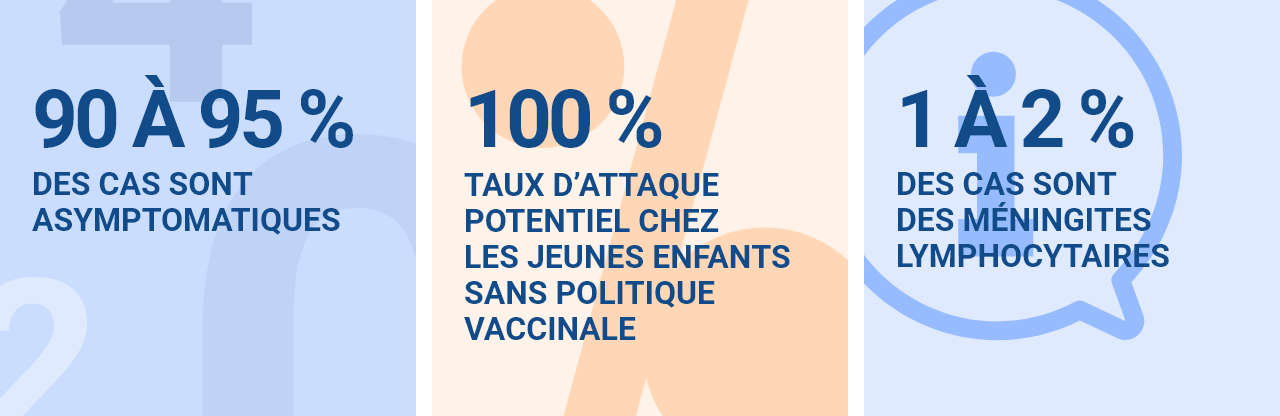
The virus is transmitted from person to person, either directly (fecal-oral or respiratory) or indirectly through ingestion of contaminated water or food. The only reservoir is humans. In countries with poor hygiene, around a case within the same household, the risk of transmission to susceptible individuals is very high, with a seroconversion rate of up to 100% for children and 90% for adults. Contagiousness is highest during a period of 7 to 10 days before and after the onset of symptoms.
Vaccine Prevention
Since the introduction of polio vaccination into the French immunization schedule (1958 for the injectable, inactivated Salk-Lépine vaccine and 1962 for the oral Sabin vaccine) and its mandatory status in July 1964, the number of cases has rapidly declined.
Since 1986, only the injectable vaccine has been available in France; however, the oral vaccine remains in use worldwide, which explains the detection of vaccine viruses or vaccine virus derivatives during surveillance in France.
This vaccination has remained mandatory for all infants born on or after January 1, 2018.
As part of the final phase of disease eradication, it is essential to maintain high vaccination coverage.
Varied symptoms
The incubation period lasts 3 to 21 days. The infection can present with a variety of symptoms. In the vast majority of cases (90 to 95%), the infection remains asymptomatic. When it presents clinically (4 to 8% of infections), it begins as an acute, nonspecific, flu-like febrile syndrome without signs of central nervous system involvement (though the presence of very intense muscle pain should be noted). In 1–2% of infections, this syndrome is accompanied by aseptic lymphocytic meningitis. All these symptoms may resolve spontaneously, leading to full recovery within about ten days; however, in less than 1% of infections, acute flaccid paralysis may occur on the 6th to 8th day: typically asymmetric, varying in location and intensity depending on the extent of neuronal involvement, with a predominance of lower limb involvement compared to the upper limbs and without objective sensory disturbances.
The onset of paralysis is generally sudden, occurring within a few hours, with an ascending spread reaching its peak within 3 to 5 days, accompanied by fever, and posing a life-threatening risk when it affects the respiratory and/or swallowing muscles. In endemic areas, the risk of the paralytic form ranges from 1 in 1,000 in children to 1 in 75 in adults.
A diagnosis that is not always straightforward
Differential diagnosis is extremely difficult in non-paralytic forms. The meningeal syndrome, when present, is no different from that of other viral meningitis.
While the clinical features of the paralysis are usually sufficient to suggest a diagnosis of poliomyelitis, the most frequently considered differential diagnoses in cases of acute flaccid paralysis (AFP) are:
Guillain-Barré syndrome: however, in this case, the paralysis is usually symmetrical, with a course that can last up to 15 days; in most cases, it is accompanied by objective sensory disturbances; other accompanying signs are absent (fever, headache, nausea, and vomiting). Signs of peripheral neuropathy are present on EMG. CSF analysis shows elevated protein levels and the absence of the pleocytosis observed in poliomyelitis;
acute transverse myelitis: paralysis, most often symmetrical, initially flaccid, subsequently becoming spastic, accompanied by sensory symptoms and sphincter dysfunction;
other possible diagnoses include: acute compression of the spinal cord or cauda equina, traumatic paralysis (including that related to intramuscular injections), infections caused by other viruses (enteroviruses, arboviruses), diphtheria or botulism neuropathies (descending deficit, accommodation disorder suggestive of these conditions).
In relation to

Vaccination
thematic dossier
Contagious diseases most often affect children at a very young age. Because children are particularly vulnerable, they are a priority target for vaccination programs.











