




Data
Venous thromboembolism: data
The surveillance system for venous thromboembolic disease established by Santé publique France enables the study of epidemiological trends in this vascular disease.
Mortality increases with age
In 2013, 15,501 deaths were recorded with venous thromboembolic disease as one of multiple causes, including 8,697 among women and 6,804 among men. VTE was reported in over 80% of cases. Premature mortality—that is, before age 65—accounted for 16% of all deaths attributed to venous thromboembolism, with a significant gender disparity (22% among men and only 11% among women). The crude mortality rate from venous thromboembolic disease increased significantly with age, ranging from 0.1 per 100,000 among those under 25 to 351.4 per 100,000 among those over 85. The age-standardized mortality rate from venous thromboembolic disease, across all causes, was higher among men than among women.
Learn more

Number and rate of deaths from venous thromboembolism and pulmonary embolism by sex and age, 2013
Declining Mortality from Pulmonary Embolism
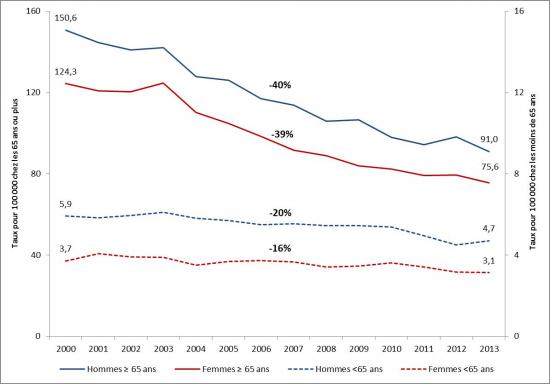
The age-standardized mortality rate from PE decreased significantly between 2000 and 2013, with a 36% reduction in both men and women. This decrease was less pronounced among those under 65 (-19%) than among those over 65 (-39%).
Trends in mortality rates* from pulmonary embolism (all causes) by sex from 2000 to 2013
An increase in hospitalizations with age
In 2014, 128,237 people were hospitalized at least once with venous thromboembolism as a primary or associated diagnosis, of whom 60,440 had PE. Nearly 35% of patients hospitalized for venous thromboembolism were under 65 years of age, and 53% were women. The crude rate of patients hospitalized for venous thromboembolism increased exponentially with age, rising from 12.3 per 100,000 among those under 25 to over 1,200 per 100,000 among those over 85. Standardized rates were higher among men than among women.
Learn more

Number and rate of patients hospitalized in acute care (MCO) for venous thromboembolism and pulmonary embolism (primary or secondary diagnosis) by sex and age, in 2014
Hospitalizations for pulmonary embolism remain stable
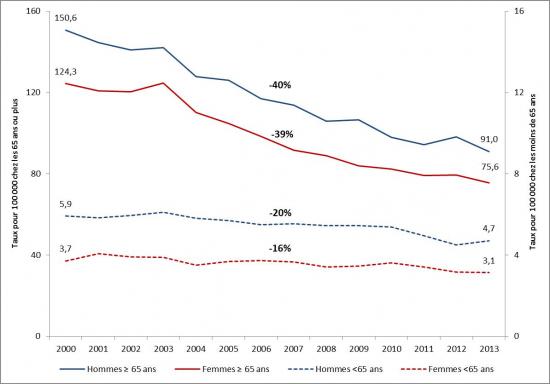
Between 2002 and 2014, the standardized rate of patients hospitalized for PE remained fairly stable. However, among those under 65, there was a 48% increase among men and a 9% increase among women. This increase could be explained, in part, by overdiagnosis of pulmonary embolism linked to the introduction, in the early 2000s, of new, more sensitive diagnostic tools capable of detecting PEs that may not always have clinical significance. Other hypotheses, such as the increased prevalence of certain risk factors like obesity or a sedentary lifestyle, as well as improved survival rates among patients with multiple trauma and cancer—who are populations at risk for VTE—could also explain the trends observed before age 65.
Trends in the rates* of hospitalized patients with a primary or secondary diagnosis of pulmonary embolism by sex from 2002 to 2014
Significant regional disparities
Analysis of regional standardized rates reveals significant disparities in mortality and hospitalization rates due to venous thromboembolism across France. The regional disparities observed are fairly consistent between mortality and hospitalization rates.
Rate of patients hospitalized for venous thromboembolic disease:
A large quarter of the regions in the Northeast have a standardized rate more than 10% above the national average (Bourgogne-Franche-Comté, Hauts-de-France, Grand-Est, Île-de-France, and Auvergne-Rhône-Alpes)
Rates at least 10% below the national average in Brittany, Pays de la Loire, Nouvelle-Aquitaine, Occitanie, and Provence-Alpes-Côte-d’Azur
Corsica and Réunion had the lowest standardized rates in France in 2014.
Mortality rates from venous thromboembolism:
Hauts-de-France, the Grand-Est region, Bourgogne-Franche-Comté, Guadeloupe, and Martinique have the highest mortality rates from VE due to multiple causes, exceeding the national average by more than 10%
Corsica, Réunion, Provence-Alpes-Côte-d’Azur, Brittany, Pays-de-la-Loire, and Île-de-France have rates more than 10% lower than the national average.
In relation to

Vascular disorders of pregnancy
thematic dossier
Cardiovascular and cerebrovascular diseases are the second leading cause of death among women and the leading cause of postpartum maternal mortality in France. Certain pregnancy complications...

Nutrition and Physical Activity
thematic dossier
Nutrition and physical activity are two major determinants of health that contribute to improving the health of the population and are key priorities in public health policy.

thematic dossier
Cancers
Les cancers représentent en France la première cause de décès chez l’homme et la deuxième chez la femme. Santé Publique France copilote la surveillance épidémiologique et participe à leur prévention.











