



What We Do
The primary objective of the epidemiological surveillance of CJD conducted by Santé publique France is to monitor trends in vCJD cases and the effectiveness of the measures implemented (ban on the use of meat-and-bone meal in cattle feed). In addition, the surveillance aims to detect the emergence of new forms of CJD as early as possible and to investigate their origin and transmissibility.
Epidemiological surveillance of Creutzfeldt-Jakob disease
The national CJD surveillance network and mandatory reporting
Since 1992, the epidemiology of Creutzfeldt-Jakob disease (CJD) has been monitored by a network comprising laboratories, neurologists, and volunteer neuropathologists, coordinated by Unit 1127 (formerly U975) of the French National Institute of Health and Medical Research (Inserm). In addition, suspected cases of CJD and other human subacute spongiform encephalopathies (SSEs) have been included on the list of notifiable diseases (ND) since September 19, 1996. Since that date, close collaboration has been established between Santé publique France and Inserm U1127.
In light of the emergence of the variant form of CJD (vCJD) and the expansion of potential data sources—particularly due to the use of 14–3–3 protein testing as a criterion for suspected CJD—Santé publique France initiated, in early 2000, a strengthening of this surveillance in collaboration with the various relevant partners.
In France, 2,958 deaths linked to confirmed or probable Creutzfeldt-Jakob disease from 1992 to 2017. Among the 2,958 cases in France: 2,543 (86%) sporadic cases; 135 iatrogenic cases; 257 genetic cases; and 27 vCJD cases.
Tools for Mandatory Reporting
Mandatory reporting involves collecting as comprehensive information as possible regarding all suspected cases of Creutzfeldt-Jakob disease from healthcare professionals. It involves two successive procedures: reporting and notification.
Physicians and laboratory professionals who suspect Creutzfeldt-Jakob disease (CJD) or a related disease must report it immediately and by any appropriate means (telephone, fax) to the physician at the Regional Health Agency (ARS) in their area of practice. As soon as a report of a suspected case of CJD reaches the ARS, all details of the report are forwarded as quickly as possible to Santé publique France. Suspected cases are also reported directly to the RNS-CJD.
The information available at the time of notification does not always allow for immediate classification of the suspected case as possible, probable, or confirmed. Depending on the patient’s progression and the results of tests (EEG, MRI, etc.), the classification of the case, based on the case definition (see below), may take several months to several years.
Particular attention is paid to whether the patient donated blood prior to the disease being reported. Indeed, due to the potential transmission of the variant form of CJD through blood or blood-derived products and medications, if a patient suspected of having CJD has recently donated blood, Santé publique France, in collaboration with the EFS, searches for any blood-derived products and medications still available in order to exclude them.
After the report, physicians or laboratory scientists who suspect CJD must notify the public health inspector at the ARS in their area of practice by completing a specific notification form for suspected Creutzfeldt-Jakob disease.
As soon as this form reaches the ARS, it is validated, anonymized, and forwarded to Santé publique France without waiting for updates on the disease’s progression or confirmation of the diagnosis.

Report Form for Suspected Creutzfeldt-Jakob Disease

Procedural Guidelines for Suspected Cases of CJD - For Clinicians
Informing the public about the reporting of notifiable diseases
Case definitions for Creutzfeldt-Jakob disease
Surveillance of the disease is based on classification criteria for CJD to monitor the different forms: sporadic, genetic, acquired, or the variant form
Sporadic forms
| I | rapidly progressive dementia | |
|
II |
A | myoclonus |
| B | visual or cerebellar abnormalities | |
| C | pyramidal or extrapyramidal syndrome | |
| D | akinetic mutism | |
| III | Typical EEG | |
| IV | Hypersignals in the caudate nucleus or putamen on brain MRI * |
Confirmed: Neuropathological or immunocytochemical confirmation
Probable
I + 2 of II + III
or I + 2 of II + IV (effective January 1, 2010)
or possible CJD + positive 14-3-3
Possible: I + 2 of II + duration less than 2 years
Genetic forms
Confirmed
Transmissible subacute spongiform encephalopathy (TSSE) confirmed as of January 1, 2010 + TSSE defined or probable in a first-degree relative TSSE defined with a pathogenic mutation in the PRNP gene
Probable
Progressive neuropsychiatric disorder + confirmed or probable TSE in a first-degree relative. Progressive
neuropsychiatric disorder + pathogenic mutation in the PRNP gene.
Acquired forms
Confirmed: Confirmed TTS with a recognized iatrogenic risk factor
Probable
Progressive cerebellar-predominant syndrome in a patient treated with pituitary hormone
or probable ESST with a recognized iatrogenic risk factor.
vCJD
Confirmed case: IA and neuropathological confirmation of vCJD (e)
Probable cases
I and 4/5 of II and IIIA and IIIB
or I and IVA
| I | A | progressive neuropsychiatric disorder |
| B | duration of illness >6 months | |
| C | routine tests do not suggest another diagnosis | |
| D | no evidence of exposure to a potential iatrogenic source | |
| E | no evidence of a familial form of TSE | |
| II | A | early psychiatric symptoms (a) |
| B | Persistent painful sensory symptoms (b) | |
| C | ataxia | |
| D | myoclonus or chorea or dystonia | |
| E | dementia | |
| III | A | no EEG typical of sporadic CJD (c) (or no EEG available) |
| B | Bilateral “pulvinar sign” on MRI | |
| IV | A | Positive tonsil biopsy (d) |
Risk factors relevant to the classification of a case of iatrogenic CJD
The relevance of exposure to a risk factor must take into account the time interval between exposure and the onset of the disease:
Treatment with human pituitary growth hormone, human pituitary gonadotropin, or human placenta;
Corneal transplantation if the corneal donor had a confirmed or probable prion disease;
Exposure to neurosurgical instruments previously used on a patient with a confirmed or probable human prion disease.
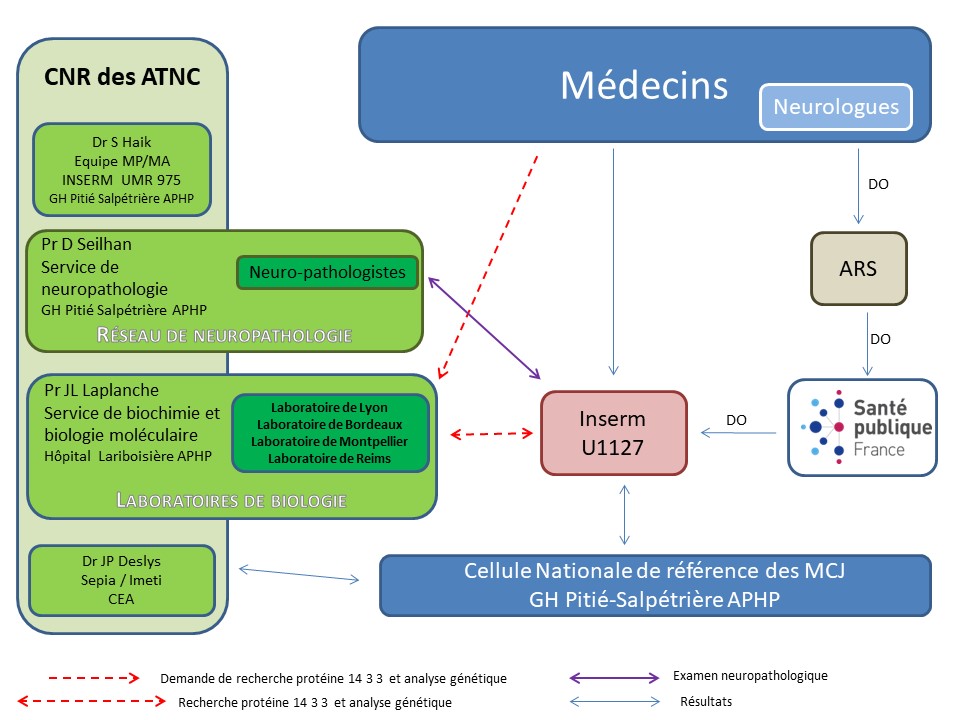
The National Surveillance Network for Creutzfeldt-Jakob Disease and Related Diseases.
Since suspected cases of CJD and other human subacute spongiform encephalopathies (SSE) were added to the list of notifiable diseases on September 19, 1996, a close collaboration has developed between Santé publique France and Inserm U1127.
In early 2000, Santé publique France, together with the various partners involved, initiated a strengthening of this surveillance through the creation of the National Surveillance Network for Creutzfeldt-Jakob Disease and Related Diseases.
This network comprises various stakeholders:
Neurologists,
Inserm Unit 975,
the National Reference Center (CNR) for Unconventional Transmissible Agents (ATNC), comprising three laboratories: the Department of Pathological Anatomy and Neurology at the Pitié-Salpêtrière Hospital, Assistance Publique-Hôpitaux de Paris, which coordinates the Neuropathology Network for CJD, consisting of 22 regional neuropathology centers; the Department of Biochemistry and Molecular Biology at Lariboisière Hospital (Assistance Publique-Hôpitaux de Paris), which coordinates a network of laboratories; and the Inserm Avenir team – Prion Diseases in Humans, IFR of Neurosciences, Pitié-Salpêtrière Hospital Group,
The Regional Health Agencies,
Santé publique France.
Coordinated by Santé publique France, this network is formalized by a three-year agreement between Santé publique France and Inserm. Its objectives are to:
Detect all cases of human transmissible subacute spongiform encephalopathy (TSSE), and more specifically cases of vCJD,
Classify them by etiology,
Estimate their incidence,
Describe their temporal and spatial distribution and trends,
Detect clusters of cases.
Diagram showing the relationships among the various partners in the National Surveillance Network for prion diseases and related disorders
In relation to

thematic dossier
Neurodegenerative diseases
Les maladies neurodégénératives sont des maladies chroniques progressives qui touchent le système nerveux central. Santé publique France en assure la surveillance épidémiologique.












