



The disease
Creutzfeldt-Jakob Disease in France
Creutzfeldt-Jakob disease (CJD) is a neurodegenerative disease caused by the accumulation of an abnormal prion protein in the brain. It occurs in three epidemiological forms:
The most common form is known as sporadic. It affects individuals of both sexes aged 60 and older,
The familial or genetic form, with cases most often appearing between the ages of 45 and 60 and all associated with a mutation in the gene encoding the prion protein PrP (Protease-resistant Protein) (PRNP gene)
Iatrogenic forms. These include cases linked to dura mater transplants (extremely rare), cases linked to the injection of human growth hormone prior to 1982, and more recent cases of variant Creutzfeldt-Jakob disease, linked to the consumption of animal products derived from cattle fed with animal-derived meal.
Creutzfeldt-Jakob disease is invariably fatal, regardless of the form of the disease.
Variant Creutzfeldt-Jakob disease (vCJD) was first described in 1996 in Great Britain following the identification of 10 atypical cases of CJD in individuals under the age of 40. Nine of them were under the age of 30. Apart from age, the symptoms of the disease were also distinctive, featuring a psychiatric onset, an abnormally long disease course (14 months on average, compared to 6 weeks to 6 months in the usual forms of Creutzfeldt-Jakob disease), and neuropathology specific to this form, particularly highly consistent histopathological lesions. In these patients, the distribution of amyloid plaques surrounded by vacuoles (florid plaques) was very similar from one patient to another.
Creutzfeldt-Jakob disease is one of the human transmissible prion diseases or subacute spongiform encephalopathies (SSE), along with Gerstmann-Sträussler-Scheinker syndrome and fatal familial insomnia. These conditions are suspected or diagnosed based on the presence of at least one neurological clinical sign associated with dementia and after ruling out all other neurological causes. They must be reported and notified as soon as clinical suspicion arises. Confirmation of the diagnosis is postmortem.
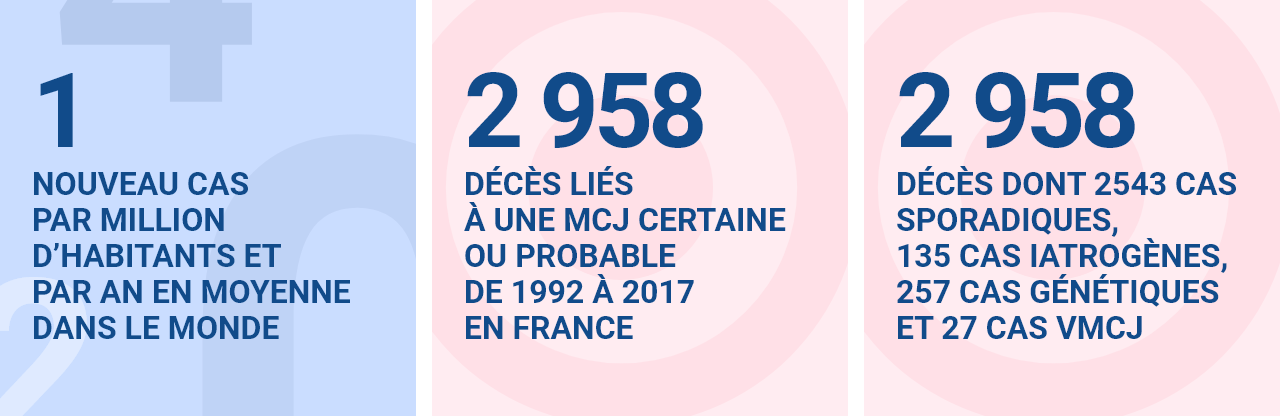
Key Statistics on Creutzfeldt-Jakob Disease
Transmission
The sporadic form of CJD is considered non-transmissible. In the iatrogenic forms, the transmission of Creutzfeldt-Jakob disease in humans is linked to medical procedures: administration of extracted growth hormone, dura mater transplantation, and, very recently, possible transmission of the variant form of CJD (vCJD) through blood in the United Kingdom.
Transmission to humans of the new variant of Creutzfeldt-Jakob disease (vCJD) is linked to diet via a bovine prion when consuming food derived from animals fed animal-derived meal. This mode of transmission was first suspected in 1996, during the so-called "mad cow" crisis, in reference to the symptoms exhibited by cattle affected by transmissible subacute spongiform encephalopathy (TSSE).
Diagnosis
The diagnosis of CJD is initially based on clinical suspicion (see case definition). Several laboratory tests contribute to the diagnosis, but confirmation occurs only after the patient’s death, during the autopsy.
Other factors help establish a probable diagnosis of CJD: symptoms and clinical course, an electroencephalogram (EEG) that identifies specific disturbances in brain activity, and an MRI that reveals highly suggestive abnormalities in certain regions of the brain.
Developed in 1997, the Western blot (WB) test for detecting the 14-3-3 protein in cerebrospinal fluid (CSF) is used when Creutzfeldt-Jakob disease (CJD) is suspected. A positive result on this test strengthens the suspicion but does not, on its own, confirm the diagnosis.
A definitive diagnosis of Creutzfeldt-Jakob disease, which confirms the condition, requires examination of brain tissue samples via immunohistochemistry and can only be performed after the patient’s death.
As for familial forms, they can be distinguished from other forms by genotyping the gene encoding the prion protein.
Progression
Prion infections, such as Creutzfeldt-Jakob disease, cause degenerative diseases of the central nervous system (encephalopathies) that are invariably fatal.
There is currently no treatment available for Creutzfeldt-Jakob disease that can slow its progression.
Links
In relation to

thematic dossier
Neurodegenerative diseases
Les maladies neurodégénératives sont des maladies chroniques progressives qui touchent le système nerveux central. Santé publique France en assure la surveillance épidémiologique.












