



Polio viruses detected in wastewater in Europe: Santé publique France remains on alert
Following the detection of poliovirus derived from a vaccine strain in wastewater from densely populated metropolitan areas in several European countries where poliovirus is no longer circulating, Santé publique France remains vigilant in light of this unusual situation.

Polio
thematic dossier
Although polio has been eliminated in the WHO European Region since 2002, high vaccination coverage must be maintained to achieve the eradication of the disease.
Type 2 polioviruses (VDPV2) have been detected in wastewater from densely populated urban areas, including Poland, Spain, Germany, Finland, and the United Kingdom. Although poliovirus is no longer actively circulating in these countries and no cases of polio have been reported, these detections represent an unusual and concerning situation. Santé publique France is monitoring the situation closely, as these events indicate a risk of reintroduction and continued circulation of the virus within Europe until the global eradication goal is achieved.
What is currently known about the circulation of polioviruses in Europe?
In recent months, polioviruses derived from type 2 vaccine-derived poliovirus (VDPV2) strains have been detected in wastewater samples collected in various cities across Europe in five different countries: Barcelona (Spain), Warsaw and Rzeszów (Poland), Tampere (Finland), as well as several cities in Germany and the United Kingdom.
These polioviruses are genetically linked to a strain that emerged in Nigeria several years ago and circulated primarily in North and West African countries until 2024. While isolated detections may be observed during wastewater surveillance programs, their current frequency and extent suggest a potential risk of transmission within communities with low vaccination coverage. To date, no local circulation has been confirmed, and no cases of paralysis have been observed. According to international and European authorities, the most likely explanation for these detections is repeated introductions of polioviruses from regions where this cVDPV2 is currently circulating.
The World Health Organization (WHO) and the European Centre for Disease Prevention and Control (ECDC) consider that, in geographic areas with high vaccination coverage, the risk of contracting polio is very low among vaccinated individuals and low among unvaccinated or incompletely vaccinated individuals. However, the risk becomes moderate among unvaccinated or incompletely vaccinated populations in geographic areas where vaccination coverage rates are less than optimal.
According to ECDC estimates, approximately 600,000 children aged 12 to 23 months are expected to be inadequately protected (< 3 doses of DTP vaccine) in 2022–2023 in Europe.
Thus, a risk of transmission exists among unvaccinated or incompletely vaccinated populations. European health authorities are therefore calling for heightened vigilance in clinical and environmental surveillance of polioviruses and reiterate the importance of achieving high vaccination coverage rates (3-dose coverage > 90%) across the entire European territory, including at the subnational level. Authorities advocate for the implementation of programs aimed at verifying and promoting the updating of polio vaccinations, prioritizing children and unvaccinated or incompletely vaccinated populations such as migrant populations.
Learn more: Rapid Risk Assessment – Assessing the risk to public health of multiple detections of poliovirus in wastewater in the EU/EEA (January 30, 2025)
The Global Context: A Challenge for Polio Eradication
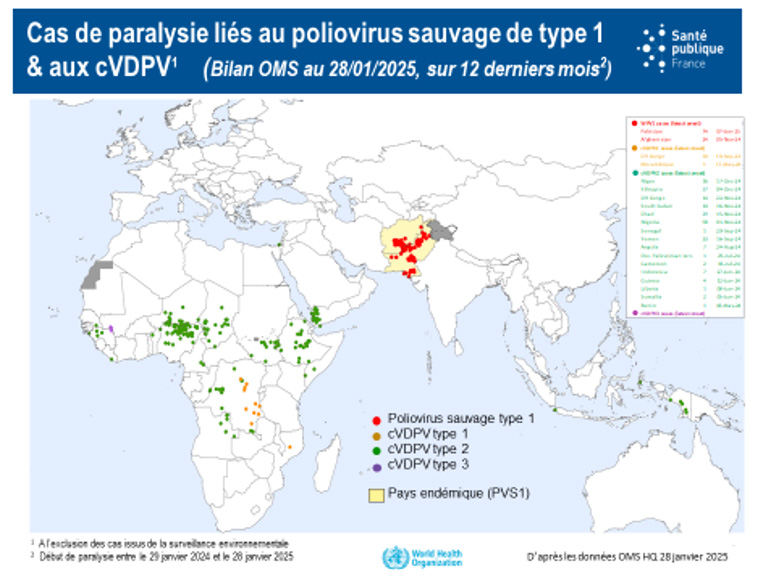
Although Europe has been officially polio-free since 2002, the risk of poliovirus introduction remains as long as global eradication has not been achieved. Outbreaks of wild poliovirus persist in some regions of the world, such as Pakistan and Afghanistan. Furthermore, type 2 VDPVs are circulating epidemically in many countries worldwide (Yemen, Chad, Nigeria, DRC, Ethiopia).
In recent years, cases of paralysis caused by vaccine-derived polioviruses (cVDPV type 2 or 3) were detected in Ukraine in 2021–2022, in Israel in 2022, and in Gaza in 2024, underscoring the need to maintain enhanced surveillance and launch vaccination campaigns in response to these alerts. A case of paralytic polio caused by VDPV2 was reported in July 2022 in New York, and genetically similar VDPV2 was detected in wastewater in London, New York County, and Jerusalem that same year, demonstrating the still-real risk of this virus circulating and the possibility of polio cases occurring, even in countries that have been polio-free for many years.
Cases of paralysis associated with wild poliovirus type 1 and cVDPVs (WHO report as of January 28, 2025, covering the past 12 months)
Low risk of poliovirus in France, but vigilance must be maintained
In France, surveillance for poliovirus in wastewater ceased in 2018 due to the rarity of virus detections and an already very high three-dose vaccination coverage rate, which now stands at 96% among 24-month-old infants born in 2020. The ANRS-MIE research program launched in 2023–2024 aims to pave the way for the resumption of routine poliovirus surveillance in France. This ongoing work led to the detection of type 3 VDPV in French Guiana in 2024.
Health authorities in France remain vigilant regarding the risk of introduction and spread of vaccine-derived polioviruses linked to individuals arriving from countries where the oral polio vaccine is still in use. This risk exists within the country, as recently demonstrated by the detection of type 3 VDPV circulating in French Guiana, particularly in areas or among certain population groups with limited use of the healthcare system and access to vaccination (migrants, socially disadvantaged populations, immigrant populations, etc.), where vaccination coverage is lower. Thus, the priority remains maintaining a high (>90%) and consistent vaccination rate by reducing social and regional health inequalities in order to prevent any risk of a resurgence of the disease. Indeed, there is no treatment for polio. The main measures rely on hygiene and vaccination.
Although the risk of transmission in France remains low, it is essential to remain vigilant and prevent the emergence of transmission clusters in the event of the virus being reintroduced into the country by administering catch-up vaccinations to population groups that are unvaccinated or inadequately vaccinated. The HAS recommends that migrant children arriving in France receive a booster dose of a trivalent inactivated polio vaccine, even if they have been properly vaccinated with the oral vaccine and have not previously received a dose of inactivated polio vaccine.
Learn more
What to do in case of suspected polio or incidental detection of poliovirus
Poliovirus infection: identifying and managing a suspected case in France—information for healthcare providers | Coreb (08/24/2022)
Action plan established in 1998 (revised in 2000) by the National Commission for the Certification of Polio Elimination (BEH 2000;46-47) and again in 2019 (HCSP opinion of October 18, 2019)
Procedures to follow in the event of any clinical suspicion or detection of the virus in the environment (HCSP opinion of October 18, 2019)
Vaccination strategy in the event of a polio case or detection of poliovirus in the environment (HAS opinion of November 2019)
Vaccination in France. Overview of vaccination coverage in 2023.
Latest updated data | Polio dossier
Vaccination Information Service
What are vaccines for? How do they work? At what age should children be vaccinated? Vaccination-info-service.fr answers the most frequently asked questions about vaccination. A separate...












