


Measles in France: Surveillance Data as of June 27, 2018
Measles is currently affecting several regions in France, and the rapid increase in the number of cases since the beginning of the year raises concerns about a new major outbreak across the country. In light of this, Santé publique France has issued an update and reminds the public that vaccination is the only way to protect against measles.
After declining between 2012 and 2016, the number of measles cases has been rising sharply since November 2017. This situation is the result of insufficient vaccination coverage among infants (79% with two doses of the vaccine instead of the required 95%), children, and young adults. The sharp increase in the number of cases since November 2017 in Nouvelle-Aquitaine has continued into 2018, with several outbreaks occurring in this region as well as in other French regions.
Epidemiological situation in France as of June 27, 2018
Decline in the number of new weekly cases: rapid since the epidemic peak (W13 to W18), followed by stabilization with an average of 50 reported cases per week (W19 to W23)
As of June 24, 2018, 2,567 cases reported since November 6, 2017
84 departments have reported at least 1 case; this number has remained stable since the last bulletin
Since Week 13, a decrease in the number of cases in Nouvelle-Aquitaine, with no active outbreaks
Highest incidence among children under 1 year of age: 27.2 cases per 100,000 inhabitants
22% of reported cases were hospitalized
88% of measles cases occurred in unvaccinated or inadequately vaccinated individuals
Death of a 26-year-old and a 17-year-old in critical condition: both immunocompromised and likely infected by an unvaccinated family member
Cumulative incidence and number of reported measles cases, by department, from November 6, 2017, to June 24, 2018 (provisional data, n=2,567)
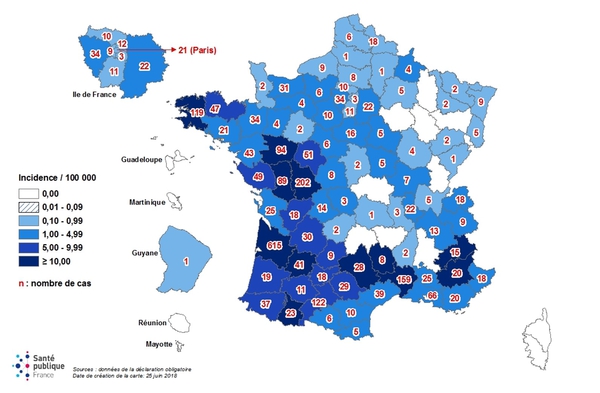
Learn more: Measles Epidemiological Bulletin. Surveillance data as of June 27, 2018.
A person with measles can infect 15 to 20 people
Measles is a highly contagious and potentially serious viral infection for which there is no curative treatment. It is a disease that affects not only young children but also adolescents and young adults. Measles is caused by a respiratory virus that spreads through the projection of saliva or respiratory droplets, particularly when coughing or sneezing. Measles cases are contagious starting about four days before the rash appears and remain so for up to about four days after the rash begins.
Vaccination is the only way to protect against measles
Santé publique France emphasizes the need for very high vaccination coverage in the population (at least 95% with two doses of vaccine among children and young adults). Such herd immunity would help eliminate the disease and its complications, thereby also protecting the most vulnerable individuals who cannot be vaccinated themselves (infants under one year of age, pregnant women, and immunocompromised individuals). It is therefore imperative that all individuals born in or after 1980 have received two doses of the vaccine.
As of January 1, 2018, measles vaccination is mandatory for infants, who must receive one dose of the combined Measles-Mumps-Rubella (MMR) vaccine at 12 months of age and a second dose between 16 and 18 months.
The more people who are vaccinated, the lower the risk of an epidemic.
Vaccination effectiveness for community protection
Learn more:
Vaccination-info-service (page dedicated to measles): http://www.vaccination-info-service.fr/Les-maladies-et-leurs-vaccins/Rougeole
Measles: Understanding to Take Action
Measles outbreak in France. Updated surveillance data/Thematic files/Infectious diseases/Vaccine-preventable diseases/Measles/News updates












