Visuel illustrant des bassins industriels

Industrial basins and public health: Launch of the first national study

Santé publique France is establishing a national surveillance system to study and monitor the health of communities living near industrial areas, in relation to the activities and emissions from these sites.

Residents living near industrial areas are exposed to various environmental hazards, including chemical substances, noise, odors, and visual pollution. Studying and monitoring the health impacts of these hazards is a major public health priority, with the aim of implementing and, where necessary, adapting management and prevention measures to protect the health of residents in such areas. However, the impacts of these industrial zones on the health of nearby residents remain largely unknown today.

Santé publique France has therefore proposed conducting a study to better understand the health impacts of industrial clusters. This study is national in scope and is based primarily on identifying and grouping industrial clusters according to common characteristics. Subsequently, data on the characteristics of the clusters will be cross-referenced with health data on residents living near these clusters, as recorded in medical-administrative databases. This approach provides data representative of the French territory and population.

The report published today aims to describe the industrial clusters identified in France. It presents the method used to identify these clusters, along with the main characteristics of each cluster (types of industries, activities, and discharges from ICPEs—Classified Facilities for Environmental Protection) and the databases used.

Santé publique France, as part of its mandate to monitor public health, has been called upon on several occasions at the local level. However, by focusing on only a single industrial site (or zone) at a time, these studies suffer from a lack of statistical power; that is, the populations living near such zones are not large enough to yield robust epidemiological results or to study the impact of a population’s exposure to an industrial site or zone.

To address this challenge, Santé publique France will, for the first time, propose the implementation, on a national scale, of a multicenter ecological study focusing on industrial basins. To achieve greater statistical power, this national multicenter study aims to examine several industrial basins spread across the country but sharing common characteristics in terms of discharged substances or polluting activities.

At the same time, several health indicators for populations living near these basins will be defined and identified in existing health databases (medical-administrative databases such as healthcare reimbursements and hospital stays).

By cross-referencing the collected environmental data with available health data at the same geographic scale, Santé publique France aims to study, for the first time in France, the national health impact of industrial basins and subsequently implement a multicenter health surveillance system by repeating this national study.

The implementation of this national multicenter ecological study requires preliminary steps, including a description of the available environmental data.


This report describes the industrial areas identified by Santé publique France using available economic, industrial, and environmental data (reported economic activities, regulatory information available for facilities classified for environmental protection (ICPE), and discharge data reported in the IREP Pollutant Emissions Registry).

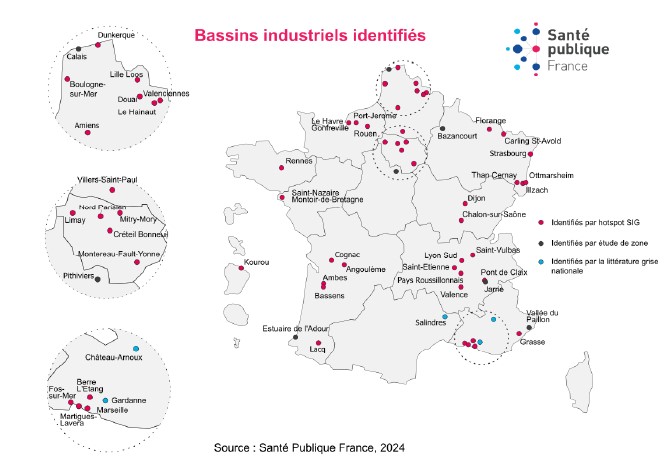
This study identified 52 industrial clusters in France, including overseas territories, which constitute areas of high industrial density with a variety of activities and discharged substances. They accounted for 8% of ICPEs authorized or registered in France in 2016 and are therefore not representative of all industrial activity in France, which remains dispersed.

The majority of the 52 identified industrial basins are located in urban or suburban areas, while a few are situated in more rural areas. Basins surrounding very large metropolitan areas feature a large number of ICPEs within intermingled mixed-use areas (industrial and residential). Ultimately, manufacturing accounts for just over one-third of industrial activity in these basins, through activities related to chemicals, metallurgy, and agri-food. Waste collection and sorting activities are also present in all of the major basins identified.

While there is a wide variety of activities within each basin, in some cases, a single activity may predominate. This work is essential for properly defining the data currently available to characterize the environment of industrial basins.

The next step involves defining a typology of water bodies, that is, identifying criteria for homogeneity related to the environmental characteristics of the water bodies (such as activities, discharges, etc.) that will allow us to group, as far as possible, water bodies with common characteristics. The objective will then be to identify specific health indicators to be studied in relation to exposure to these groups of basins.

A study protocol is scheduled for publication in late 2025. The multicenter ecological epidemiological study will begin in 2026. Upon completion of the study, it will be possible to determine the relevance of continuing surveillance and to define the implementation procedures more precisely.

In addition to this nationwide study, other studies may be conducted locally by Santé publique France at the request of local authorities in the industrial areas of Lacq, Florange, or Thann (as part of the Esspol study), with different objectives and methodologies. In fact, these studies directly survey the population to collect individual health data on symptoms or conditions that are not necessarily recorded in medical-administrative databases.

In addition to conducting this multicenter study, Santé publique France was selected as a recipient of the first joint call for proposals from Green Data For Health (GD4H) and the Health Data Hub (HDH) on the integration of environmental and health data. As part of this initiative, a study titled Industrial Zones and Health (BIS) will be conducted in partnership with the National Institute for Industrial Environment and Risks (Ineris), focusing on major industrial zones characterized by a high density of ICPE facilities subject to the IED (European Industrial Emissions Directive) or Seveso regulations. Several health indicators will be studied: childhood asthma, all-cause mortality, incidence of obstructive airway diseases (adults), as well as two perinatal indicators (preterm birth and low birth weight for gestational age).

The first results will be available starting in the second quarter of 2025. The BIS study will also provide insights and help refine the methodology to be applied for further work across all French industrial regions.

Map of Industrial Clusters in France in 2024

Learn more

rapport/synthèse

3 December 2024

Epidemiological surveillance around major industrial areas: description of industrial areas and available data for characterizing population exposure