presse

Participatory Study on the Health of Residents Living Near the Lacq Industrial Area
In late 2023, Santé publique France conducted an epidemiological study on the health and quality of life of residents living near the Lacq industrial area, building on the work already underway in that area since 2016.
Join our citizen workshops
The next citizen workshops will take place on May 19 and 26, 2026, in Mourenx!
If you’re interested, please contact Planète Citoyenne at: contact@planetecitoyenne.eu
Study Background
The Lacq industrial complex is located northwest of Pau, in the Pyrénées-Atlantiques department. It is a major industrial complex that has been home to numerous specialized companies for 60 years, particularly in the fields of natural gas extraction, thio-chemistry, fine chemicals, and green chemistry.
In October 2015, the Directorate General for Health referred the matter to Santé publique France to assess:
- the health impacts on the populations living near the industrial basin;
- the appropriateness and feasibility of establishing epidemiological surveillance.
In response to this request, Santé publique France developed a multi-step approach and has been conducting epidemiological studies in this area since 2016:
- a local study of expectations and context (published in 2019);
- a mortality study (published in 2021);
- a morbidity study on disease prevalence (first phase on feasibility published in late 2021; second phase on the actual implementation of the study published in April 2026);
- the participatory health study focusing on the Lacq industrial basin.
Download
24 February 2026
Questions & Answers - Participatory Study on the Health of Residents Living Near the Lacq Industrial Area
Presentation of the participatory health study
This is a cross-sectional epidemiological study, conducted via individual questionnaires, among the general population. It complements previous studies conducted since 2016.
The pilot phase took place in March 2023. The population survey was conducted between October 2023 and January 2024.
What is the study about?
The study will examine the health of the population in the study area (general health status, health conditions and symptoms, health-related changes in quality of life, etc.), perceptions of the local environment, and any perceived nuisances (odors, smoke, views of industrial facilities, noise).
What does the study involve?
A representative sample of residents has been invited to complete an individual questionnaire on their health and quality of life*.
The study, led by Santé publique France, incorporates a participatory approach through the involvement of:
local residents and community organizations, invited to participate in collaborative citizen workshops, organized starting in November 2021 for preparation and throughout the study,
local stakeholders (non-profit organizations, healthcare professionals), invited to join the study’s expanded project team.
*Please note that this study does not involve biological or blood samples.
Why a new study?
The need for a study on the health and quality of life of residents in the industrial area was confirmed by the local context study, which surveyed healthcare professionals, elected officials, and local residents
The participatory health study made it possible to directly survey those affected by the subject under study. The aim is to collect individual health data on symptoms or conditions that do not necessarily require medical follow-up or treatment (and are therefore not recorded in health information systems) but which are nonetheless likely to affect quality of life and well-being from the perspective of the individuals themselves.
The comprehensive epidemiological studies conducted by Santé publique France in the Lacq basin will provide a complete snapshot of the health status of the basin’s populations and determine the need for epidemiological surveillance of these populations.
Objectives
describe the health status of residents living near the Lacq industrial area;
describe their perception of the local environment;
analyze the links between the two.
This study is part of a comprehensive initiative aimed at improving the health and quality of life of residents in the Lacq basin.
Download

enquêtes/études
27 May 2026
A participatory epidemiological study of the health of residents living near the Lacq industrial basin: protocol
Download

questionnaire
27 May 2026
Participatory epidemiological study of the health of residents living near the Lacq industrial area: questionnaire
Who is affected?
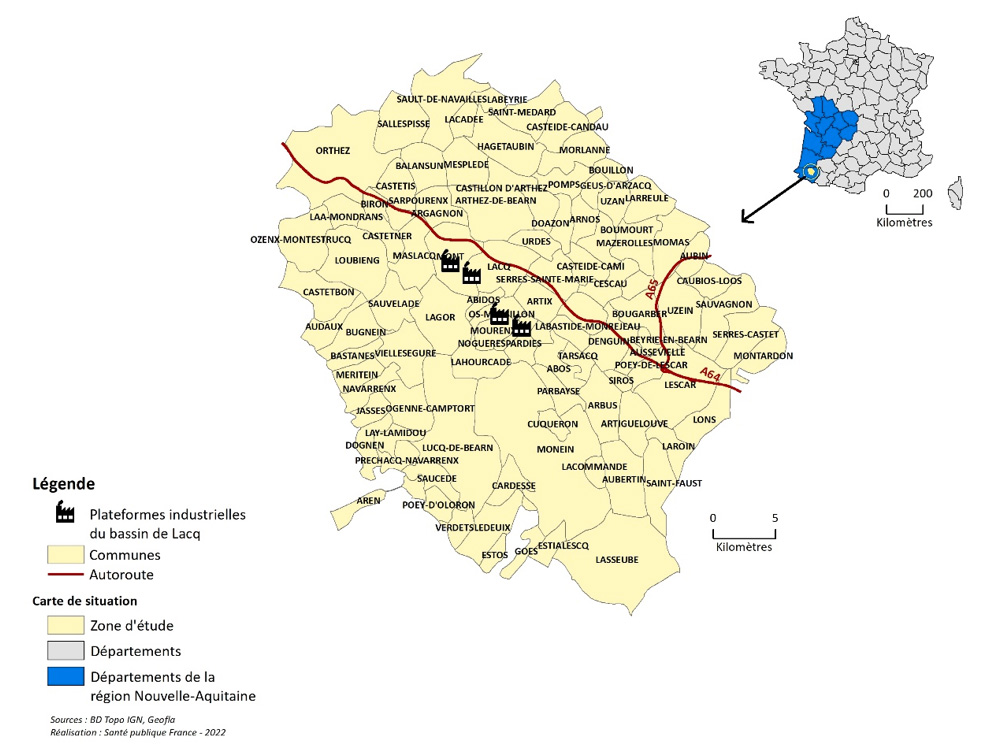
Residents of 99 municipalities in the Pyrénées-Atlantiques region located around the four industrial platforms in the Lacq industrial basin, representing more than 100,000 residents.
The study area, which is the same for the three epidemiological studies conducted around the industrial basin, is divided into three concentric zones: A, B, and C. These zones correspond, from the center of the study area (A) to its periphery (C), to decreasing levels of exposure to industrial pollution from the Lacq basin. The study area includes municipalities located at a distance and therefore, in principle, less exposed to the various emissions from industrial facilities.
Map of the Lacq Basin Study Area
How is the study conducted?
Data collection
The participatory health study consisted of two field phases:
the pilot phase: March 2023 (4 weeks);
the population survey: October 2023 – January 2024 (at least 10 weeks).
The individuals invited to participate in the survey were selected at random and confidentially by the general and agricultural health insurance funds from their beneficiary databases.
They received a letter explaining the objectives and context of the study.
Data collection was conducted by Ipsos, a company specializing in population surveys, in accordance with the study protocol of Santé publique France.
Each randomly selected person was invited to complete a questionnaire consisting of about 100 questions, either online or with an interviewer by phone or in person at home.
The goal is to collect responses from 2,000 people.
Public announcement of the survey in October 2023 | Downloadable documents: brochure (PDF, 306 KB), poster (PDF, 387 KB)
Data analysis
Data collection is followed by data processing and analysis, and then interpretation of the results.
How will the results be utilized?
The final results of the study will be available in the second half of 2026 and published on the Santé publique France website. These results will be invaluable for assessing the health status of the population living near the Lacq industrial basin and for helping to implement any necessary prevention and management measures.
Participatory Approach: Citizen Workshops
Santé publique France sought to collaborate with residents living near industrial facilities in the Lacq basin and local organizations through citizen workshops to ensure that the study best addresses their concerns and incorporates their knowledge of the environment and health.
The involvement of citizens, alongside scientists, in the design and implementation of the participatory health study makes it possible to:
enrich the study with residents’ knowledge and expertise;
collectively develop the survey questionnaire (identify topics of interest, jointly draft the questions, etc.);
encourage local residents’ support for and participation in the study.
Citizen workshops support the entire study process:
during the design and preparation of the study: developing the survey questionnaire, discussing key elements of the protocol and how the study will be conducted, publicizing the study and creating communication materials, etc.;
after the pilot phase: discussions on the results and adjustments to the questionnaire, work on communication for the study’s rollout;
after the survey’s rollout to the public: presentation and discussions regarding the data collection assessment and the survey results, discussions on communicating these results to the general public and public health recommendations.
Some collaborative workshops included separate sessions for the general public and for individuals engaged in environmental health issues around the Lacq basin.
Who can participate in the workshops?
The workshops are open to any adult volunteer living in one of the 99 municipalities included in the study area (see map above). Anyone interested can participate in one or more citizen workshops at any time.
What are the objectives of the upcoming workshops?
The next two workshops, scheduled for spring 2026 (May 19 and 26), will be dedicated to sharing and interpreting the initial findings of the study.
Residents wishing to participate in the workshops can register with Planète Citoyenne. Participation in both workshops is preferred; however, if you are unable to attend both, you may attend just one of the two workshops.
Regulatory Framework and Data Rights
The study received a favorable opinion from the Ethics and Scientific Committee for Research, Studies, and Evaluations in the Health Sector (CESREES) (decision dated 12/15/22) and was authorized by the National Commission on Informatics and Civil Liberties (CNIL) (Decision DR-2023-046 of May 11, 2023).
Specific measures have been taken to ensure the confidentiality and IT security of the data collected as part of this study. The collected data will remain strictly confidential.
Participation in this health study is voluntary, and each respondent has rights regarding the data collected. Everyone may exercise their rights to access, rectify, erase, restrict, and object to the processing of their data.
The procedures for exercising these rights are outlined in the informational letter sent to each randomly selected individual.
If the selected individuals believe that their data rights are not being respected, they may file a complaint with the National Commission on Informatics and Civil Liberties (CNIL):
either by mail: CNIL - Complaints Department - 3 Place de Fontenoy - TSA 80715 - 75334 PARIS CEDEX 07;
Partnerships and Funding
The study is entirely funded by public funds. It receives financial support from the Nouvelle-Aquitaine Regional Health Agency as part of the Regional Health and Environment Plan and also draws on Santé publique France’s own financial resources.
Santé publique France is supported by the Ipsos Observer Institute for data collection and by Planète Citoyenne, a provider specializing in citizen participation, to organize and facilitate the citizen workshops.
Contact
For more information about this study, please contact us at: etudesantelacq@santepubliquefrance.fr