




Data
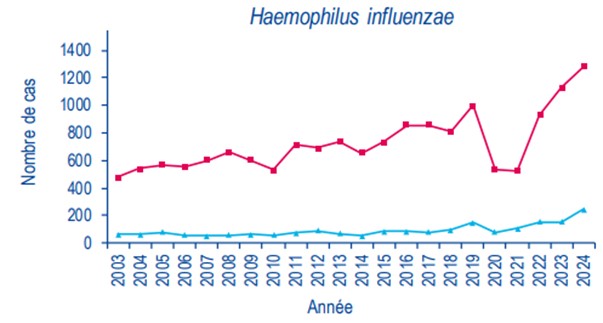
Since 2022, a resurgence of invasive Haemophilus influenzae infections has been observed in the EPIBAC network, as has been the case with other respiratory-transmitted bacterial infections.
Among children under 5 years of age, the number of cases of invasive Hib infections confirmed by the National Reference Center for Meningococcal and Haemophilus influenzae Diseases has increased since 2018. It rose from 14 cases in 2018 to 46 cases in 2021, then decreased in 2022 and 2023 before rising again in 2024 and 2025. According to NRC data, 62 cases of invasive Hib infection were identified in 2025.
available for download

bulletin national
26 March 2026
Invasive Haemophilus influenzae infections in France. 2025 Report.
A retrospective analysis of cases caused by serotype b that occurred between 2018 and 2024 showed that the majority of cases were up to date on their vaccinations, but that the estimated vaccine efficacy of the full vaccination series remained high, at over 90%.
Vaccine failures remain very rare compared to the number of children vaccinated, but these data raise questions about risk factors that may impact vaccine efficacy, the vaccine’s effectiveness in reducing carriage and transmission of the bacterium in the population, and finally, the duration of protection provided by the current vaccination schedule.
Trends in estimated cases of meningitis and bacteremia by bacterium, Epibac, mainland France, 2003–2024
See also
bulletin national
2 December 2024
Invasive bacterial infections in 2023. Summary of surveillance data from the Epibac network.
Vaccination Coverage Data
Vaccination coverage data are published annually during European Immunization Week in the Vaccination Bulletin and posted online in ODISSE.
In relation to

Antibiotic resistance
thematic dossier
Antibiotic resistance renders one or more antibiotics ineffective against a bacterial infection. This phenomenon can make it difficult, or even impossible, to treat certain infections.

Vaccination
thematic dossier
Contagious diseases most often affect children at a very young age. Because children are particularly vulnerable, they are a priority target for vaccination programs.











