


Monitoring of Antibiotic and Antifungal Use in Residential Care Facilities for the Elderly with an In-House Pharmacy. Spares Project. 2024 Results
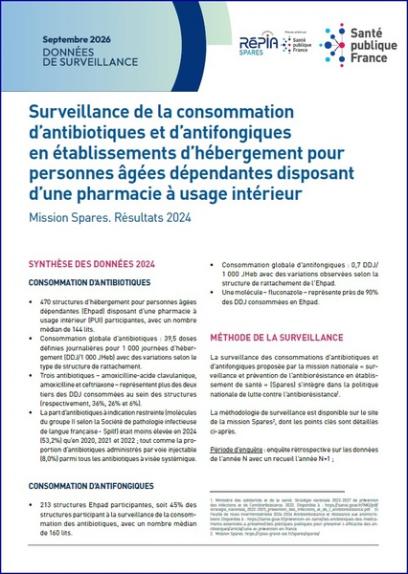
The monitoring of antibiotic and antifungal use, conducted by the national Spares initiative (surveillance and prevention of antibiotic resistance in healthcare facilities), is part of the national policy to combat antibiotic resistance. In 2024, 470 long-term care facilities (Ehpad) equipped with an in-house pharmacy (PUI) participated in this surveillance, with an estimated total antibiotic consumption of 39.5 defined daily doses per 1,000 days of care (DDJ/1,000 JHeb), with variations depending on the type of facility. Three antibiotics accounted for the vast majority of this consumption: amoxicillin-clavulanic acid (36%), amoxicillin alone (26%), and ceftriaxone (6%), which together accounted for more than two-thirds of the ADDs. The share of antibiotics with restricted indications (Group II according to Spilf) decreased in 2024, reaching 53.2%, as did that of antibiotics administered by injection (8.0% of systemic antibiotics). For antifungals, 213 long-term care facilities (representing 45% of facilities participating in antibiotic surveillance) were included, with an overall consumption of 0.7 DDJ per 1,000 resident-days, mainly attributable to fluconazole, which accounts for nearly 90% of the DDJ consumed.The surveillance methodology is based on a retrospective survey of data from year N, collected the following year (N+1). It covers long-term care facilities that are either integrated into healthcare institutions or stand-alone, and that have a pharmacy department. The monitored antibiotics include those in the WHO ATC class J01, as well as rifampin, oral imidazoles, and fidaxomicin, while the monitored antifungals are limited to those in the WHO ATC class J02 for systemic use, excluding topical treatments. The characteristics of the long-term care facilities, such as the number of beds or their affiliation type (university hospital, general hospital, specialized medical care facility, long-term care facility, psychiatric hospital, medical-care facility, or standalone long-term care facility), are also taken into account. The 2024 results show an increase in antibiotic use compared to 2022, consistent with trends observed in community settings and healthcare facilities. This increase is particularly notable for amoxicillin, either alone or in combination with clavulanic acid, while the use of fluoroquinolones continues to decline. The ratio of amoxicillin to amoxicillin-clavulanic acid, set at 0.72, reflects a growing preference for amoxicillin alone, in accordance with recommendations. Despite this increase, consumption in nursing homes remains lower than that in the long-term care sectors of healthcare facilities and comparable to that in nursing homes without an in-house pharmacy in 2023.The use of antifungals, studied for the first time in 2024, is very low (0.7 DDJ per 1,000 JHeb), primarily due to fluconazole, which is used in nearly all facilities to treat candidiasis. It also remains lower than that in long-term care sectors (1.6 DDJ per 1,000 hospital days in 2024).In light of these findings, it is essential to continue monitoring anti-infective agents and to promote their appropriate use to preserve their effectiveness and minimize adverse effects. Several courses of action are being considered, such as promoting the use of amoxicillin alone rather than amoxicillin-clavulanic acid when indicated, or maintaining prudent use of fluoroquinolones. Preventing infections—particularly urinary and respiratory infections—remains a priority, with measures such as vaccination against COVID-19, influenza, or pneumococcal disease for at-risk populations. Resources and support are available through the Infectious Risk Prevention Teams (EPRI), the Mobile Hygiene Teams (EMH), the Multidisciplinary Antibiotic Therapy Teams (EMA), the CPias and CRAtb, as well as on the RéPIA website (preventioninfection.fr).
Publishing year: 2026
Pages: 7 p
Collection: Monitoring Data
In relation to
Our latest news

news
Physical Activity and Combating a Sedentary Lifestyle: How Does Santé...
news
Etienne Pot Appointed Interim Director General of Santé publique France

news












