



What We Do
When a new strain of influenza virus that can infect humans emerges, a flu pandemic occurs. In France, surveillance measures are in place for avian influenza.
An influenza pandemic occurs when a new influenza virus emerges that is well-adapted to humans and capable of being efficiently transmitted from person to person. In previous influenza pandemics, the viruses responsible resulted from genetic exchange between influenza viruses of animal and human origin.
The public health implications of avian influenza are therefore significant and require surveillance of zoonotic influenza cases in order to:
detect cases of avian influenza—whether imported or indigenous—as early as possible,
ensure they are referred for appropriate medical care,
implement measures to limit the risk of person-to-person transmission of an avian influenza virus.
A specific surveillance system for "so-called passive" avian influenza cases has been in place in France since 2004, based on the reporting of any suspected case of avian influenza to health authorities by the treating physician. The starting point for this surveillance is a patient who has reported symptoms suggestive of avian influenza following a risk exposure.
Surveillance of avian influenza cases is supplemented by an enhanced, so-called "active" surveillance protocol (known as the SAGA protocol), conducted among individuals exposed to an outbreak of highly pathogenic avian influenza, even in the absence of symptoms. The starting point for this surveillance is high-risk exposure to infected animals in a farming setting (commercial farm, backyard poultry) or any other facility housing animals in captivity (wildlife care center, zoo, educational farm).
In addition, the National Reference Center for Respiratory Infection Viruses (CNR) and the National Reference Laboratory for Avian Influenza (ANSES, Ploufragran-Plouzané-Niort laboratory) conduct virological surveillance of avian influenza viruses and all type A influenza viruses for the H1 and H3 genes (human viruses) in subtypes detected in private or hospital laboratories, in collaboration with Santé publique France, to enable early detection of any emergence of a virus better adapted to humans.
Epidemiological surveillance of avian influenza
Santé publique France is responsible for epidemiological surveillance and for validating the classification of any suspected case of avian influenza as a probable case (requiring virological confirmation by the National Reference Center for Respiratory Virus Infections) detected in France, and contributes to investigations conducted regarding confirmed cases.
In this context, Santé publique France works in coordination with national and international health authorities and relies on the regional network formed by Santé publique France’s regional units, which interact directly with the Regional Health Agencies (ARS).
The objectives of surveillance and investigation of human cases of avian influenza are:
to identify early any cases occurring within the country or imported from abroad;
to refer affected patients to appropriate medical care;
to implement management measures for confirmed cases;
to reduce the risk of the emergence and spread of a virus with pandemic potential by isolating confirmed cases and investigating contacts and co-exposed individuals;
to describe and characterize human cases of infection with avian or swine influenza viruses and their exposures, particularly to inform health authorities as part of international influenza virus surveillance.
Passive surveillance of zoonotic influenza: identification and follow-up of probable and confirmed cases of avian influenza
Any person presenting with symptoms of acute respiratory infection (sudden onset of fever or fever-like sensation and respiratory signs) or ocular symptoms (particularly conjunctivitis) and who has had a risk exposure within 10 days prior to symptom onset meets the definition of a possible case of avian influenza.
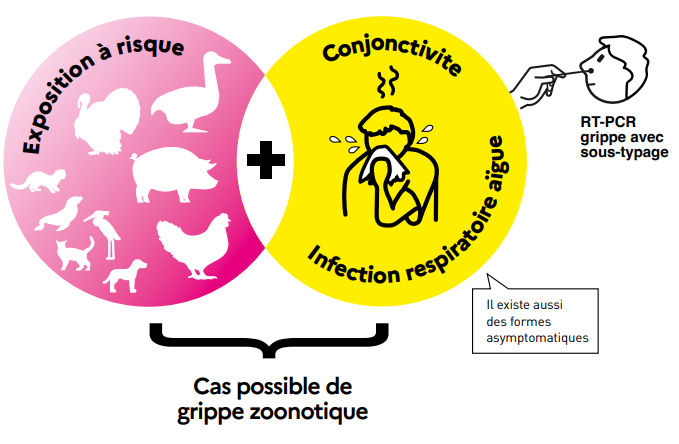
The patient must then consult a physician so that an RT-PCR test can be ordered to identify the influenza virus and seasonal influenza virus subtypes. If the test is positive for an influenza A virus and negative or inconclusive for the seasonal subtypes H1N1 and H3N2, the patient meets the definition of a probable case of avian influenza.
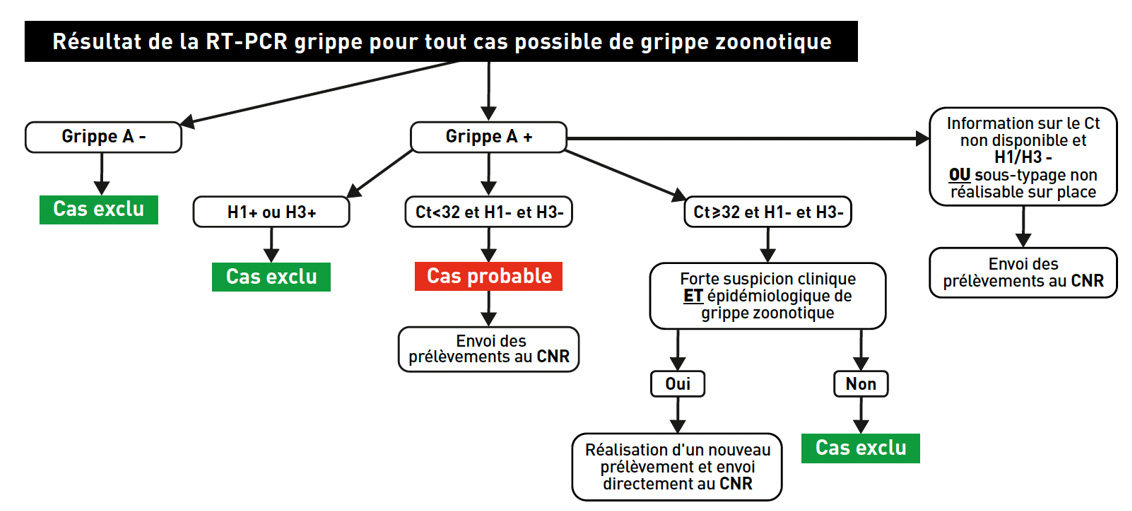
The physician must immediately report any patient meeting the definition of a probable case of avian influenza to the Regional Health Agency (ARS), which validates the patient’s classification as a probable case with Santé publique France. The opinion of a consulting infectious disease specialist and the CNR may be sought if necessary.
If the case is confirmed by the CNR, the patient is monitored until full recovery. The patient will be asked to remain in isolation for 10 days after the onset of symptoms, to limit contact with others as much as possible, to wear a surgical mask in the presence of others, and to follow other preventive measures (handwashing, ventilating the home, sneezing and coughing into the elbow, using disposable tissues, avoiding handshakes and kissing, etc.). Any contact with animals will also be strongly discouraged. Antiviral medications such as oseltamivir will be prescribed regardless of the severity of symptoms, and combined with treatment appropriate to the patient’s clinical condition.
In addition, the Regional Health Agency (ARS), in collaboration with Santé publique France, identifies and monitors individuals who have been exposed to the same source as the confirmed case, as well as the case’s close contacts, to prevent any risk of human-to-human transmission of the virus. Testing will be offered to them, even in the absence of symptoms, to ensure that these individuals have not been infected. They will also be prescribed prophylactic antiviral treatment, in accordance with the recommendations of the High Council for Public Health.
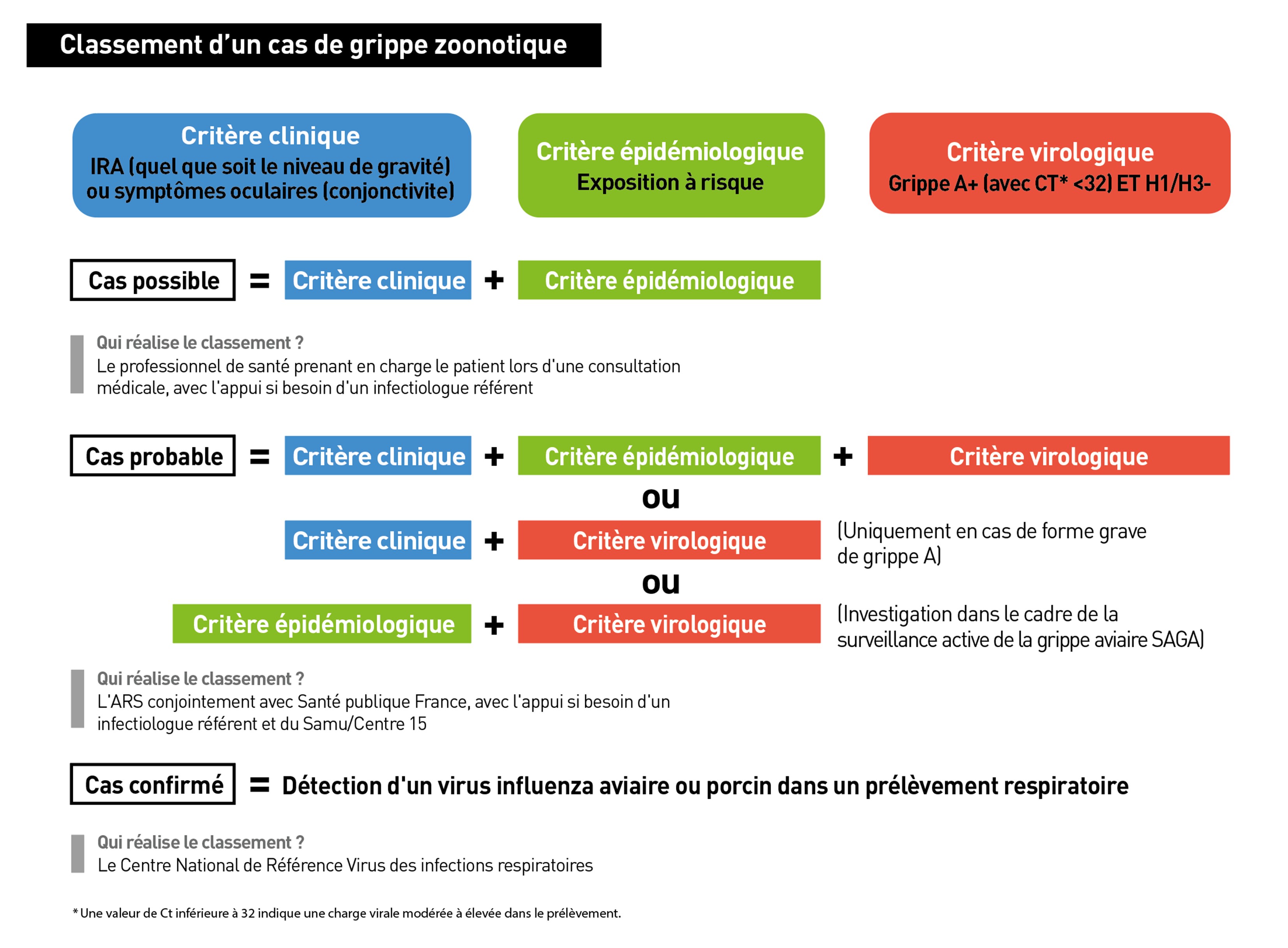
Classification of a case of zoonotic influenza

Guidelines for dealing with individuals exposed to the animal-origin influenza virus

Zoonotic Influenza Questionnaire - Part 1: Initial Report
Zoonotic Influenza Questionnaire - Part 2: Probable/Confirmed Case / Contact / Co-exposed Individual
Clinical Information Sheet on Zoonotic Influenza
Active Surveillance of Avian Influenza (SAGA Protocol) for Individuals Exposed to Animals Infected with Highly Pathogenic Avian Influenza Virus
Since October 2025, a protocol for active surveillance of avian influenza (SAGA) has been implemented across all French regions. This system was initially tested as a pilot program during the 2023–2024 and 2024–2025 winter seasons.
If an outbreak of highly pathogenic avian influenza is detected on a poultry farm, health authorities offer RT-PCR testing to individuals who were exposed to the farm within the 8 days prior to the outbreak’s confirmation, even if they show no symptoms at the time the outbreak is detected. This testing is conducted at a local medical testing laboratory, with no upfront costs for those being tested.
If a human infection is detected, management of the confirmed case is organized by the ARS, in coordination with Santé publique France, in accordance with the protocol for zoonotic influenza.

SAGA Protocol
SAGA Fact Sheet
SAGA Fact Sheet
SAGA Household Identification Questionnaire
SAGA questionnaire: Confirmation of case, contacts, and co-exposed individuals
Information Sharing
Santé publique France ensures that information gathered during investigations into any confirmed case of avian influenza is transmitted to the relevant national and international health authorities (WHO, ECDC), in accordance with the International Health Regulations (2005).
For healthcare professionals
Santé publique France has established guidelines for suspected cases of avian or swine influenza, taking into account the recommendations issued by the High Council for Public Health in its opinion of May 16, 2025, and the latest clinical, virological, and epidemiological information available on the international situation regarding influenza viruses with zoonotic potential.
A guide for your practice has been developed to raise awareness among healthcare professionals about zoonotic influenza and the procedures to follow in the event of clinical suspicion.
A quick-reference guide developed by the Coreb mission for healthcare professionals is available on the website of the French-Speaking Society of Infectious Diseases (Spilf).
Learn more
Opinion of the High Council for Public Health on the prevention of zoonotic influenza in humans (May 6, 2025)
Opinion of the High Council for Public Health on the prevention of human transmission of swine and avian influenza viruses (December 10, 2021)
CNR website on respiratory viruses (including influenza and SARS-CoV-2)
Website of the National Agency for Food, Environmental and Occupational Health & Safety
Page dedicated to avian influenza on the ESA platform website
Preventive measures and advice for travelers
In the event of exposure to risk, personal protective measures can help protect against potential infection.
Learn more: Avian Flu - The Disease
Just as with people exposed to the avian virus, vaccination against seasonal flu is recommended:
for all individuals targeted by the current vaccination schedule recommendations, particularly those participating in group travel or cruise ship travel;
for cruise ship and airline crew members, as well as tour guides accompanying groups of travelers and travel escorts.
To learn more about health recommendations for travelers
Ministry of Foreign Affairs/Travel Information:
Health Recommendations for Travelers 2025 (for healthcare professionals)
In relation to

Flu
thematic dossier
The flu is a contagious viral respiratory infection that causes seasonal outbreaks every winter. The flu vaccine is the most effective way to protect yourself.

Vaccination
thematic dossier
Contagious diseases most often affect children at a very young age. Because children are particularly vulnerable, they are a priority target for vaccination programs.












