



Data
Avian influenza is a viral zoonosis. Currently, more than a dozen avian or swine influenza A viruses can infect humans.
Currently, highly pathogenic avian influenza viruses with hemagglutinin H5 (H5Nx) are circulating widely around the world (including in France), particularly viruses of the A(H5N1) subtype from clade 2.3.4.4b. These viruses cause mass mortality in wild birds and affect various animal species: poultry, as well as more than 70 species of wild and domestic mammals (particularly dairy cattle in the United States and domestic cats).
In France
To date, no cases of human influenza caused by an avian influenza virus (so-called “avian influenza” cases) have been detected in France.
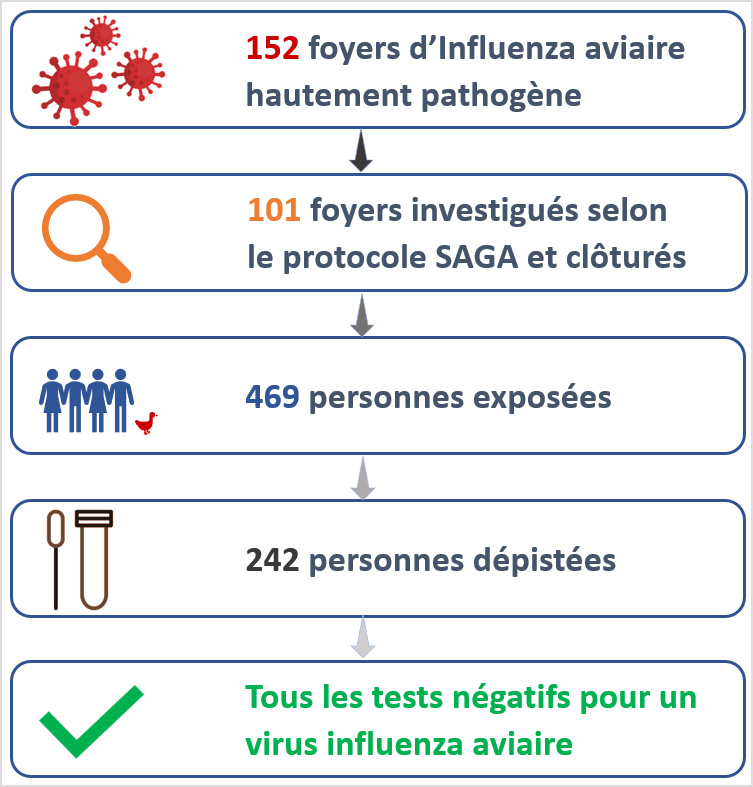
As of March 23, 2026, the results of the active surveillance protocol for avian influenza (SAGA), implemented nationwide during the 2025–2026 winter season, are as follows:
See also:
Around the World
In the United States, A(H5N1) viruses belonging to clade 2.3.4.4b have been introduced on at least three occasions since late 2023 into dairy cattle herds, where more than 1,000 confirmed outbreaks have been recorded since spring 2024. These are the first incursions of avian influenza viruses identified in this species. Domestic cats and other mammalian species have been found infected following exposure to infected dairy farms or the ingestion of contaminated raw milk.
More than 80 human cases caused by these A(H5N1) viruses of clade 2.3.4.4b have been identified worldwide since 2021, primarily in the United States, but also in Mexico, Canada, Chile, and Peru on the American continent; in England and Spain on the European continent; and finally in China and Vietnam on the Asian continent.
In addition, highly pathogenic avian influenza viruses of the A(H5N1) subtype belonging to other clades are also circulating in Asia and are responsible for a recent resurgence of human cases in Cambodia and Vietnam (clade 2.3.2.1e), as well as in India and Bangladesh (clade 2.3.2.1a).
Finally, four other subtypes of avian influenza viruses have caused human cases worldwide since 2022, primarily in China: H9N2, H5N6, H10N3, and H3N8.
The World Health Organization (WHO) and the ECDC (European Centre for Disease Prevention and Control) consider that the risk posed by avian influenza viruses with zoonotic potential currently circulating is low for the general population, and low to moderate for people directly exposed to these viruses. No human-to-human transmission has been documented from recent human infections.
Nevertheless, given the high capacity of influenza viruses to undergo genetic evolution and adapt to new hosts, the emergence of a virus capable of being efficiently transmitted from human to human cannot be ruled out. Such an evolution could, if it occurs, lead to an epidemic or even a pandemic linked to these viruses. The widespread circulation of A(H5N1) viruses globally, with a particularly dynamic situation in the United States since the fall of 2024, increases the risk of a virus better adapted to humans and calls for heightened vigilance.
In this context, international health organizations are calling for enhanced surveillance of zoonotic influenza cases at the animal-human interface.
In relation to

Flu
thematic dossier
The flu is a contagious viral respiratory infection that causes seasonal outbreaks every winter. The flu vaccine is the most effective way to protect yourself.

Vaccination
thematic dossier
Contagious diseases most often affect children at a very young age. Because children are particularly vulnerable, they are a priority target for vaccination programs.












