



The disease
Avian influenza is a viral zoonosis. Currently, more than a dozen types of avian or swine influenza A viruses can infect humans.
A viral zoonosis
Avian influenza is a viral infectious disease caused by an influenza-type virus that primarily affects birds. Certain strains of this virus can be transmitted from animals to humans and, in some cases, cause severe infections. The disease is generally transmitted through direct contact with infected birds or their droppings. Viruses can evolve and spread rapidly, especially if they mutate, potentially causing epidemics or even pandemics.
How do avian influenza viruses circulate in France and around the world?
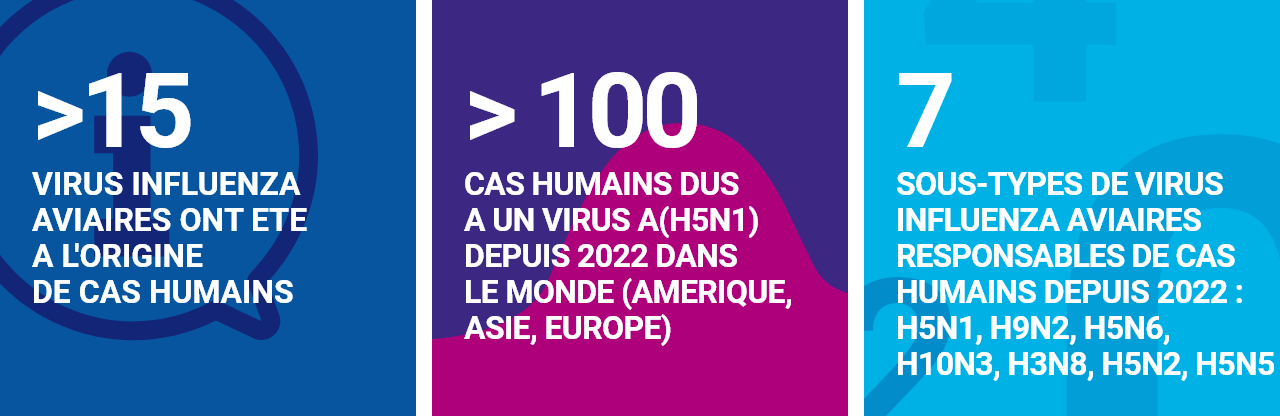
About fifteen avian influenza viruses have infected humans, including the H5N1 and H7N9 subtypes, which have caused more than 2,500 cases since 2003.
Although sporadic cases are regularly reported in North America, Asia, and to a lesser extent in Europe, no cases of avian influenza have been detected in France to date.
According to the WHO and the ECDC, the risk of human infection is low for the general population and low to moderate for people directly exposed to these viruses. No human-to-human transmission has been documented from recent human infections.
Nevertheless, the widespread circulation of A(H5N1) viruses globally, with a rapidly evolving situation in the Americas and Asia since the fall of 2024, increases the risk of a virus better adapted to humans and calls for heightened vigilance. Indeed, although human-to-human transmission has not been observed, the rapid evolution of the viruses could allow a new virus to spread among humans, thereby increasing the risk of an epidemic or a pandemic.
Key Statistics on Avian Influenza
A bird disease that can be transmitted to humans
In birds
Avian influenza viruses circulate naturally among wild waterfowl, which are usually not sick. However, infection can cause illness—and even death—in certain domestic bird species, such as chickens, turkeys, and ducks.
Avian influenza viruses are classified into two categories based on the virus’s specific characteristics and its ability to cause severe disease and kill chickens under experimental conditions:
Low-pathogenic avian influenza viruses, which cause no disease or only mild clinical signs in poultry (e.g., decreased egg production) and are detected by veterinary health authorities as part of surveillance plans monitoring duck vaccination.
Highly pathogenic avian influenza viruses, which cause severe disease in poultry, with high mortality.
Highly pathogenic avian influenza viruses are highly contagious among birds and can spread rapidly within poultry flocks. The A(H5N1) subtype of clade 2.3.4.4b, which caused an epizootic of unprecedented scale internationally, is responsible for fatal infections in a large number of different wild bird species, with unprecedented mass mortality events.
In humans
Human cases of infection with avian influenza virus are generally primary cases, resulting from exposure to infected birds or a contaminated environment, particularly in poultry farms or live poultry markets.
Avian influenza viruses are excreted in large quantities in the feces of infected birds as well as in their respiratory secretions. They are thus found in the environment (dust contaminated with feces, bodies of water, etc.). Transmission to humans occurs through inhalation of contaminated dust or aerosols, or through contact while handling infected birds (feathers, evisceration, etc.). Exposure on farms, in backyards, or at live poultry markets poses the primary risk of infection; exposure while swimming in contaminated water has also been documented as a risk factor.
The consumption of meat, foie gras, and eggs—and more generally of any poultry-based food product—poses no risk to humans. In the United States, given the specific strains of the highly pathogenic A(H5N1) virus circulating in dairy farms, U.S. health authorities have recommended avoiding the consumption of or contact with raw milk or raw milk-based dairy products. However, no human infections caused by this virus following the consumption of contaminated raw milk have been detected to date.
Exposure to the risk of zoonotic influenza is defined as follows:
| Direct contact with a living animal confirmed to be infected with an avian or swine influenza virus | Direct contact with an animal suspected of being infected with a highly pathogenic avian or swine influenza virus | Contact with an environment or equipment contaminated with an avian or swine influenza virus |
|---|---|---|
|
Animal confirmed to be infected with an AI/IP virus by the National Reference Laboratory for Avian/Swine Influenza or any other authorized laboratory: bird, pig, or any other domestic or wild animal species Human case confirmed by the National Reference Center for Respiratory Infections (see definition of a contact person) |
Bird-rearing context (professional or recreational) with sudden and abnormal mortality Pig farming context (commercial or recreational) with animals exhibiting flu-like symptoms Context of direct contact with wildlife: the wild bird or mammal handled was sick or found dead |
Staying for at least 15 minutes in an enclosed space where animals infected with avian or swine influenza virus were present Direct contact with materials or surfaces from a confirmed outbreak of avian or swine influenza (e.g., handling tools or bedding, cleaning up droppings) Direct contact with a specimen or any other biological material contaminated with an avian or swine influenza virus (e.g., in a research or diagnostic laboratory) |
Occasionally, individuals infected with an avian influenza virus are detected by seasonal influenza surveillance systems and do not report any risk exposure. This is particularly true of several cases caused by the A(H5N1) virus of clade 2.3.4.4b detected since 2024 in the United States, Canada, and Mexico. However, to date, these cases remain sporadic.
What should you do if you are exposed to avian influenza viruses?
It is strongly advised not to touch or pick up sick or dead wild birds or mammals.
If exposed to infected animals (or those strongly suspected of being infected) or to an environment contaminated with an avian influenza virus, it is necessary to protect yourself from potential contamination by wearing appropriate personal protective equipment and consistently following preventive measures:
wear disposable protective clothing,
wear a respiratory protection mask (preferably FFP2), protective goggles or a face shield, and waterproof protective gloves,
wash hands with soap or an alcohol-based hand sanitizer after each contact with these animals or contaminated surfaces, even when wearing protective gloves.
These individual protective measures are detailed in Appendix 3 of the opinion of the High Council for Public Health regarding the prevention of human transmission of swine and avian influenza viruses dated December 10, 2021, and on the website of the Ministry of Agriculture and Food Sovereignty.
Anyone exposed to a risk of avian influenza must monitor their health for 10 days following the last exposure, even if they are wearing appropriate protective equipment. Indeed, in situations involving significant aerosolization (slaughter, high-pressure cleaning, etc.), a residual risk cannot be ruled out for staff despite the implementation of precautionary measures (see HCSP opinion of December 10, 2021). Furthermore, it may happen that this equipment (particularly masks) is not worn correctly throughout the entire exposure period without the exposed individuals realizing it, especially during activities requiring significant physical exertion (e.g., slaughtering activities).
What should you do if you experience symptoms?
If you develop symptoms (fatigue, fever, body aches, headache, runny nose, cough, red eyes, difficulty breathing, disorientation, dizziness, etc.), you should:
limit contact with others,
wear a mask (surgical or FFP2) when around others,
follow other preventive measures (handwashing, ventilating your home, sneezing and coughing into your elbow, using disposable tissues, avoiding handshakes and hugs, etc.),
consult a doctor immediately, mentioning your exposure to risk.
For more information, see the brochure "Best Practices for Dealing with Avian and Swine Flu."
Since spring 2022, the French National Authority for Health (HAS) has recommended seasonal flu vaccination for healthcare professionals exposed to avian and swine influenza viruses. Such vaccination does not reduce the risk of infection with an influenza virus of animal origin, as the seasonal flu vaccine does not contain avian or swine viral strains, but aims to reduce the risk of a new virus emerging that is better adapted to humans in the event of a person being co-infected by an avian virus and a human virus (a phenomenon known as “reassortment”).
In relation to

Flu
thematic dossier
The flu is a contagious viral respiratory infection that causes seasonal outbreaks every winter. The flu vaccine is the most effective way to protect yourself.

Vaccination
thematic dossier
Contagious diseases most often affect children at a very young age. Because children are particularly vulnerable, they are a priority target for vaccination programs.












