



Data
National Surveillance of Lyme Disease
Surveillance of cases diagnosed in primary care, 2009–2024
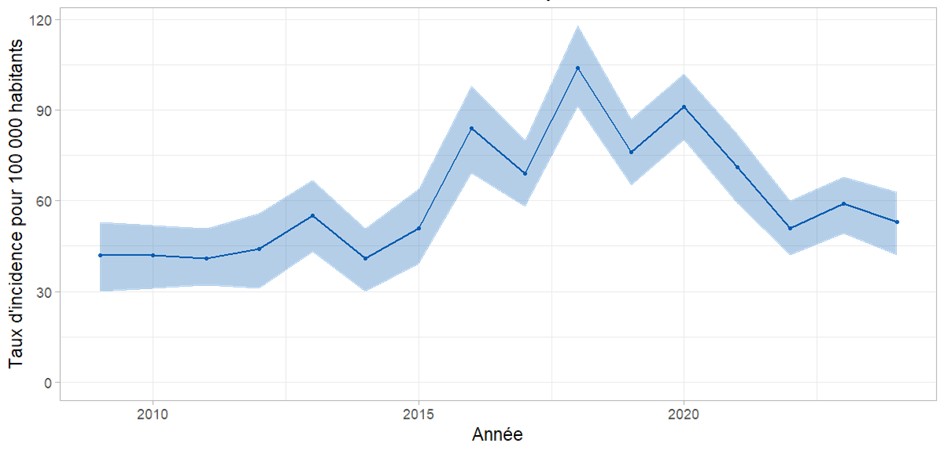
Between 2009 and 2024, the estimated number of Lyme disease cases diagnosed in primary care ranged from 26,146 (in 2014) to 68,530 cases (in 2018) per year. In 2024, this number was estimated at 35,147 cases. The estimated annual incidence rate of Lyme borreliosis fluctuated around an estimated average of 61 cases per 100,000 inhabitants, ranging from 41 per 100,000 inhabitants (in 2014) to 104 per 100,000 inhabitants (in 2018) in mainland France. The incidence has decreased since 2020, reaching 53 cases per 100,000 inhabitants (35,147 estimated cases) in 2024.
Estimated annual incidence of Lyme borreliosis, France, 2009–2024 (Sentinelles Network)
| Year | No. of participating physicians* | No. of reported cases | Erythema migrans Proportion (no.) | No. of other forms | Estimated incidence per 100,000 [95% CI] | Estimated annual number of cases |
|---|---|---|---|---|---|---|
| CONTINUOUS SURVEILLANCE | ||||||
| 2024 |
557 (1.0%) |
143 |
96.5% (n=138) |
Total: 5 neurological: 4 Skin: 1 |
53 [43–63] | 35 147 |
| 2023 |
526 (0.9%) |
177 |
99% (n=175) |
total: 2 joint: 2 |
59 [50–68] | 39,052 |
| 2022 |
543 (1%) |
154 |
98% (n=151) |
Total: 3 neurological: 2 |
51 [42–60] | 34,017 |
| 2021 |
608 (1.1%) |
210 |
97% (n=203) |
Total: 7 Joint: 1 Neurological: 3 Skin: 3 |
71 [60–82] | 46,598 |
| 2020 |
685 (1.2%) |
347 |
98% (n=339) |
Total: 8 |
91 [80–102] | 60,033 |
| 2019 |
552 (0.9%) |
230 |
99% (n=228) |
total: 2 joint: 2 |
76 [65–87] | 50 133 |
| 2018 |
480 (0.8%) |
288 |
98% (n=283) |
Total: 5 Joint: 3 Neurological: 2 Skin: 0 |
104 [91–117] | 68,530 |
| 2017 |
458 (0.7%) |
204 |
96.6% (n=197) |
Total: 7 Joint: 4 Neurological: 2 Skin: 1 |
69 [58–80] | 44,679 |
| 2016 |
442 (0.7%) |
194 |
95% (n=184) |
Total: 10 Joint: 7 Neurological: 1 Skin: 2 |
84 [70–98] | 54,647 |
| 2015 |
455 (0.76%) |
105 |
98% (n=103) |
Total: 2 Joint-related: 1 Neurological: 1 |
51 [38–64] | 33 202 |
| 2014 |
394 (0.7%) |
76 |
95% (n=72) |
Total: 4 Joint-related: 2 Neurological: 1 Skin-related: 1 |
41 [30–52] | 26 146 |
| 2013 |
332 (0.5%) |
113 |
97% (n=110) |
total: 3 neurological: 2 cutaneous: 1 |
55 [43–67] | 35,369 |
| 2012 |
375 (0.6%) |
85 |
93% (n=79) |
Total: 6 Joint: 3 Neurological: 1 Skin: 2 |
44 [32–56] | 27,817 |
| 2011 |
359 (0.6%) |
94 |
90% (n=85) |
Total: 9 Joint: 4 Neurological: 2 Skin: 3 |
41 [31–51] | 26 166 |
| 2010 |
372 (0.6%) |
84 |
98% (n=77) |
total: 2 interphalangeal: 2 |
42 [32–52] | 26,227 |
| 2009 |
452 (0.7%) |
80 |
90% (n=67) |
Total: 7 Joint: 1 Neurological: 4 Skin: 2 |
46 [34–58] | 29,072 |
Note: Some cases present with both erythema migrans and other clinical forms.
*proportion relative to the total number of general practitioners in France
Trends in the estimated annual incidence rate of Lyme disease in France between 2009 and 2024 (Sentinelles Network)
Surveillance of Hospitalized Cases, 2005–2024
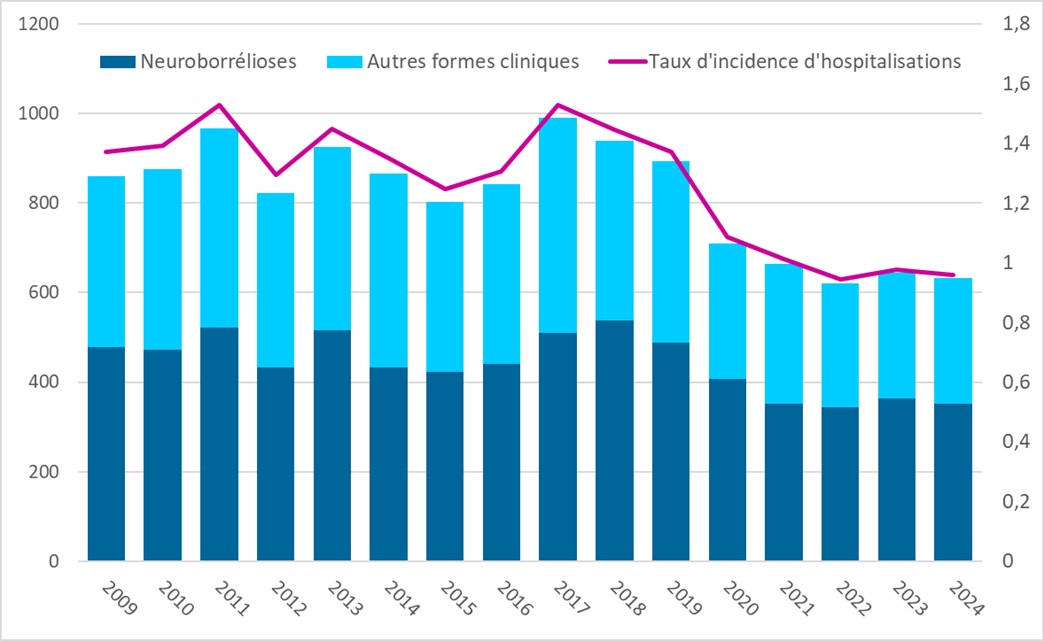
Surveillance of hospitalized cases is conducted based on an analysis of hospital data from the Medical Information Systems Program (PMSI). In 2024, 633 cases of Lyme disease were hospitalized in France.
Between 2005 and 2024, the annual number of hospitalized cases diagnosed with Lyme borreliosis ranged from 620 in 2022 to 990 in 2017, with an average of 801 hospitalized cases per year. The incidence rate of these hospitalizations fluctuated between 0.94 (in 2022) and 1.53 per 100,000 inhabitants (in 2011 and 2017), with a significant upward trend during the 2005–2017 period. However, a decrease was observed starting in 2018, and the incidence stabilized between 2021 and 2024. In 2024, the incidence rate reached 0.96 per 100,000 inhabitants.
The decrease in incidence in 2020 should be interpreted with caution due to the possible impact of the COVID-19 pandemic on hospital utilization or the implementation of recommendations regarding the care pathway for patients with tick-borne vector-borne diseases (notably the creation of the CRMVT). However, this decrease was also noted in the surveillance of cases seen in primary care, which could reflect a real decline in the incidence of the disease in France since 2020.
Hospitalizations for Lyme disease are more frequent between June and October. The age groups most affected are usually children aged 5 to 9 and adults aged 70 to 79.
Half of hospitalized cases are generally associated with neurological symptoms (neuroborreliosis).
The annual incidence of hospitalizations for neuroborreliosis has also decreased since 2018 and has remained stable since 2021 (between 0.52/100,000 inhabitants and 0.55/100,000). In 2024, it was 0.53/100,000 inhabitants.
Patients hospitalized for Lyme disease, by clinical form, and incidence rate per 100,000 inhabitants for all forms combined, between 2005 and 2024, throughout France, according to PMSI data.
Significant regional variation in incidence rates
Regional incidence rates of Lyme borreliosis are estimated based on surveillance data from the Sentinelles Network for cases diagnosed in primary care and on analysis of hospital data from the Medical Information Systems Program (PMSI) for hospitalized cases. These incidence rates in primary care at the regional level should be interpreted with caution due to low statistical precision (reflected in confidence intervals that are sometimes very wide).
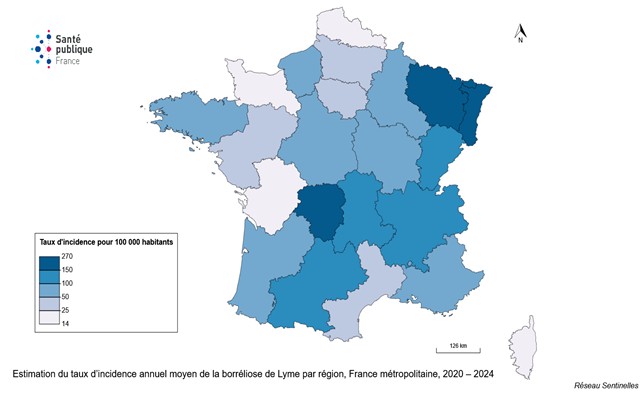
These various data sources reveal significant regional disparities, with incidence rates of cases diagnosed in primary care estimated to be high (>100 cases/100,000) in the eastern and central parts of mainland France (Alsace, Lorraine, Limousin in particular) and low (<50/100,000) in the west and the southeastern Mediterranean region. The same pattern is observed for hospitalizations, with higher annual incidence rates of hospitalized cases for Lyme borreliosis (>2 cases/100,000) in eastern and central France.
Sentinelles Network
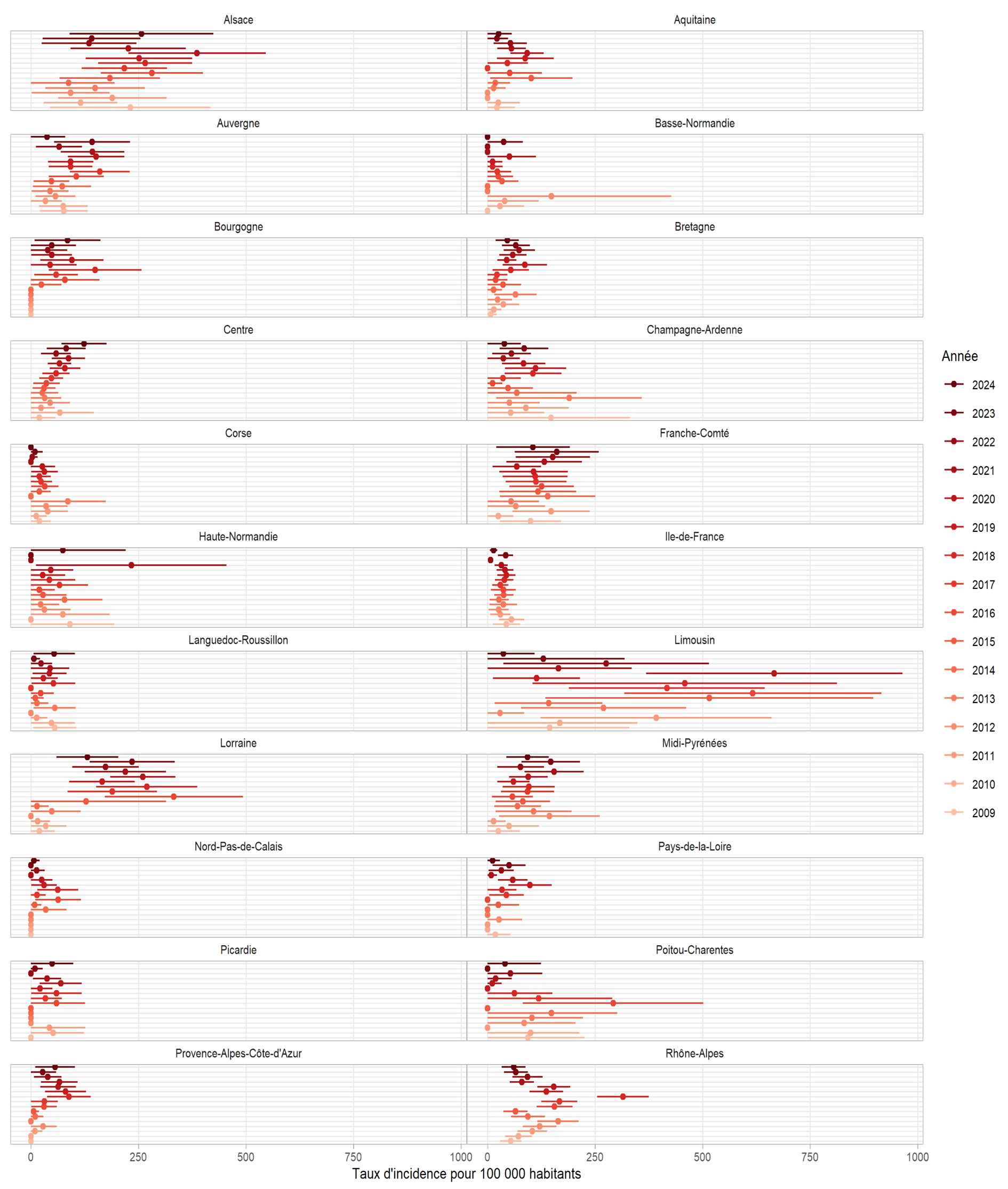
The average annual incidence rates, estimated by the Sentinelles Network, during this period were highest in the former regions of Alsace, Lorraine, Rhône-Alpes, and Limousin. Between 2017 and 2018, a significant increase in incidence was noted in the Rhône-Alpes region. Starting in 2019, incidence rates there declined and fell below 100 per 100,000 inhabitants as of 2021. In 2024, the former regions of Alsace, Lorraine, Franche-Comté, and Centre had incidence rates exceeding 100 per 100,000 inhabitants.
Annual incidence rates of Lyme disease cases seen in general practice between 2009 and 2024 by former region (95% confidence interval), Sentinelles Network
Estimated average annual incidence rate of Lyme disease by region, mainland France, 2012–2024
Studies by Santé publique France and Regional Offices
Studies by Santé publique France and regional units conducted between 2001 and 2015 show geographical variation in estimated regional incidence rates ranging from 232 per 100,000 to 24 per 100,000.
The incidence was highest in the eastern regions (Alsace: 232 per 100,000 during the 2001–2003 period, Haute-Savoie 185/100,000 for the 2006–2008 period), and lowest in Aquitaine for the 2010–2012 period (24/100,000).
|
Region |
Year (study period) |
No. 1, % participation 2, |
Number of confirmed cases (N) |
Proportion (n/N) |
No. of other forms4 |
Incidence/100,000 low-high |
|
Alsace |
2001–2003 |
419 |
992 |
86% |
Total: 136 without EM |
180–232 |
|
Alsace |
2014–2015 |
388 |
653 |
79% |
joint: 68 |
117 [95% CI 109–126] |
|
Limousin |
2004–2006 |
236 |
259 |
94% |
joint: 34 |
65–105 |
|
Rhône-Alpes |
2006–2008 |
241 |
657 |
93% |
joint: 12 |
Ain: 145 |
|
Franche-Comté |
2010–2012 |
254 |
421 |
93% |
joint: 4 |
85 [95% CI 77–92] |
|
Aquitaine |
2010–2012 |
325 |
122 |
87% |
joint-related: 6 |
11–24 |
|
1Number: number of participating physicians; 2% participation: proportion of participating physicians among those solicited; 3% general practitioners: proportion of general practitioners among participating physicians; 4some cases present with both erythema migrans and other clinical forms. |
||||||
Seroprevalence data
Between 1989 and 2020, the Mutualité sociale agricole (MSA) conducted five seroprevalence studies of Lyme borreliosis among its affiliated staff. Two other studies were conducted among hunters in 1995–1996 and among blood donors (1995–1996).
The estimated seroprevalence of Lyme borreliosis among foresters ranged from 14% to 22%. Among blood donors (Ile-de-France, Berry) and MSA administrative staff in eastern France, it was around 3% to 4%.
|
Study region |
Year of study |
Data source |
Study population |
Seroprevalence |
Bibliographic references |
|
West (16 departments) Brittany, Pays de Loire, Lower Normandy, Poitou-Charentes |
<1989 |
MSA1 |
Affiliation: MSA |
20.5% [17.4–23.6]; (133/653) |
Doby JM et al., 1989 |
|
Southern Berry |
1995–1996 |
not specified |
Hunters |
15% (25/170) |
Christiann C et al., 1997 |
|
Southern Berry |
May 17–24, 1995, and June 19, 1995 |
Blood drive |
Blood donors |
3.3% (6/82) |
Christiann C et al., 1997 |
|
Ile-de-France |
<1997 |
MSA1 |
Forest workers Blood donors |
15.2% (32/211) 3.2% (1/31) |
Zhioua E et al., 1997 |
|
Alsace |
Nov.–Dec. 1996 |
MSA1 |
Forest workers |
18.2% (80/442) |
Cire Est, 1999 |
|
Grand Est (Alsace, Lorraine, Franche-Comté, Burgundy, Champagne-Ardenne) |
2002–2003 |
MSA1 |
Forest workers |
14% (419/2,975) |
Rigaud E et al., 2016 |
|
Northern France, Auvergne, and Limousin |
2019–2020 |
MSA |
Forest workers |
15.5% [13.9–17.3] (256/1,777) |
Septfons S et al., 2023 |
Study on Knowledge, Attitudes, and Practices Regarding Lyme Disease and Tick Bites, Santé publique France Barometer
To characterize the French population’s level of exposure to tick bites as well as their knowledge regarding tick bites and Lyme disease, several studies were conducted as part of the Public Health France Barometer survey in 2016, 2019, and 2024.
In 2024, 28%—nearly one-third of the population—reported having been bitten by a tick at some point in their lives, and 5% in the past year.
Furthermore, while in 2016, 35% of the metropolitan population reported never having heard of Lyme disease, this proportion was 21% in 2019 and 16% in 2024, indicating a potential positive impact of the awareness campaigns launched in 2016. Finally, the estimated proportion of people who felt well-informed about Lyme disease was 29% in 2016, 41% in 2019, and 40% in 2024.
Regarding measures to prevent tick bites, in 2024, 23% of adults reported feeling exposed to tick bites. Among them, 81% reported wearing long clothing to protect themselves against tick bites, and nearly two-thirds (65%) reported checking their bodies for ticks after exposure to risk. Finally, 28% of respondents who felt exposed to tick bites reported using skin repellents during potential exposures.
In relation to

Tularemia
thematic dossier
Tularemia is caused by infection with Francisella tularensis. Hares and ticks are the primary vectors in France. The severity of the disease varies, and reporting cases is mandatory.

thematic dossier
Vector-borne diseases
Les maladies à transmission vectorielle sont des maladies infectieuses transmises par des vecteurs, essentiellement insectes et acariens hématophages. Santé publique France participe à leur...












