



The disease
An infectious disease transmitted by tick bites
Lyme disease is the most common tick-borne illness in France. It is caused by a bacterium of the Borrelia burgdorferi sensu lato complex transmitted to humans through bites from infected hard ticks of the genus Ixodes. The main pathogenic species of Borrelia in Europe are B. afzelii, B. garinii, and B. burgdorferi sensu stricto.
While the disease is present throughout France, there are significant geographical disparities.
The most common clinical presentation is a skin rash known as erythema migrans, but the infection can also, more rarely, cause systemic symptoms. Individual
preventive measures exist against tick bites, helping to reduce the risk of contracting the infections they can transmit.
In 2024, 28% of the population reported, as part of the Santé publique France Barometer, having been bitten by a tick at some point in their lives, and 5% in the past year. Furthermore, in 2016, 35% of the French population reported having never heard of Lyme disease; this proportion was 21% in 2019 and 16% in 2024, indicating a possible beneficial impact of the awareness campaigns launched in 2016.
In this context, Santé publique France’s priorities are:
To monitor Lyme borreliosis. To do so, we rely on the Sentinelles Network, the National Reference Center for Borrelia, and data from the PMSI.
To track changes in the public’s knowledge and perception of Lyme disease.
To promote the use of preventive measures against Lyme disease and tick-borne illnesses.
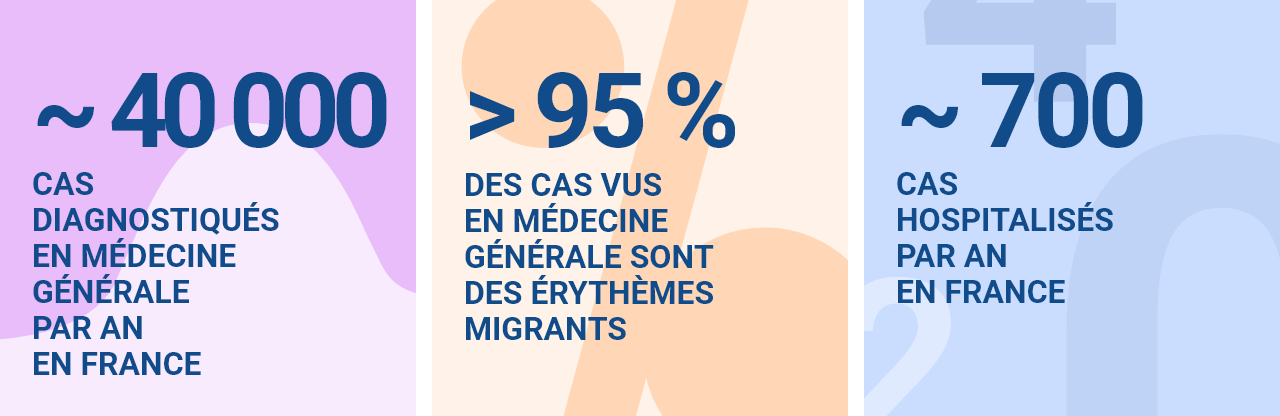
Key statistics on Lyme disease
Ixodes ricinus, the vector for Lyme disease
In France, the vector for Lyme borreliosis is a hard tick of the Ixodes ricinus complex. Ticks are mites that feed on the blood of animals; humans are accidental hosts. Ixodes
ricinus hard ticks live in deciduous forests, undergrowth, and pastures/meadows; they are rarely found in coniferous forests. They can also be found in peri-urban wooded areas, city parks, and private gardens. They are present in most regions of France, with the exception of high-altitude areas, very dry areas, or flood-prone areas.
The search for a host to feed on (tick activity) occurs when environmental conditions are optimal (humidity, temperature). They are typically active seasonally from April to November in regions with a continental climate and year-round in regions with milder temperatures (oceanic climate).
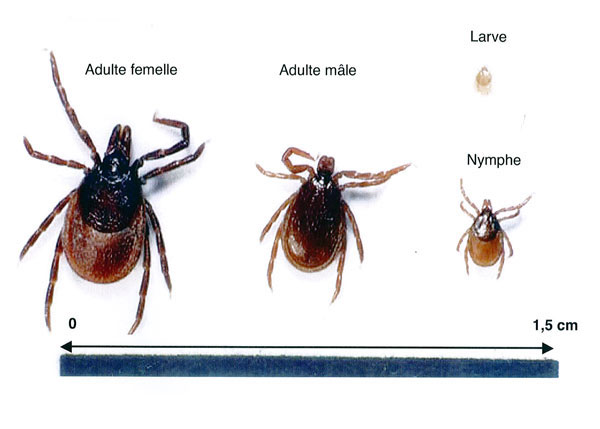
The life cycle of the Ixodes ricinus tick consists of three stages, and the duration of this cycle ranges from 2 to 6 years. The stages are as follows: a larva hatches from the egg, transforming into a nymph (2 mm) and then into an adult (3–4 mm). A blood meal from a host is required for the adult female tick to lay eggs and at each stage of its development. The Ixodes ricinus tick becomes infected by feeding on the blood of hosts contaminated with Borrelia burgdorferi sensu lato bacteria. The primary reservoir hosts for Borrelia burgdorferi sensu lato are small wild mammals (voles, field mice, squirrels, etc.).
Life cycle of Ixodes ricinus and its various hosts (adapted from J. Gray and B. Kaye)
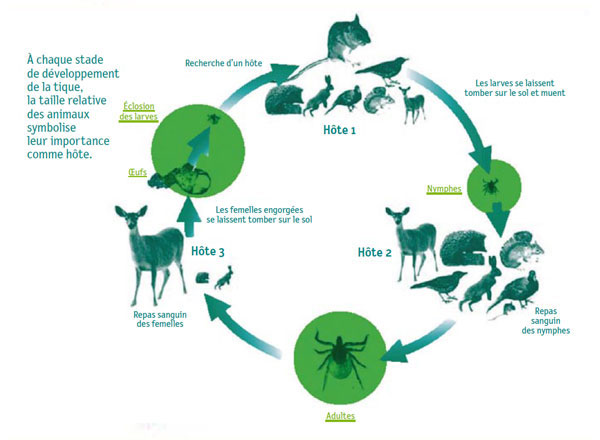
Certain species of birds and reptiles also serve as reservoirs. Large mammals, such as deer, are hosts to adult ticks but are incompetent reservoirs of Borrelia burgdorferi—that is, they are unable to transmit the bacterium to an uninfected tick. The blood meal lasts 3 to 7 days depending on the life stage. At the end of the blood meal, the tick detaches from its host and falls into vegetation near the ground. It requires a minimum level of humidity to survive (80%) and can wait several months to progress to the next stage of the life cycle or lay eggs, in the case of a female tick.
The Ixodes ricinus tick has never been found in France’s overseas departments and regions, due to a climate unsuitable for its development.
Ixodes ricinus (adult, nymph, larva)
Transmission by Ticks
Borrelia burgdorferi is transmitted to humans through the bite of an infected Ixodes tick. During the blood meal that follows the bite, bacteria from the tick’s gut pass into its salivary glands. Transmission via saliva depends on the duration of contact and the tick’s infestation rate. In American studies, the risk of transmission appears low for attachment durations of less than 72 hours. In Europe, experimental and clinical data have shown that this timeframe is shorter, with an increased risk after 24 hours of attachment. This timeframe depends on the vector and the bacterium; it has been demonstrated that transmission of B. afzelii is faster than that of B. burgdorferi sensu stricto.
Humans can be bitten by a tick at any stage of its development (larva, nymph, adult). Nymphs appear to be responsible for most transmissions. They are in fact more numerous than adults, more likely to bite humans (accounting for over 80% of bites in some regions), and also less likely to be detected when attached due to their smaller size.
In France, the prevalence of Borrelia burgdorferi infection in ticks varies by season and location, ranging from 2% to 20%. These infection rates can reach up to 30% in Central Europe.
It is essential to note that Lyme disease is not transmitted:
From person to person
Through direct contact with animals
Through food (e.g., venison)
Through bites from other insects
The HCSP emphasized in 2017 (opinion dated June 27, 2017) that there are no reported cases of transmission of Borrelia burgdorferi sensu lato to humans via blood transfusion or organ transplantation. However, studies have shown that the bacterium B. burgdorferi can survive in blood stored for donation (Nadelman RB et al. 1990; Johnson SE et al. 1990).
Maternal-fetal transmission has been suspected in a few isolated case studies; however, data from larger retrospective and prospective studies have never confirmed that Lyme borreliosis can contribute to adverse pregnancy outcomes.
Transmission via breast milk or sexual contact has not been documented in humans to date.
Clinical manifestations
A diagnosis of Lyme disease may be considered if the patient has been exposed to a risk of tick bite. However, a documented history of a tick bite is not essential for diagnosing Lyme disease, as a tick bite may go unnoticed.
The symptoms of Lyme disease depend on the stage of the disease. Three stages are usually distinguished:
Early localized Lyme disease
This occurs 3 to 30 days after the tick bite. It is characterized by a typical skin manifestation, erythema migrans. This is a painless erythematous patch at the site of the tick bite that expands in a ring-shaped, centrifugal pattern.
Erythema migrans is the most common manifestation (60 to 90% of cases) and the most characteristic of Lyme borreliosis.
It should not be confused with a reaction to tick saliva, which appears earlier and does not spread centrifugally.
Early disseminated Lyme
borreliosis It occurs several days to several weeks after the tick bite and may present symptomatically as:
Multiple erythema migrans
Neurological manifestations (neuroborreliosis: meningo-radiculitis, facial paralysis, isolated meningitis, acute myelitis)
More rarely, joint manifestations (arthritis with effusion in a large joint such as the knee), skin manifestations (borreliosis lymphocytoma), cardiac, or ophthalmological manifestations
Late-stage disseminated Lyme
borreliosis It occurs several months or even years after the tick bite and is characterized by the following manifestations:
Joint
Skin manifestations (chronic atrophic acrodermatitis)
Rare specific neurological symptoms (encephalomyelitis)
The clinical manifestations of Lyme borreliosis in the early and late disseminated stages may appear after early localized Lyme borreliosis has gone unnoticed.
Some patients experience post-infectious symptoms that may persist despite proper antibiotic treatment; they may present with what is known as PTLDS (Post-Treatment Lyme Disease Syndrome), which resembles a post-infectious syndrome. In cases where managing these symptoms is difficult or there is diagnostic uncertainty, patients may be referred by their primary care physician to a Center of Expertise for Tick-Borne Diseases (CCMVT) or, in complex cases, to a Reference Center for Tick-Borne Diseases (CRMVT).

Diagnosing Lyme disease
The diagnosis of Lyme disease is based on:
The observation of objective clinical signs suggestive of the condition
Medical history: history of a tick bite or exposure to a risk of a tick bite
In cases of early or late disseminated manifestations, a serological test (which detects specific antibodies against Borrelia burgdorferi sensu lato)
Serology is not recommended during the erythema migrans stage (the most common form) due to numerous false negatives at this stage. The diagnosis is then strictly clinical.
Due to the low specificity of most clinical manifestations of disseminated Lyme borreliosis, a laboratory test is necessary to confirm the diagnosis at this stage of the disease. Laboratory
tests rely primarily on indirect techniques (serology: detection of specific antibodies). Direct detection techniques (primarily detection of Borrelia DNA via PCR or culture) are reserved for specialized laboratories using validated methods and tests.
Serological testing follows a two-step approach: a screening test (ELISA, IFI) is routinely followed by a confirmatory test using immunoblotting (Western blot or immunoblot) when the screening test result is positive or equivocal. Serology is not indicated in the following situations:
Routine screening of exposed individuals
A tick bite without clinical symptoms
Typical erythema migrans
Serological follow-up of treated patients
Treating Lyme disease
Treatment for Lyme disease involves antibiotic therapy regardless of the stage of the disease. In the early localized stage, antibiotic therapy not only cures erythema migrans but also prevents progression to disseminated forms.
Preventing Lyme disease and other tick-borne illnesses
There is currently no vaccine available against Lyme disease or tick bites. However, a vaccine is available against tick-borne encephalitis (though it does not protect against other tick-borne infections such as Lyme disease).
Activities that expose people to tick bites are those taking place in areas where ticks are likely to be present (wooded areas, meadows, and even gardens). These can include both recreational and professional activities (such as those of foresters, loggers, and silviculturists). Precautions should be taken during the tick season, which runs from April to November in most regions of France. However, caution is advised year-round in areas with a mild, humid climate, such as Brittany.
Individual prevention of Lyme disease relies on:
Physical protection
Walking on well-marked trails without dense vegetation or tall grass to limit the risk of contact with Ixodes ticks.
Wearing protective clothing, possibly treated with repellents, to reduce the risk of being bitten by a tick.
Wearing light-colored clothing to spot ticks that haven’t yet attached to the skin more quickly.
A thorough examination (since ticks in the nymph stage measure only 1 to 3 mm) of the body after exposure to the risk of a bite
Pay special attention to skin folds, the backs of the knees, the armpits, the genital area, the navel, and—especially in young children—the scalp, neck, and behind the ears.
It may be helpful to conduct another inspection the next day, as the tick, partially engorged with blood, will be more visible.
Removing ticks attached to the skin
Remove the tick as quickly as possible to prevent the transmission of Borrelia. The risk of transmission increases the longer the tick remains attached.
Use a tick hook (available at pharmacies) if possible; otherwise, use fine-tipped tweezers or, if those are unavailable, regular tweezers (do not pull the tick out with your fingers).
The use of petroleum jelly, ether, gasoline, alcohol, local anesthetics, or any other biological or chemical substance is not recommended.
Disinfect the bite site after removing the tick.
Monitor the bite site for 4 weeks. If erythema migrans (a red, round rash) or general symptoms (fever, malaise, body aches) appear, consult your doctor.
Antibiotic prophylaxis after a tick bite is not recommended.
There is no acquired immunity against Lyme disease. Individual preventive measures therefore also apply to people who have had Lyme disease.
Other infections can be transmitted by ticks in France
Several infections can be transmitted by different species of ticks besides Lyme disease. These infections are much rarer in France. The clinical presentations they cause are varied and differ from those of Lyme disease. They are often associated with fever along with other symptoms specific to the causative pathogen. Surveillance of these diseases is based on their respective National Reference Centers as well as on mandatory reporting for tick-borne encephalitis, tularemia, and Crimean-Congo hemorrhagic fever (African hemorrhagic fever).
| Disease | Clinical presentation | Infectious agent | Vector tick |
|---|---|---|---|
| Human granulocytic anaplasmosis | Fever, cytopenias +/- hepatic cytolysis | Anaplasma phagocytophilum | Ixodes ricinus |
| Babesiosis | Fever +/- splenomegaly | Babesia spp | Ixodes ricinus |
| Crimean-Congo Hemorrhagic Fever* | Fever, hemorrhagic signs | CCHFV | Hyalomma marginatum |
| Tick-borne encephalitis | Fever, neurological symptoms | TBEV (Tick-Borne Encephalitis Virus) | Ixodes ricinus |
| Tick-borne relapsing fever | Recurrent fever every 7 days on average, with possible associated symptoms | B.miyamotoi | Ixodes spp. |
| Neoehrlichiosis caused by Neoehrlichia mikurensis | Fever and thromboembolic complications | Neoehrlichia mikurensis | Ticks (?) |
| Rickettsioses | Rickettsia spp | Dermacentor | |
| TIBOLA / SENLAT / DEBONEL / LAR) | Fever, skin inoculation lesion, lymphadenopathy/lymphangitis | ||
| Mediterranean spotted fever | Fever, inoculation lesion, maculopapular rash | Rickettsia conorii | Rhipicephalus (Mediterranean basin) |
| Tularemia | Various clinical forms + other modes of transmission | Francisella tularensis | Dermacentor |
* No cases reported to date in mainland France, but the virus has been detected in Hyalomma marginatum ticks in Occitanie and Corsica.
In relation to

Tularemia
thematic dossier
Tularemia is caused by infection with Francisella tularensis. Hares and ticks are the primary vectors in France. The severity of the disease varies, and reporting cases is mandatory.

thematic dossier
Vector-borne diseases
Les maladies à transmission vectorielle sont des maladies infectieuses transmises par des vecteurs, essentiellement insectes et acariens hématophages. Santé publique France participe à leur...












