



Data
The data presented are drawn from six French registries of congenital anomalies. These registries’ affiliation with the European EUROCAT network helps standardize the definitions and classification of malformations. However, there are variations from one registry to another, whether regarding the duration of data collection (1 week in Paris and 1 year for the other registries) or the characteristics of the population being monitored (e.g., distribution of maternal age). Caution is therefore warranted when comparing data across different registries and interpreting the observed regional variations. Furthermore, sample sizes are small and can fluctuate significantly from one year to the next. To improve the accuracy of regional prevalence estimates, data are presented as cumulative totals for the past five years, except for the Brittany registry, which has a three-year history. For national estimates, data are aggregated over three years.
Definitions and Methodology
Definitions
Live births: number of live newborns.
Births or total births: live births + stillbirths
Medical termination of pregnancy (MTP): termination of pregnancy performed when the mother’s health is at risk or when “there is a high probability that the unborn child has a particularly serious condition recognized as incurable at the time of diagnosis.”
Stillbirths: children born dead at or after 22 weeks of gestation. In this report, medical terminations of pregnancy performed at or after 22 weeks of gestation are not counted as stillbirths.
Total prevalence of congenital anomalies: number of live births, stillbirths, and IMGs with congenital malformation(s) / total number of births and stillbirths.
Prevalence among live births: number of live newborns with congenital malformation(s) / number of live births.
Public health indicators
A health indicator is a measurable piece of information that describes the health status of a population or a specific group within a population. These are quantitative measures that characterize certain health events. For example, a mortality indicator—a “mortality rate”—provides information on the frequency of deaths in a population over a given period.
Prevalence of 21 major congenital anomalies
The registries record all congenital malformations and chromosomal abnormalities, excluding inborn errors of metabolism and minor malformations or isolated deformities.
As part of the coordination of French registries, 21 congenital anomalies were selected for detailed analysis due to their epidemiological significance in terms of frequency and severity, and because they are anomalies detected prenatally and recognizable at birth.
These 21 anomalies are as follows:
Other indicators for monitoring congenital anomalies
A collaborative effort with EUROCAT/JRC has led to the recommendation of public health indicators for the surveillance of congenital anomalies. These indicators can be useful for measuring the burden of these conditions on health status and for describing the frequency of congenital anomalies in different geographic areas. They are now available in the ‘National Estimates’ tab. The indicators are as follows:
Perinatal mortality associated with congenital anomalies per 1,000 births: this measure covers fetal deaths in utero and stillbirths at 22 weeks of gestation or later, as well as early neonatal deaths (first 7 days). It is an indicator that measures part of the burden of mortality associated with congenital anomalies.
Prevalence of prenatal diagnosis of congenital anomalies per 1,000 births: this indicator is broken down into genetic and non-genetic anomalies because the screening methods differ. It is an indicator of the rate of screening and prenatal diagnosis of congenital anomalies.
Prevalence of medical terminations of pregnancy (MTP) due to congenital anomalies per 1,000 births: this indicator is broken down into genetic and non-genetic anomalies because the screening methods differ. It provides information on the proportion of cases of congenital anomalies diagnosed in each category that result in a medical termination of pregnancy (MTP).
Prevalence of trisomy 21 (Down syndrome) among live births per 1,000 births: this indicator is broken down into two categories based on maternal age at delivery. This indicator allows for the evaluation of the effect of maternal age, screening policies, and the use of MIP in cases of trisomy 21.
Prevalence of selected congenital anomalies requiring surgical intervention at birth per 1,000 births: this indicator allows for the assessment of surgical care for children with these anomalies. It applies only to live-born children with the anomalies under study.
Total prevalence of neural tube defects per 1,000 births: this indicator is broken down by pregnancy outcome and can serve as a marker of the implementation of policies promoting folic acid supplementation for women of childbearing age starting 8 weeks before conception and continuing up to 4 weeks after conception, ideally in conjunction with planned pregnancies.
Methodological considerations
To calculate the total prevalence of children with anomalies, each child is counted only once, even if they have multiple anomalies.
Calculation of prevalence and the confidence interval for prevalence
The formula used to calculate prevalence is as follows:
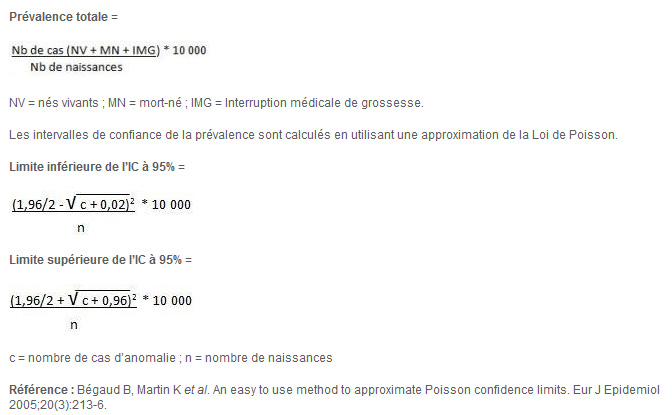
Public health indicators developed by Eurocat
All cases of congenital anomalies among live births, stillbirths, and medically indicated abortions recorded by the six French registries (Antilles, Auvergne, Brittany, Paris, Réunion, and Rhône-Alpes (RHÔNE-ALPES)) for the period 2011–2015 were included in the calculation of the indicators.
Prevalences were calculated per 1,000 births. For each indicator, two measures are presented: prevalence by registry and the cumulative trend of recorded cases across all registries.
Each indicator was represented graphically in two ways: prevalence by registry and trends over the 2011–2015 period. The analysis of trends was conducted by aggregating data from all registries.
National estimates of the prevalence of congenital malformations
The number of live-born or stillborn children with congenital anomalies is not known for all of France, but national estimates of prevalence can be obtained by extrapolating from data from the six French registries (Antilles, Auvergne, Brittany, Paris, Réunion, Rhône-Alpes). The six registries account for 19% of all births in France in 2013–2015.
In the table below, the total estimated number of cases reflects the overall burden of congenital anomalies in terms of public health, as it includes medically indicated terminations of pregnancy (MIT) and stillbirths (SB). The estimate of the number of children with anomalies alive at birth allows for an assessment of the impact of the condition in terms of morbidity and disability.
In 2013–2015, the total prevalence of newborns (including MIPs and stillbirths) with congenital anomalies in France is estimated at 3.4 cases per 100 births, or slightly more than 28,000 cases per year, including approximately 20,800 live newborns, 440 stillbirths, and 6,600 IMGs. The estimates were calculated based on the total number of births (live births + stillbirths) in France published by INSEE for 2013–2015, amounting to nearly 2,486,000 births.
| National estimate of the annual number of newborns and fetuses with congenital anomalies (extrapolation based on data from the six French congenital malformation registries*, 2013–2015) | |||||
|---|---|---|---|---|---|
| Live births + stillbirths + IMG | Newborns (live births) | ||||
| Frequency1 | Number | Total prevalence3 | Frequency1 | Number | Prevalence4 |
| 1 case per 28 births | 28,733 | 3.5% | 1 case per 37 live births | 21,964 | 2.7% |
*Antilles, Auvergne, Brittany, Paris, Réunion, Rhône-Alpes.
1 Incidence: 1 case per n births;
3 Total prevalence: number of newborns or fetuses with anomaly(ies) / total number of births;
4 Prevalence: number of live newborns with anomaly(ies) / number of live births.
National prevalence estimates for 21 major anomalies
National estimates of the number of newborns and fetuses with a major anomaly were calculated for 21 major anomalies. These anomalies were selected for their public health significance (frequency, severity, prevention programs, prenatal screening) and because they could be identified according to a common definition across all registries.
Prevalence estimates are also presented, excluding cases with known chromosomal anomalies. Chromosomal anomalies involve any alteration in the number or structure of chromosomes and are often the cause of multiple malformation syndromes.
For each of the 21 anomalies, data extrapolated to the national level are presented overall and then excluding cases of known chromosomal anomalies, first as frequencies and number of cases (Tables 1 and 2) and then as prevalence (Tables 3 and 4).

National estimate of the number of newborns with one or more birth defects
National estimate of the number of newborns and fetuses with one or more anomalies but no known genetic abnormalities
National prevalence estimates for 21 monitored anomalies per 10,000 births, extrapolated from data from six French congenital anomaly registries, 2013–2015
National prevalence estimate for 21 monitored anomalies without known genetic causes per 10,000 births, extrapolated from data from six French congenital anomaly registries, 2013–2015
Registry data
The number of cases and prevalence are presented for each of the following anomalies by registry.
Neural tube defects: anencephaly; spina bifida
Circulatory system anomalies: coarctation of the aorta; transposition of the great arteries; tetralogy of Fallot; left ventricular hypoplasia
Craniofacial anomalies: cleft lip and cleft lip and palate; cleft palate
Digestive and abdominal wall anomalies: esophageal atresia; anorectal atresia and stenosis; congenital diaphragmatic hernia; laparoschisis; omphalocele
Urinary tract anomalies: bilateral renal agenesis
Genital anomalies: hypospadias
Limb anomalies: limb reduction
Chromosomal abnormalities: trisomy 21 (Down syndrome); trisomy 18 (Edwards syndrome); trisomy 13 (Patau syndrome); Turner syndrome; Klinefelter syndrome
In relation to

Tobacco
thematic dossier
Despite a slight decrease compared to 2015, tobacco remains responsible for more than 68,000 premature deaths in 2023—accounting for 11% of total mortality—making it still the leading cause of...

Alcohol
thematic dossier
Alcohol is deeply rooted in French culture. Its consumption remains a major cause of death and illness in France.












