



The disease
Congenital Anomalies
Congenital anomalies are structural or functional defects in an organ or a region of the body resulting from an abnormality in the normal developmental process of the embryo or fetus. Congenital anomalies are, by definition, present at birth; however, they may not be diagnosed until later in life. They are extremely diverse, varying in severity from minor defects to major malformations incompatible with life.
The nucleus of the cells that make up the human body contains our genetic information, which is distributed across 23 pairs of chromosomes. Chromosomes are made of DNA and carry genes.
If an anomaly results from a problem with a chromosome, it is called a chromosomal abnormality. When the abnormality results from a gene malfunction, it is generally referred to as a mutation. When these mutations lead to more or less severe dysfunctions, we speak of a genetic disorder: monogenic if a single gene is involved, or polygenic if multiple genes are involved.
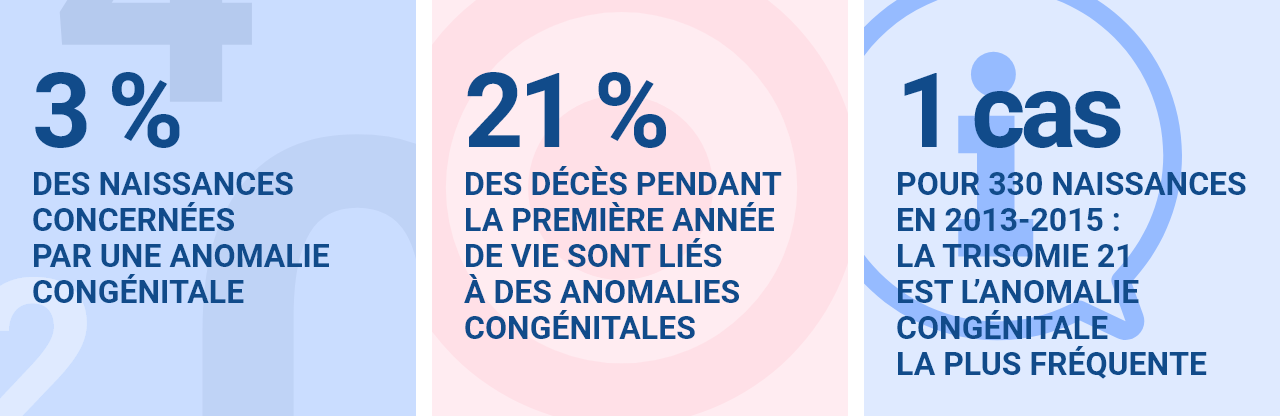
Congenital anomalies are a major cause of disease (approximately 3% of births), infant mortality, and disability. They are also a significant cause of death during infancy (21% of deaths during the first year of life: source CépiDC 2014).
Key statistics on congenital anomalies and malformations
Prenatal Screening and Diagnosis of Congenital Anomalies
There are medical methods and tools available to detect potential morphological malformations or genetic or chromosomal disorders before birth. Prenatal screening and prenatal diagnosis are two concepts that seem very similar but should not be confused and must be clearly distinguished.
Prenatal screening consists of tests, some of which are mandatory for pregnant women, designed to estimate their risk of carrying a fetus with, for example, a genetic abnormality such as Down syndrome. Screening may be followed by a diagnostic test, offered to the woman, in the event of a confirmed risk.
Prenatal screening
Combined screening
It is exclusively a public health policy and uses techniques that pose no risk to the pregnancy. It is intended for all couples, even if there is no known risk prior to pregnancy.
Since 2009, following recommendations from the French National Authority for Health, a new combined screening strategy—combining ultrasound measurements and serum marker testing starting in the first trimester of pregnancy—has been implemented (Article R. 2131-2 of the Public Health Code). This strategy applies to "all pregnant women, regardless of age" and must be preceded by "information provided to the pregnant woman," who must give her consent "in writing" to undergo the screening.
Thus, the combined screening procedure recommends performing the following during the first trimester:
An ultrasound (routine or screening) performed between 11 and 13 weeks of amenorrhea, which uses nuchal translucency measurement to screen for certain major malformations and aids in the detection of chromosomal abnormalities;
A blood test for “serum marker analysis,” which involves measuring substances present in the mother’s blood. These tests aim to assess the risk that the fetus has certain abnormalities, including trisomy 21 (Down syndrome) or a neural tube defect (anencephaly and spina bifida). If the calculated risk exceeds an established threshold, a confirmatory diagnosis is necessary.
If the combined screening could not be performed during the first trimester, screening can be conducted later in the pregnancy, combining first-trimester ultrasound measurements with second-trimester serum marker testing, or using second-trimester serum marker testing alone.
As part of prenatal care, two additional ultrasounds (at a minimum) are recommended in France:
the second-trimester scan, around 22 weeks (known as the “morphological ultrasound”), which aims to detect malformations that could not be identified earlier; a diagnosis of such conditions may lead to considering either termination of pregnancy, specific treatment after birth, or, in some cases, in utero treatment of the unborn child;
a final ultrasound, usually performed in the third trimester to assess fetal growth and detect late-onset abnormalities.
Prenatal screening via whole-genome DNA analysis
These are highly sensitive tests that improve detection rates and reduce the need for invasive procedures. The French National Authority for Health (HAS) recommends offering these tests to pregnant women following a combined screening test when the estimated risk of abnormalities is between 1 in 1,000 and 1 in 51. However, this test is not yet covered by health insurance.
Prenatal diagnosis
A diagnosis is offered to pregnant women for whom an increased risk of congenital abnormalities has been identified during screening. When the estimated risk level is greater than or equal to 1 in 250, diagnostic confirmation is offered via fetal karyotyping using invasive sampling: either chorionic villus sampling (collection of cells from the developing placenta), which can be performed as early as the 12th week of amenorrhea, or amniocentesis (collection of amniotic fluid), which can be performed starting at 16 weeks of amenorrhea, or, more rarely and under very specific indications, cordocentesis (collection of fetal blood), which can be performed after 20 weeks of amenorrhea. All of these invasive techniques carry a risk of miscarriage (0.5% for amniocentesis, 1% for trophoblast biopsy, and higher for cordocentesis).
A diagnostic test may also be considered following genetic counseling for couples whose risk was identified prior to pregnancy.
CPDPNs
These are multidisciplinary prenatal diagnostic centers (CPDPN) whose mission is to assist medical teams and couples with analysis, decision-making, and pregnancy monitoring. When a detected fetal abnormality is considered to have a “high probability that the unborn child is affected by a particularly serious condition deemed incurable at the time of diagnosis” (Art. L. 2231-1 of the CSP), the CPDPNs are responsible for certifying this. This then makes it possible, upon parental request, to perform a medical termination of pregnancy (MTP). Otherwise, the CPDPNs are responsible for contributing to the monitoring of the pregnancy, the delivery, and the care of the newborn under the best possible conditions of care.
Clinical Genetics
A genetic consultation may be offered to the pregnant woman following her care by a CPDPN when an abnormality is suspected in the unborn child following a screening test, or for couples whose risk has been previously identified due to the parents’ medical history. Consultations are provided by a medical geneticist or a genetic counselor under the geneticist’s supervision and help guide any genetic testing of the fetus to determine the severity of suspected or diagnosed conditions, and most importantly, inform the parents about treatment options or, if necessary, medical termination of pregnancy (MTP), if that is the parents’ wish.
Learn more:
- Haute Autorité de Santé (Evaluation of screening strategies for trisomy 21. Public health recommendations. June 2007. www.has-sante.fr).
- Opinion No. 120, National Consultative Ethics Committee, 2013
.- Agence de la Biomédecine: Prenatal Diagnosis (www.agence-biomedecine.fr)
.- Biomedicine Agency: “Current Status of Prenatal Diagnosis in France” (www.agence-biomedecine.fr)
- Weekly Epidemiological Bulletin 2008;28-29.
In relation to

Tobacco
thematic dossier
Despite a slight decrease compared to 2015, tobacco remains responsible for more than 68,000 premature deaths in 2023—accounting for 11% of total mortality—making it still the leading cause of...

Alcohol
thematic dossier
Alcohol is deeply rooted in French culture. Its consumption remains a major cause of death and illness in France.












