




The Disease
An infectious disease
Dengue is an infectious disease caused by an arbovirus. “Arthropod-borne viruses” are viruses transmitted by blood-feeding arthropods (notably mosquitoes, sandflies, and ticks). They belong to three main families: the Flaviviridae, the Togaviridae, and the Bunyaviridae." data-tooltip-title="Arboviruses (arthropod-borne viruses) are viruses transmitted by blood-feeding arthropods (including mosquitoes, sand flies, and ticks). They belong to three main families: the Flaviviridae, the Togaviridae, and the Bunyaviridae." data-tooltip-content="" data-tooltip-placeholder-is-selection="true" data-tooltip-placeholder-is-selection-text="arbovirus" data-tooltip-data="[{"tooltipTitle":"Arboviruses « arthropod-borne viruses » are viruses transmitted by blood-feeding arthropods (mosquitoes, sandflies, and ticks, among others). They belong to 3 main families, the Flaviviridae, the Togaviridae, and the Bunyaviridae.","tooltipContent":"","placeholderIsSelection":"true","placeholderIsSelectionText":"arbovirus"}]">arbovirus: the dengue virus. This virus is transmitted by mosquitoes of the genus Aedes: Aedes aegypti and Aedes albopictus (the latter is also known as the tiger mosquito).
The dengue virus belongs to the Flaviridae family (genus Flavivirus) and has four different serotypes (DEN1 through DEN4).
Infection with one serotype confers immunity against that serotype but not against the others; therefore, a person can be infected multiple times with different dengue serotypes. While the infection is often asymptomatic, the disease, in its typical form, presents as a sudden fever accompanied by muscle aches and a rash. In rare cases, serious and sometimes fatal complications may occur.
Key Statistics on Dengue Fever
Several modes of dengue transmission
Vector-borne transmission
The dengue virus is primarily transmitted by blood-feeding arthropods (which include insects and mites) that transmit an infectious agent (virus, bacterium, parasite) from one vertebrate to another" data-tooltip-title="blood-feeding arthropods (which include insects and mites) that transmit an infectious agent (virus, bacteria, parasite) from one vertebrate to another" data-tooltip-content="" data-tooltip-placeholder-is-selection="true" data-tooltip-placeholder-is-selection-text="vectors" data-tooltip-data="[{"tooltipTitle":"arthropod (including insects and mites) hematophagous (feeding on blood) that transmits an infectious agent (virus, bacteria, parasite) from’one vertebrate to another","tooltipContent":"","placeholderIsSelection":"true","placeholderIsSelectionText":"vectors"}]">vectors. Blood-feeding arthropods (including insects and mites) that transmit an infectious agent (virus, bacterium, parasite) from one vertebrate to another" data-tooltip-title="blood-feeding arthropods (including insects and mites) that transmit an infectious agent (virus, bacterium, parasite) from one vertebrate to another" data-tooltip-content="" data-tooltip-placeholder-is-selection="true" data-tooltip-placeholder-is-selection-text="vectors" data-tooltip-data="[{"tooltipTitle":"arthropod (including insects and mites) hematophagous (feeding on blood) that transmits an infectious agent (virus, bacteria, parasite) from one vertebrate to another","tooltipContent":"","placeholderIsSelection":"true","placeholderIsSelectionText":"vectors"}]">Dengue vectors are mosquitoes of the genus Aedes, primarily Aedes aegypti and Aedes albopictus (the tiger mosquito).
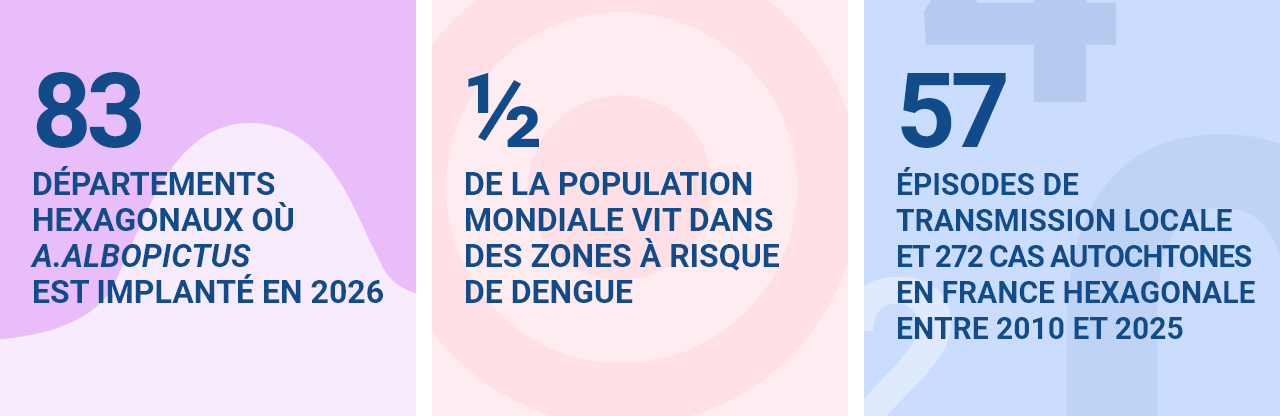
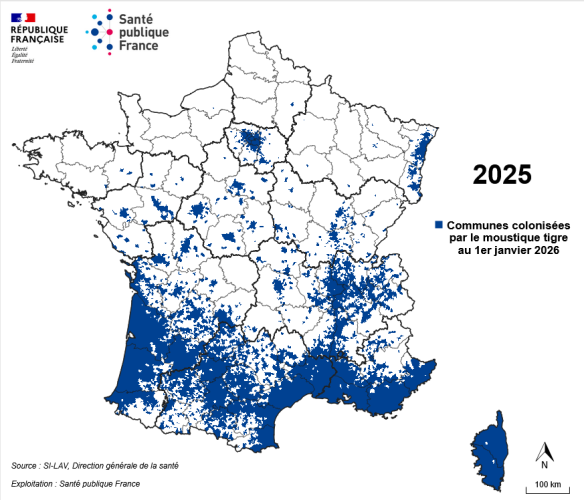
Dengue is an infection that is most prevalent in the intertropical zone, where blood-feeding arthropods (which include insects and mites) transmit an infectious agent (virus, bacterium, parasite) from one vertebrate to another" data-tooltip-title="blood-feeding arthropods (including insects and mites) that transmit an infectious agent (viruses, bacteria, parasites) from one vertebrate to another" data-tooltip-content="" data-tooltip-placeholder-is-selection="true" data-tooltip-placeholder-is-selection-text="vectors" data-tooltip-data="[{"tooltipTitle":"arthropod (including insects and mites) hematophagous (feeding on blood) that transmits an infectious agent (virus, bacteria, parasite) from’one vertebrate to another","tooltipContent":"","placeholderIsSelection":"true","placeholderIsSelectionText":"vectors"}]">vectors Aedes aegypti and Aedes albopictus are present. Within France, Aedes aegypti is present in the French West Indies, French Guiana, and Mayotte, while Aedes albopictus is present on Réunion Island. Aedes albopictus is also found in temperate regions, particularly in Europe. In mainland France, as of 2026, it was established in 83 departments, and episodes of local dengue transmission have been regularly identified since 2010.
These Aedes mosquitoes thrive primarily in urban areas and do not travel far during their lifetimes. Females lay their eggs in breeding sites where standing water is necessary for larval development: rainwater collection containers, vases, saucers, used tires, poorly maintained gutters, various types of debris that can trap water (bamboo, bromeliads, etc.). Man-made breeding sites are the primary places where these mosquitoes lay their eggs.
Aedes mosquito bites occur mainly during the day, with peak activity at the beginning and end of the day. When a mosquito bites an infected person during the viremic phase, it acquires the virus from that person’s blood. The virus then multiplies within the mosquito for approximately 7 to 10 days, a period known as the extrinsic incubation period. At the end of this extrinsic phase, the mosquito can transmit the virus and infect another person through a subsequent bite.
For dengue, the period when the virus is present in the person’s blood." data-tooltip-title="period when the virus is present in the person’s blood." data-tooltip-content="" data-tooltip-placeholder-is-selection="true" data-tooltip-placeholder-is-selection-text="viremic phase" data-tooltip-data="[{"tooltipTitle":"the time when the virus is present in a person’s blood.","tooltipContent":"","placeholderIsSelection":"true","placeholderIsSelectionText":"viremic phase"}]">The viremic phase begins approximately 1 to 2 days before the onset of clinical signs and lasts up to 7 days after that.
Transmission via products of human origin
In rarer cases, the virus can be transmitted through transfusions or transplants (of organs or cells).
Symptoms and complications
Dengue is asymptomatic in 50 to 90% of cases (the percentage varies depending on the outbreak).
In 10 to 50% of people infected with the virus, symptoms appear after an incubation period averaging 4 to 7 days (though this can range from 3 to 14 days).
- The “classic” form is characterized by a high fever that comes on suddenly. It is often accompanied by chills, headaches, retroorbital pain, nausea, vomiting, and joint and muscle pain. Sometimes, a rash may appear around the fifth day. The course of the illness is usually favorable after a few days.
- The severe form (or severe dengue) can occur in 1 to 5% of symptomatic cases (WHO 2009). People infected for the second time are at increased risk of severe dengue. It is characterized by increased vascular permeability, which can lead to shock and hemorrhage and may be life-threatening.
- Warning signs appear 2 to 7 days after onset and after the fever subsides (defervescence),
- Clinical vigilance must be at its highest around the 4th day.
Primary and Secondary Dengue
There are four serotypes of the dengue virus. Infection with one serotype confers immunity against that serotype but not against the others. We refer to:
- Primary dengue, which occurs during a first infection with the dengue virus
- Secondary dengue when an individual is reinfected with a different serotype
The risk of developing a severe form of the disease appears to be higher with secondary dengue than with primary dengue.
Treatment and Management
There is no specific antiviral treatment for dengue. Management is therefore primarily symptomatic, aimed at relieving symptoms. Pain and fever are treated with analgesics and antipyretics. Aspirin and nonsteroidal anti-inflammatory drugs (NSAIDs) should be avoided due to the risk of bleeding.
Diagnosis
The diagnosis of dengue virus infection is made using techniques that allow for:
- Detect the viral genome, viral antigens, or the virus itself: gene amplification (RT-PCR), detection of the NS1 antigen, and viral culture.
- Detect antibodies (immunoglobulins, Ig) (serology)
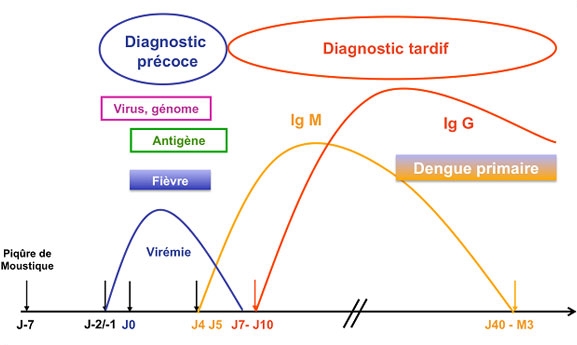
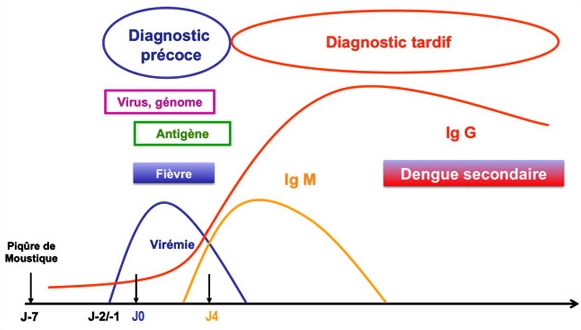
- IgM antibodies appear starting on the 5th day after the onset of clinical symptoms and persist for an average of 2 to 3 months
- IgG antibodies appear shortly after IgM (primary dengue) or at the same time (secondary dengue) as IgM and persist for life.
In the presence of IgG alone (without IgM), a diagnosis of dengue can only be established if there is an increase in the antibody titer (IgG) in successive samples taken at a minimum interval of 10 days, indicating a recent infection. Early testing (up to Day 7) using RT-PCR should be prioritized due to its significantly higher specificity compared to serology.
It is essential to accurately identify the date of symptom onset (DSO) to guide diagnostic testing.
Kinetics of the Virus and IgM and IgG Antibodies During Dengue Virus Infection. A Case of Primary Infection.
Dynamics of the Virus and IgM and IgG Antibodies During Dengue Virus Infection: A Case of Secondary Infection
The diagnostic protocol recommended in the ministry’s plan to “prevent the spread of chikungunya and dengue” is as follows:
- Up to 5 days after the onset of symptoms (D5): RT-PCR
- Between D5 and D7: RT-PCR and serology
- After D7: serology only (IgG and IgM) with a second confirmatory sample taken no earlier than 10 days after the first sample
Blood samples may be collected by any clinical laboratory. Each sample must be accompanied by a clinical information form.
Preventing Dengue
Preventing dengue relies on both individual and community actions.
Individual Prevention
Individual prevention involves:
- preventing mosquito bites:
- Eliminating potential breeding sites around homes (standing water, gutters, vases, buckets, trash, etc.);
- Wearing loose-fitting, covering clothing (long sleeves and pants);
- Using skin repellents—such as sprays or creams—on parts of the body not covered by clothing;
- Installing mosquito screens on doors and windows;
- Use a mosquito net when sleeping, even during the day;
- Create drafts (using fans or, if possible, air conditioning).
This protection is especially important during the day. Aedes mosquitoes, which transmit the disease, bite mainly during the day, with peak activity at dawn and dusk.
Vaccination: There is a vaccine against dengue (Qdenga®), marketed by Takeda. The HAS has issued a favorable opinion on the use of the Qdenga® vaccine in the French West Indies, French Guiana, as well as in Mayotte and Réunion in 2024. Starting in April 2025, vaccination against dengue is recommended in these departments for children aged 6 to 16 who have had a previous dengue infection, as well as for adults aged 17 to 60 with comorbidities, with or without a history of dengue infection. The Qdenga® vaccine is a live-attenuated vaccine; it is therefore contraindicated in immunocompromised individuals as well as in pregnant or breastfeeding women.
The vaccination schedule consists of two doses, administered three months apart.
Note that in the case of a recent dengue virus infection, it is recommended to wait 6 months before starting the dengue vaccination series.
Regarding vaccination for travelers, the dengue vaccine is recommended for travelers aged 6 years and older (regardless of personal history of dengue) if they are traveling to an area with a confirmed outbreak or if they are staying for more than one month in an area where dengue is considered endemic (incidence rate greater than 100 per 100,000 people).
Learn more:
- Information on the Qdenga® vaccine
- Dengue Vaccination | vaccination-info-service.fr
- Dengue Vaccination Strategy | Recommendation from the French National Authority for Health (HAS)
- Health Recommendations for Travelers (for healthcare professionals) | High Council for Public Health (HCSP)
Community Prevention and Vector Control
Vector control refers to all measures taken to combat and protect against mosquitoes that transmit dengue. Strategies depend on the vectors as well as the epidemiological and socioeconomic context. These include chemical control, biological control, genetic control, environmental measures, health education, and community engagement. Finally, the effectiveness of these methods is subject to ongoing evaluation.
Vector control operations may be initiated by the Regional Health Agency (ARS) when a public health risk is identified. These are targeted, strictly regulated interventions that are part of a public health strategy aimed at reducing the risk of local transmission of diseases such as dengue fever. They aim to minimize the number of adult mosquitoes that may have bitten an infected person and could therefore transmit the disease to others in the vicinity. Along with other public health measures, they also aim to reduce the risk of a disease becoming endemic (the long-term establishment of a disease in a region) or of epidemics occurring, to reduce the transmission of pathogens by vectors, and to manage outbreaks of vector-borne diseases—all within a formalized strategic framework.
Depending on the scale at which this mosquito control is carried out, we distinguish between control efforts carried out at the regional level (departments, municipalities) and those implemented at the individual level, which specifically target mosquito breeding sites (larval habitats) located in the immediate vicinity of homes.
"The set of measures intended for the control of and protection against vectors of human pathogens (mosquitoes, lice, etc.) and their surveillance." data-tooltip-title="all measures intended to control and protect against vectors of pathogens harmful to humans (mosquitoes, lice, etc.) and to monitor them." data-tooltip-content="" data-tooltip-placeholder-is-selection="true" data-tooltip-placeholder-is-selection-text="vector control" data-tooltip-data="[{"tooltipTitle":"all measures intended for à the%control and protection against vectors of pathogens affecting humans (mosquitoes, lice, etc.) and their monitoring.’human (mosquitoes, lice…) and their monitoring.","tooltipContent":"","placeholderIsSelection":"true","placeholderIsSelectionText":"vector control"}]">vector control at the regional level is carried out by public mosquito control agencies. Chemical control has two components:
- Larvicides, which target mosquito larvae specifically
- Adulticides, which specifically target adult mosquitoes
A mosquito established in mainland France
Aedes albopictus (also known as the tiger mosquito) is considered the most invasive mosquito species in the world. It is native to Southeast Asia, from where it spread through commercial transportation. In Europe, it was first identified in Albania in 1979 and then in Italy in 1990. It has been established in southern France since 2004 and has been gradually spreading since then, particularly in Southern and Central Europe.
As of early 2026, 83 departments were infested by the Aedes albopictus mosquito (out of 96 metropolitan departments).
Departments in mainland France where the Aedes albopictus vector is present
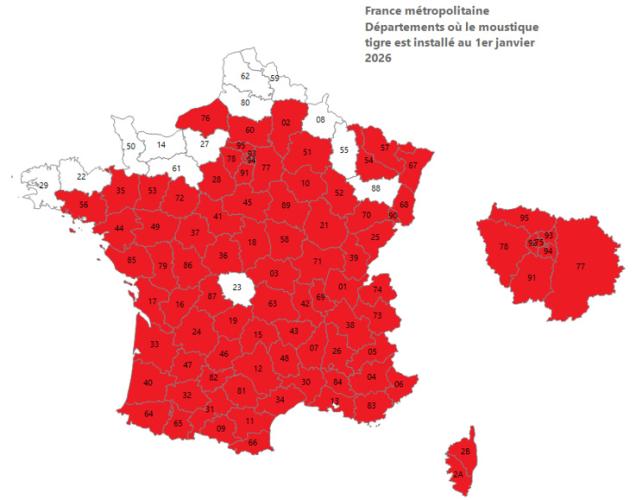
Municipalities Infested by the Tiger Mosquito as of January 1, 2026
Links
In relation to

Chikungunya
thematic dossier
Chikungunya is a viral disease transmitted by mosquitoes of the genus Aedes. The most common symptoms are fever and joint pain.

Zika
thematic dossier
Zika is a viral disease transmitted primarily by mosquitoes but also through sexual contact. Symptoms are usually mild, but the virus can cause birth defects if a woman becomes infected during...











