National Survey on Hepatitis B and C Screening, LaboHep, France, 2016
HCV Antibody Screening
Key Points
Based on a random sample of 2,008 laboratories selected by lottery (1,079 participating laboratories), it is estimated that in 2016 in France:
4.1 million serological tests for hepatitis C (anti-HCV antibodies) were performed (+14% since 2013), with the majority (71%) conducted in the private sector.
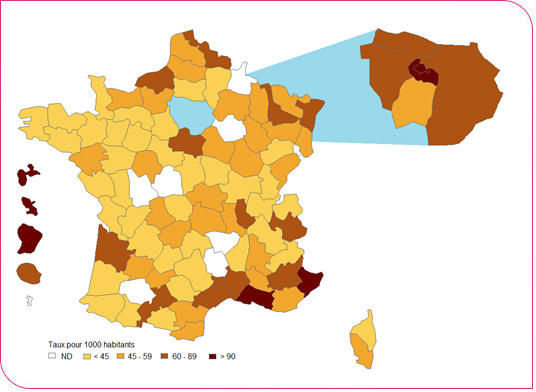
The number of anti-HCV Ab screening tests per capita is estimated at 62 per 1,000 inhabitants; it is higher in Île-de-France, particularly in Paris (174 per 1,000) and Val-de-Marne (125 per 1,000), as well as in the French departments of the Americas (DFA): Martinique (111 per 1,000), Guadeloupe (106 per 1,000), and French Guiana (101 per 1,000)
the positivity rate (control indicator) for anti-HCV antibody screening is estimated at 0.7%, down from 2013 (0.9%): - it is higher in the public sector (1.2%) than in the private sector (0.5%)- it is higher in Île-de-France (1.0%) and Occitanie (0.9%) than in other regions
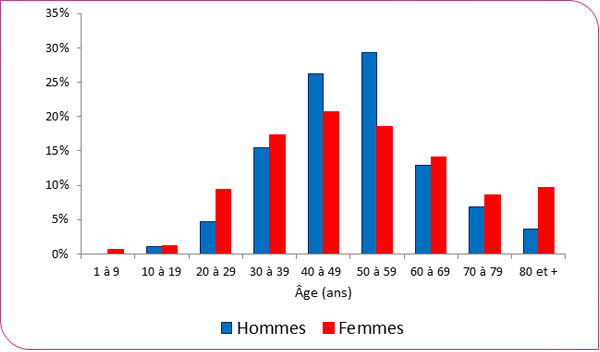
People confirmed as positive for hepatitis C for the first time in 2016 are predominantly men (56%) with an average age of 51. - more than half (55%) of men are between 40 and 59 years old- women tend to be older (average age: 52 years), with one-third of them aged 60 and older
This new edition of the LaboHep survey shows that in France, HCV antibody screening activity is high and has been increasing since 2010, while the number of confirmed positive HCV tests and the HCV antibody positivity rate are declining. This decrease may be partly linked to the impact of second-generation direct-acting antiviral agents (DAAs) and harm reduction policies targeting drug users, the primary reservoir for HCV transmission. This survey highlights marked regional and departmental disparities, particularly between the Overseas Departments and Regions (DROM) and Metropolitan France.
Participation
The overall participation rate of laboratories in this survey is 54%: this rate is higher for public laboratories (64%) than for private laboratories (51%). It is higher in metropolitan France (54%) than in the overseas departments and regions (DROM) (39%). The highest participation rate was observed in Brittany (74%) and the lowest in French Guiana (18%).
Overall serological testing for anti-HCV antibodies (Ab)
The overall serological testing activity for anti-HCV antibodies (Ab) is estimated at 4.1 million [95% CI: 3.9 – 4.4] in France in 2016, of which 71% were performed in private-sector laboratories (i.e., 2.9 million [95% CI: 2.7 – 3.1]). Anti-HCV Ab screening activity increased by 6% between 2010 and 2013 and by 14% between 2013 and 2016.Relative to the French population (provisional INSEE estimates as of late 2016), anti-HCV antibody testing activity is estimated at 62 tests per 1,000 inhabitants. In mainland France, HCV antibody testing rates are highest in Île-de-France, particularly in Paris (174 per 1,000) and in Val-de-Marne (125 per 1,000), as well as in Alpes-Maritimes (97 per 1,000). In the French departments of the Americas (DFA), anti-HCV antibody screening activity is high in Martinique (111 per 1,000), Guadeloupe (106 per 1,000), and French Guiana (101 per 1,000)
Figure 1 - Number of anti-HCV antibody tests performed per 1,000 inhabitants, by department, LaboHep 2016, France
Number of confirmed positive anti-HCV antibody tests
The number of confirmed positive anti-HCV antibody tests for the first time in 2016 is estimated at 30,229 [95% CI: 26,189–34,269], half of which were performed in private LABMs. Following a 10% increase between 2010 and 2013, there was a 7% decrease in the number of confirmed positive tests between 2013 and 2016.
Note: The number of positive tests does not reflect the number of people newly diagnosed as positive for anti-HCV antibodies in 2016, as the same person testing positive for the first time in different laboratories may be counted multiple times.
Relative to the population (provisional INSEE estimates as of late 2016), the number of confirmed positive anti-HCV antibody tests for the first time in laboratories in 2016 is estimated at 45 per 100,000 inhabitants, down from previous years (46 per 100,000 in 2010 and 49 per 100,000 in 2013).The highest number of confirmed positive anti-HCV antibody tests is observed in Île-de-France (95 per 100,000), particularly in Paris (212 per 100,000) and Seine-Saint-Denis (133 per 100,000), as well as in the Provence-Alpes-Côte d'Azur (PACA) (61 per 100,000), particularly in the Hautes-Alpes and Vaucluse departments (93 and 85 tests per 100,000 inhabitants, respectively) and in the Occitanie region, specifically the Hérault department (92 per 100,000).
Figure 2 - Number of confirmed positive anti-HCV antibody tests* per 100,000 inhabitants, by department, France, LaboHep 2016
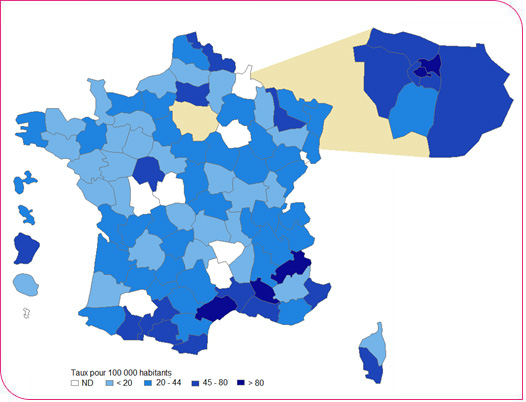
*Tests confirmed positive for the first time in the laboratory
Positivity rate (control indicator) for anti-HCV antibody (Ab) screening
The positivity rate (control indicator) for anti-HCV antibody screening is estimated at 0.7% [95% CI: 0.7%–0.8%] for all of France in 2016, down from 2010 and 2013 (0.9% in both years).
The positivity rate is higher in public laboratories (1.2%) than in private laboratories (0.5%), and is lower in the French overseas departments and regions (DROM) than in metropolitan France.
The highest anti-HCV antibody positivity rates are observed in the Île-de-France and Occitanie regions (1.0% and 0.9%, respectively) compared to other regions.
Description of individuals confirmed positive for anti-HCV antibodies
Individuals confirmed positive for anti-HCV antibodies for the first time in 2016 were predominantly men (56%).
Among individuals confirmed positive for anti-HCV antibodies for the first time in 2016, 50% were aged 40–49.
Women confirmed positive for anti-HCV antibodies are slightly older than men (mean age: 52 years versus 51 years, respectively).
Among men: the 50–59 and 40–49 age groups are the most represented (28% and 27%, respectively)
Among women: the 40–49 and 50–59 age groups account for 21% and 19% of the total, respectively.
Distribution by sex and age of individuals confirmed positive* for anti-HCV antibodies (LaboHep 2016, France)