



Health Issues
What is ultraviolet radiation?
Ultraviolet radiation, which is completely invisible to the human eye, is part of the electromagnetic spectrum emitted by the sun. It is ubiquitous, emitted naturally by the sun as well as by artificial sources. It does not produce any sensation of heat.
The electromagnetic spectrum
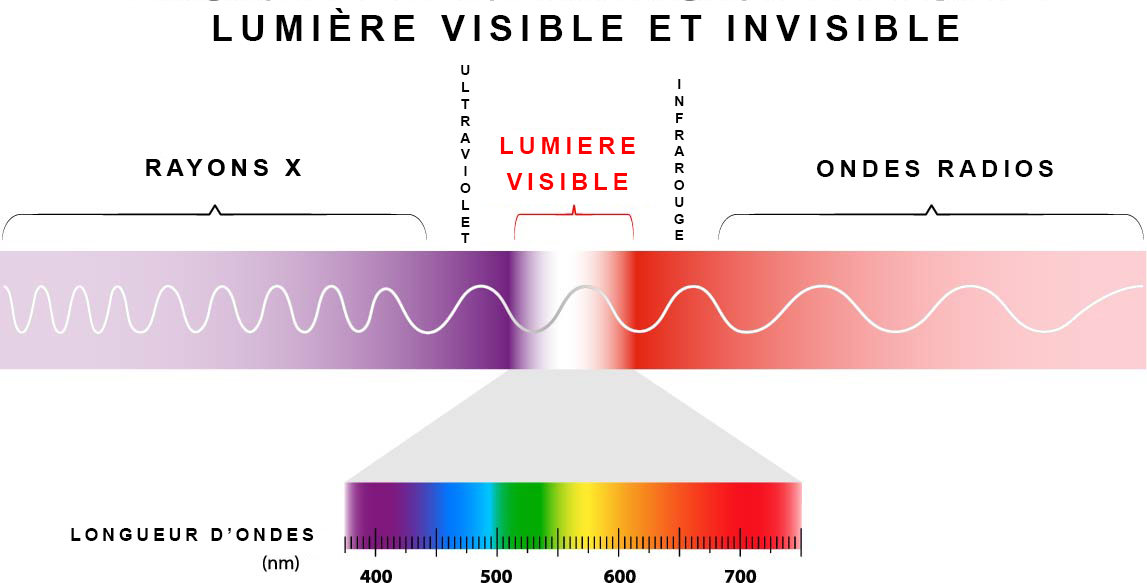
There are several types of ultraviolet radiation, commonly divided into three bands:
UVA (315–400 nm), much of which reaches the Earth’s surface. This is the most penetrating type of ultraviolet radiation: it can pass through glass.
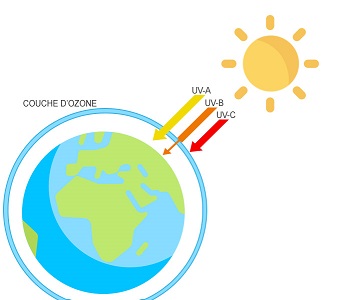
UVB (280–315 nm), nearly 90% of which is absorbed by ozone, water vapor, oxygen, and carbon dioxide in the Earth’s atmosphere before reaching the Earth’s surface
UVC rays (100–280 nm) are completely absorbed by the ozone layer and therefore do not reach the Earth’s surface.
The UV radiation present at the Earth’s surface consists largely of UVA, with a small fraction of UVB.
According to the IPCC, due to global warming, an increase in sunshine is expected, and consequently an intensification of UV radiation.
The different types of UV rays
L’intensité des UV solaires dépend de plusieurs paramètres que sont :
- la localisation sur Terre (au niveau des tropiques ou des pôles) : l’exposition aux UV diminue à mesure que l'on s’éloigne de l’équateur ;
- la saison : les rayons UV sont plus forts au printemps et en été mais ce facteur est moins important à proximité de l’équateur ;
- l’heure de la journée : plus le soleil est haut dans le ciel pour l’intensité des rayons UV est élevée. Elle atteint son maximum lorsque le soleil est au zénith (en été, entre 12h et 16 h en France métropolitaine et 11h et 15 h en Outre-mer) ;
- l’altitude : les rayons UV sont plus intense car l’épaisseur de l’atmosphère y est plus mince ;
- la météo : une épaisse couverture nuageuse à moyenne altitude réduit l’intensité des rayons UV de 30 à 70 %, alors que qu’une légère couverture ne les réduit que de 5 à 10 % ;
- la composition de l’atmosphère : plus la couche d’ozone est épaisse, plus moins les rayons UV sont intense alors que les polluants atmosphériques diminuent l’intensité des rayons UV.
Plus le soleil brille haut, plus les UV sont intenses. Un moyen facile de vérifier l’intensité des UV est d’observer son ombre : plus elle est courte, plus les rayons UV sont intenses.
Selon, l’UNEP et le GIEC, il est prévu en raison du réchauffement climatique une augmentation des périodes d’ensoleillement durant l’année et une hausse des températures, notamment dès le printemps.
En savoir plus :
- Environmental consequences of interacting effects of changes in stratospheric ozone, ultraviolet radiation, and climate: UNEP Environmental Effects Assessment Panel, Update 2024. Photochem Photobiol Sci 24, 357–392 (2025).
- Rayonnement ultraviolet
- Rayonnement ultraviolet (UV) | Effets sur la santé | Observatoire européen du climat et de la santé Climate-ADAPT
- Protocole de Montréal et la Santé Humaine : comment une action mondiale nous protège des ravages du rayonnement ultraviolet | UNEP
- Soleil : attention aux UV ! | Météo-France
What are the risks associated with excessive exposure to ultraviolet radiation?
Whether natural (emitted by the sun) or artificial (medical treatments, tanning beds, tanning lamps, etc.), ultraviolet (UV) radiation has both beneficial and harmful effects on health.
Exposure to sunlight affects mood and allows the body to produce vitamin D. However, it is generally accepted that daily exposure of 10 to 15 minutes of the face, forearms, and hands in the summer is, with rare exceptions, sufficient to maintain vitamin D levels for fair-skinned people in mainland France; for people with dark or black skin, 15 to 90 minutes are necessary.
Ultraviolet rays are also used to treat several conditions, including rickets, psoriasis, eczema, and jaundice. These treatments must be administered under medical supervision due to the risks associated with UV exposure.
Conversely, excessive exposure to ultraviolet rays, whether natural or artificial, causes:
In the short term:
Skin inflammation: erythema (commonly known as “sunburn”), solar urticaria
Eye inflammation (photokeratitis, photoconjunctivitis, acute solar retinopathy)
Skin changes such as increased melanin production by melanocytes (which causes tanning) or thickening of the superficial skin layers (to reduce UV penetration into the deeper layers of the skin). These changes are the initial consequence of excessive UV exposure and indicate that the components of the skin, skin cells, and their DNA are undergoing damage that the body struggles to repair.
In the longer term: degenerative cellular and molecular changes in fibrous tissues and blood vessels, resulting in:
Eye conditions: cortical cataracts, pterygium, pinguecula
Immunosuppression, including suppression of cell-mediated immunity and consequently an increased risk of infection or reactivation of latent infections (e.g., cold sores, papillomavirus…)
Skin changes:
Accelerated aging (premature loss of elasticity and the appearance of wrinkles)
Pigmentation: appearance of freckles, nevi, or new moles, and lentigines commonly known as “age spots”
Precancerous lesions (actinic keratoses), skin cancers (basal cell carcinoma, squamous cell carcinoma, or melanoma), and lip cancer.
Natural or artificial UV radiation is classified as carcinogenic (Group 1, known carcinogen) by the International Agency for Research on Cancer (IARC).
Long-term effects pose a lifelong risk and accumulate over time. Thus, any new exposure to UV radiation, regardless of age, increases the risk of developing the various conditions listed above (cortical cataracts, pterygium, skin cancers, etc.) a few years later.
Different types of UV radiation do not have the same effects on our bodies:
UVA rays, which penetrate deeply into the skin (down to the dermis), accelerate skin aging and promote the development of skin cancers. They are responsible for the immediate tanning effect.
UVB rays, which act on the epidermis (the skin’s outer layer) and stimulate melanin production, are responsible for sunburn and tanning. They also contribute to skin aging (by damaging collagen fibers) and the development of skin cancers. They are also beneficial in promoting vitamin D synthesis (which can also come from food) and for certain types of skin conditions such as psoriasis.

WHO. Ultraviolet radiation (UV). Frequently asked questions: The known health effects of UV.

Solar ultraviolet radiation: Global burden of disease from solar ultraviolet radiation.
Which groups are most at risk?
The risk associated with excessive UV exposure particularly affects:
Children, whose skin is thinner and more delicate than that of adults. Furthermore, excessive sun exposure during childhood is the leading cause of melanoma in adulthood.
Professionals who work outdoors: farmers, ranchers, foresters, gardeners, sports staff, and employees at ski resorts or beach resorts, construction workers, etc.
People who use artificial UV light (tanning beds).
People who use this type of device are exposed to intense sources of UVA radiation (much stronger than natural light). The risk of skin cancer is increased, as the doses of ultraviolet radiation received in tanning beds are added to those from natural UV radiation. The risk of developing skin melanoma is increased by 15% among people who have used artificial UV light at least once in their lives, and by 59% when exposure begins before the age of 35.
Therefore, the use of tanning beds is not recommended and is even prohibited for people under the age of 18.
How can you protect yourself from UV rays?
Essential steps to take:
Stay in the shade during peak hours (between noon and 4 p.m. in the summer),
Avoid sun exposure between 12 p.m. and 4 p.m.,
Wear lightweight, covering clothing,
Wear sunglasses (note: some sunglasses, even with dark lenses, do not protect against UV rays)
Wear a hat,
Apply sunscreen (SPF 30 or higher) every 2 hours when the skin cannot be covered.
In addition, avoid tanning beds, as artificial UV rays are just as dangerous as natural UV rays and do not prepare the skin for tanning. Their use is prohibited for those under 18.
In relation to
Climate change
thematic dossier
Climate change is rapidly and profoundly altering the environment. The health impacts of climate change are numerous and varied.

Skin cancers
thematic dossier
Skin cancer may be the most common form of cancer in France. Caused in more than 85% of cases by excessive exposure to natural or artificial ultraviolet (UV) radiation, it can be prevented by...

Nutrition and Physical Activity
thematic dossier
Nutrition and physical activity are two major determinants of health that contribute to improving the health of the population and are key priorities in public health policy.












