


Data
The 2015 Cancer Barometer highlighted the public’s attitudes and behaviors regarding UV exposure, cancer prevention and screening methods, as well as perceptions of the disease and the quality of care.
Persistent Misconceptions
>9
in 10 people are convinced that sun exposure is a likely cause of skin cancer
According to the 2015 Cancer Barometer, more than 9 out of 10 people are convinced that sun exposure is a likely cause of skin cancer and agree that the sun causes premature skin aging. The perception of being well-informed about the cancer risks associated with sun exposure is higher among executives and residents of coastal regions.
Users of artificial UV light also mistakenly claim that UV rays in tanning beds are less harmful than the sun and are less likely to follow recommended prevention methods.
Misconceptions such as “sunburns prepare the skin by making it less vulnerable to the sun” or “using tanning beds before vacation helps prepare the skin to protect against sunburn” persist, and in some cases are even worsening—particularly regarding the belief that sunburns during childhood have no consequences in adulthood.
Protection is not yet universal
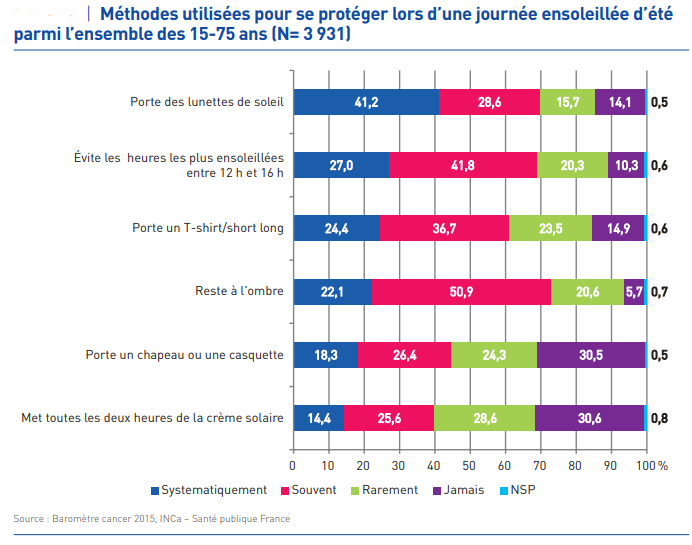
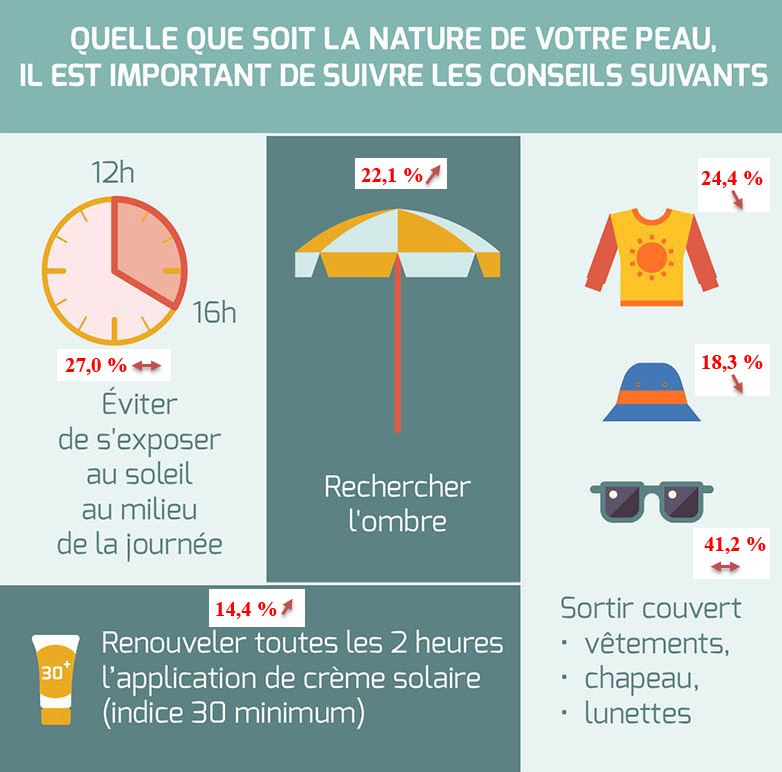
According to the 2015 Cancer Barometer, among young people and adults, sun protection is not systematic: only 27.0% avoid the sunniest hours, 22.1% stay in the shade, 14.4% apply sunscreen every two hours, 24.4% wear a T-shirt or long shorts, 41.2% wear sunglasses, and 18.3% wear a hat or cap.
In contrast, parents tend to be more attentive to protecting their children: more than half of parents with children under 15 and 70% of parents with children under 4 report avoiding sun exposure or protecting their children with sunscreen, a T-shirt, and a hat.
Trends since 2005
27%
Only young people and adults avoid the sunniest hours
Among the employed population, 21.9% report having to work frequently or routinely in the sun (primarily men, individuals with a high school diploma or lower, farmers, or other self-employed professionals) and have greater difficulty using collective or individual protective measures.
The use of artificial ultraviolet light also involves users under the age of 18, despite the ban on this practice for minors.

The proportion and number of cancers attributable to ultraviolet radiation
In mainland France in 2015, among people aged 30 and older,
More than 10,000 new cases of melanoma were attributable to exposure to solar ultraviolet radiation, representing 3.0% of all cancers and 83.5% of all new cases of melanoma in 2015 (78.5% among women and 88.6% among men).
380 new cases of melanoma were attributable to the use of tanning beds (290 among women and 90 among men), representing 4.6% of all new melanoma cases among women and 1.5% among men.

: Knowledge, beliefs, and practices of the general population in 2015. Saint-Maurice: Santé publique France, 2018. 46 p.

article
11 June 2019
Number and Proportion of Cancers Attributable to Lifestyle and Environmental Factors in Metropolitan France in 2015: Key Findings

IARC website
Download
Cancers attributable to lifestyle and environmental factors in mainland France
In relation to
Climate change
thematic dossier
Climate change is rapidly and profoundly altering the environment. The health impacts of climate change are numerous and varied.
Skin cancers
thematic dossier
Skin cancer may be the most common form of cancer in France. Caused in more than 85% of cases by excessive exposure to natural or artificial ultraviolet (UV) radiation, it can be prevented by...
Nutrition and Physical Activity
thematic dossier
Nutrition and physical activity are two major determinants of health that contribute to improving the health of the population and are key priorities in public health policy.












