


SCoPe: A Seroprevalence Study Among a Vulnerable Population in Perpignan
Santé publique France, in partnership with Perpignan University Hospital, conducted a seroprevalence study in three disadvantaged neighborhoods of Perpignan that were particularly hard-hit by the first wave of the COVID-19 pandemic.
Stay informed about the COVID-19 pandemic in France and around the world
Updates, Q&As, expert interviews... everything you need to know about the novel coronavirus (SARS-CoV-2) and COVID-19 in France and around the world
Background of the Study
During the first wave in March 2020, the COVID-19 epidemic had a particularly severe impact on disadvantaged neighborhoods in Perpignan, where the population is predominantly Romani. To address the surge in cases, dedicated COVID centers were urgently set up in these neighborhoods, and lockdown measures were strengthened. Specific surveillance conducted by Santé publique France confirmed that viral circulation had been more intense in these neighborhoods.
Subsequently, a cross-sectional seroprevalence survey of anti-SARS-CoV-2 antibodies in the population of these neighborhoods (ScoPe) was initiated by the Perpignan University Hospital in partnership with Santé publique France to more accurately estimate the impact of the first wave. This approach made it possible to assess the remaining epidemic potential in these neighborhoods and to adapt prevention measures for a population that is particularly vulnerable both to the risk of infection and to its severity.
Objectives
Main objective:
To determine the incidence rate of COVID-19 by estimating the prevalence of anti-SARS-CoV-2 antibodies in the population of these neighborhoods.
Secondary objectives:
to analyze the concordance between serological markers and the presence of clinical symptoms,
to study the association between seroprevalence levels and sociocultural and environmental factors.
Study Population
The survey covered individuals aged 6 and older who had resided in the study area since January 1, 2020. The study area consisted of three neighborhoods in Perpignan: Saint-Jacques, Haut-Vernet (Iris Haut-Vernet 3), and Nouveau-Logis.
Study Design
The study took place from June 30 to July 17, 2020. Within each neighborhood, households were selected at random, and then individuals were chosen from within those households. These individuals were invited to participate in the survey during a home visit by representatives from local organizations and staff from neighborhood social centers. Participants then went to dedicated survey centers where doctors and nurses from Perpignan University Hospital administered a questionnaire and drew blood samples. The biological analyses were performed by the Perpignan University Hospital laboratory using the Elecsys Anti-SARS-CoV-2 method.
In total, 700 people were sampled during the survey, including 312 people in Saint-Jacques, 173 people in Haut-Vernet, and 215 people in Nouveau Logis. Among the households contacted, 73.6% agreed to be included in the survey at the time of the home visit. The participation rate among those selected at random reached 56.1%.
Preliminary results
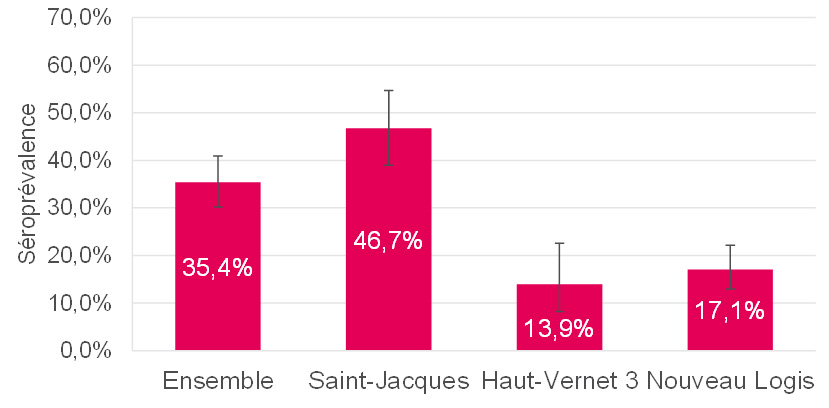
Across all neighborhoods, the proportion of HIV-positive individuals was 35.4% [95% confidence interval: 30.2–41.0]. This seroprevalence reached 46.7% [39.0–54.7] in Saint-Jacques and was significantly different from the Haut-Vernet and Nouveau Logis neighborhoods, where it reached 13.9% [8.2–22.6] and 17.1% [13.0–22.2], respectively.
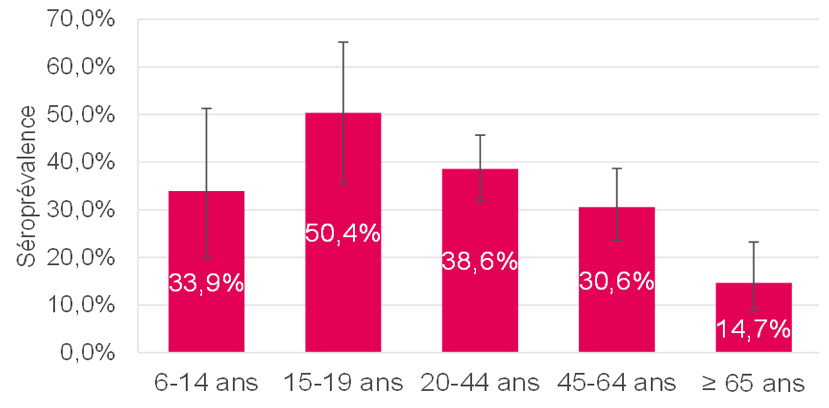
39.2% of women were seropositive and 31.5% of men. Seroprevalence was 33.9% among 6- to 14-year-olds, 50.4% among 15- to 19-year-olds, 38.6% among 20- to 44-year-olds, 30.6% among 45- to 64-year-olds, and 14.7% among those aged 65 and older. When adjusted by neighborhood, seroprevalence was significantly lower among those aged 65 and older and significantly higher among women.
Among HIV-positive individuals, 21.7% [14.1–31.8] reported having no symptoms.
COVID-19 Seroprevalence by Neighborhood, SCoPe Survey, June 2020
COVID-19 Seroprevalence by Age, SCoPe Survey, June 2020
Preliminary findings
According to data from the Epicov study (a national seroprevalence study of the general population), the seroprevalence rate was estimated at 1.9% for the Occitanie region in May. These results, when compared to those of the SCoPe study, therefore confirm significant circulation of the SARS-CoV-2 virus within these neighborhoods of Perpignan during the first wave of the epidemic. Several factors may explain the intensity of this circulation and are currently being analyzed (sociocultural, environmental, health determinants, protective measures, and preventive behaviors).
The results of this study will be supplemented by a socio-behavioral approach currently being conducted by CREAI-ORS Occitanie, which was commissioned by Santé publique France to qualitatively document the specific situation observed in these same neighborhoods in response to the COVID-19 epidemic. More specifically, the aim is to study perceptions, attitudes, and practices related to the epidemic, infection, and the understanding and implementation of recommendations regarding protective measures and lockdown.
It remains essential that the population in these neighborhoods continue to strictly adhere to protective measures and preventive protocols. Beyond the risk of infection, this population is also at higher risk of developing severe forms of the disease due to the higher prevalence of certain conditions known to increase the risk of developing a more severe form of COVID-19.
Continued analysis and dissemination of all results
Statistical analysis of the data is ongoing to describe the affected population in greater detail and to assess the association between seroprevalence and the determinants of infection. These determinants include individual characteristics (comorbidities, sick individuals in the immediate environment, etc.) and collective characteristics (neighborhood, type of housing, and population density, etc.). The complete results will be available by the end of 2020 and will be shared with the public. They will be published in the form of a report and a scientific paper.
Data Confidentiality and Protection of Study Participants
The protocol for this study received approval from an Ethics Committee and was reported to the CNIL. Individuals who agreed to participate in the survey were informed of their rights to object, access, rectify, erase, and restrict the processing of their data. The results of their serological testing were made available to them or to their primary care physician if they had requested it. The collected data remains strictly confidential, and statistical analysis is performed only after the data has been anonymized.
See also
BMJ Open Scope article: https://bmjopen.bmj.com/content/11/11/e053201
ORS website:
Study report on the qualitative sociological approach conducted by Creai-ORS: https://creaiors-occitanie.fr/wp-content/uploads/2021/07/CREAI-ORS-Occitanie-Les-Gitans-de-Perpignan-face-a-la-COVID-19-Analyse-dun-cluster-hypotheses-Rapport-final.pdf
COVID-19 Report. Adoption of public health messages by vulnerable populations. Situation of the Romani community in Perpignan: https://creaiors-occitanie.fr/revues_litterature/covid-19-appropriation-des-messages-de-sante-publique-par-des-populations-en-situation-de-vulnerabilite-situation-de-la-communaute-gitane-de-perpignan/












