


COVID-19: Studies to track the proportion of the population infected with SARS-CoV-2 in France
Since March 2020, Santé publique France has been conducting seroprevalence studies using blood samples collected in clinical laboratories to estimate and monitor the proportion of people who have been exposed to the SARS-CoV-2 virus, which causes COVID-19, and have developed antibodies.
Stay informed about the COVID-19 pandemic in France and around the world
Updates, Q&As, expert interviews... everything you need to know about the novel coronavirus (SARS-CoV-2) and COVID-19 in France and around the world
To track the scale and course of the COVID-19 pandemic, it is essential to know the proportion of people in the general population who have developed antibodies against SARS-CoV-2 and who may therefore be immune. Surveillance based on confirmed COVID-19 cases detects only those who have been tested and struggles to capture cases that develop few or no symptoms of the infection. This is why Santé publique France, in collaboration with the National Reference Center for Respiratory Viruses (including influenza) at the Pasteur Institute and the Cerba and Eurofins Biomnis laboratories, is conducting several studies on the prevalence of antibodies against SARS-CoV-2 in the French population. These studies are carried out in several waves at key points in the epidemic.
Objectives
The results provide information on the proportion of the population that has been exposed to the virus and has developed antibodies against SARS-CoV-2, and more specifically:
better understand the scale of the epidemic at the national and regional levels,
better monitor, assess, and communicate about the progression of the COVID-19 epidemic,
better guide and adapt prevention strategies.
Method
Serological surveillance is based on the analysis of “tube residues” from blood samples collected in private or public clinical laboratories as part of specialized laboratory tests other than SARS-CoV-2 testing (tests performed by Cerba or Eurofins Biomnis laboratories).
These “tube bottoms” are randomly selected by sex, by 10-year age group, and by major geographic regions of metropolitan France, reflecting the distribution of the general population according to INSEE data as of January 1, 2020. All “tube bottoms” from the overseas departments, however, are included in the study, due to a small population size that does not allow for sampling as in mainland France. These samples cover the population—adults and children—across all French regions, regardless of age and sex. The department of Mayotte was excluded from the analyses due to an insufficient number of samples. The sampled “tube collections” are anonymized before being sent to the CNR, which means individual results cannot be reported.
All samples are tested using three serological techniques developed at the Pasteur Institute in Paris:
Two LuLISA (Luciferase-Linked Immunosorbent Assay) tests that target immunoglobulin (Ig) G antibodies directed against the N protein and the S protein of the SARS-CoV-2 virus. This test estimates the proportion of people who have been exposed to the virus.
Pseudoneutralization, which uses pseudoviruses carrying the virus’s S protein on their surface. This test estimates the proportion of people who have developed neutralizing antibodies likely to confer protection against infection, regardless of their type (IgG, IgM, IgA).
Results from 1 year of serological surveillance
A moderate increase in seroprevalence during the first two waves of the epidemic
During the first year of SARS-CoV-2 circulation in France, five surveys were conducted, each based on the collection of approximately 3,500 samples. Three surveys¹ were conducted before, during, and after the national lockdown from March 17 to May 11, 2020, in weeks 11-2020 (March 9–14), 15-2020 (April 6–12), and 20-2020 (May 11–17, 2020). Two surveys, in weeks 41-2020 (October 5–11, 2020) and 06-2021 (February 8–14, 2021), cover the second wave of the epidemic in the last quarter of 2020 and the end-of-year holiday period.
During the first wave of the epidemic, our surveys revealed an increase in national seroprevalence from 0.4% [95% credibility interval: 0.1–0.9] in mid-March, to 4.1% [3.3–5.0] in mid-April, and 4.9% [4.0–5.9] in mid-May 2020. National seroprevalence rose from 9.0% [6.9–11.0] to 13.2% [10.8–15.6] during the second wave, for a total of 8,832,000 [7,217,000–10,426,000] seropositive individuals by the end of the 2020 holiday season.
Children under 10 less affected
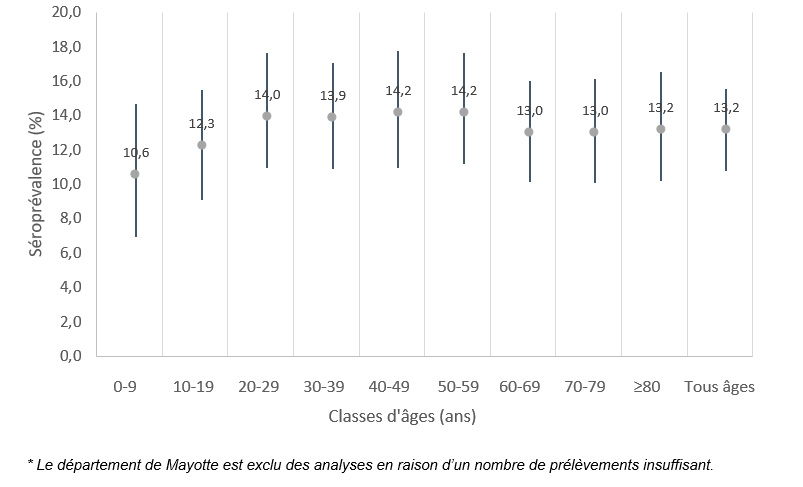
Infection rates increased across all age groups, with the highest seroprevalence in S6-2021 among people aged 20 to 59 (around 14%) and those over 80 (13.2%). Seroprevalence remained lowest among children under 10, at 10.6% at the end of the study period.
Estimates of SARS-CoV-2 infection seroprevalence by age in weeks 41 (October 5–11, 2020) and 6 (February 8–14, 2021), France*
A more severe outbreak in eastern France and the overseas regions
Regional seroprevalence estimates confirmed that eastern mainland France was more severely affected than the west, a finding also supported by incidence, hospitalization, and mortality data.
At the end of the first wave of the epidemic, while SARS-CoV-2 had already spread widely across all regions, prevalence was highest in Île-de-France (8.8%) and in the Grand Est (8.6%). Regional estimates of SARS-CoV-2 seroprevalence from all surveys are available on our Géodes mapping platform.
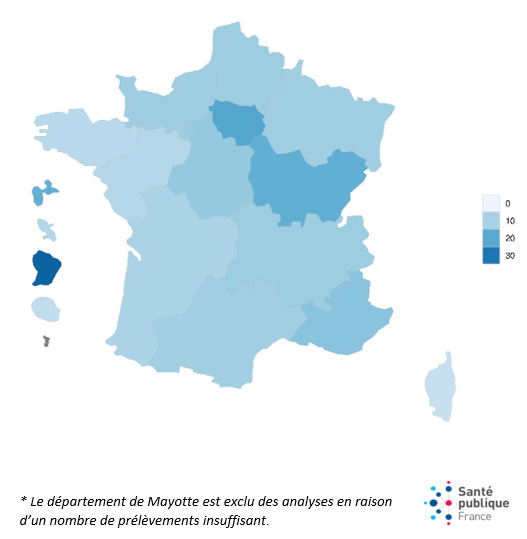
After the second wave of the epidemic in mainland France, in the second half of 2021, Île-de-France remained the most affected region in 2021 with a seroprevalence of 20.6%, followed by Bourgogne-Franche-Comté (18.7%) and Provence-Alpes-Côte d’Azur (13.9%), where viral circulation was particularly active in late 2020.
In the overseas departments and regions, the situation has been more varied since the first wave of the epidemic, with prevalence rates ranging from 2.40% in Martinique to 7.14% in French Guiana. At the start of 2021, prevalence rates in the overseas territories were higher in French Guiana (33%) and Guadeloupe (18.5%) than in Martinique (8.6%) and Réunion (6.3%).
Estimates of SARS-CoV-2 infection seroprevalence (%) by region, Week 6 of 2021 (February 8–14), France*
By the end of the first wave of the pandemic, 2.58% [2.16–3.17] of those infected were hospitalized for COVID-19, and 0.49% [0.41–0.60] required intensive care treatment for their infections. 0.84% [0.70–1.03] of those infected with the virus in France died, two-thirds of whom were in social and medical-social facilities, including residential care facilities for dependent elderly people (Ehpad)1.
Continued surveillance in 2021
After one year of monitoring the prevalence of SARS-CoV-2 infections in the French population, we have demonstrated that immunity acquired during the epidemic waves remains limited, despite major strains on hospital capacity having been observed.
Only mass vaccination would therefore allow us to rapidly achieve a level of herd immunity capable of positively impacting the course of the epidemic and preventing the saturation of hospital services.
Santé publique France continues to periodically measure the prevalence and immunity levels of the French population in 2021, taking into account the ramp-up of vaccination, the potential decline in antibodies, and the diversity of circulating strains.
1Le Vu, S., Jones, G., Anna, F., et al. Prevalence of SARS-CoV-2 antibodies in France: results from nationwide serological surveillance. Nat Commun 12, 3025 (2021).
The procedures for this study are implemented in accordance with the provisions of Articles L. 1413-7 and L. 1413-8 of the Public Health Code, in compliance with the procedures for reuse for scientific purposes by third parties of samples analyzed and stored for this purpose by Eurofins Biomnis and Cerba.












