CoviPrev: A survey to track changes in behavior and mental health during the COVID-19 pandemic

On March 23, 2020, Santé publique France launched the CoviPrev survey of the general population to track changes in behavior (precautionary measures, lockdown, alcohol and tobacco use, diet, and physical activity) and mental health (well-being and mental health issues).

CoviPrev by region: explore the epidemiological data

In the face of the COVID-19 pandemic and following the government’s lockdown measures of March 16, 2020, how are the French responding? How is this unprecedented health crisis changing behaviors, knowledge, and beliefs? What is the psychological impact on the population?

Santé publique France, in collaboration with BVA, has launched the CoviPrev survey to track changes in behavior (preventive measures, lockdown) and mental health among the general population (well-being, disorders), as well as their main determinants. The survey will be conducted regularly during the lockdown period and the post-lockdown period.

Objectives

  • Monitor the implementation of public health and safety measures during the lockdown and reopening periods

  • Collect the information needed to guide and adjust preventive measures

  • Monitor health inequalities

  • Gather insights useful for managing future pandemics

Survey Methodology

  • Repeated quantitative surveys on independent samples

  • Self-administered questionnaires to be completed online via a CAWI (Computer-Assisted Web Interview) system

  • Samples of 2,000 people aged 18 and older residing in metropolitan France recruited via an access panel (BVA Access Panel)

  • Quota sampling (gender, age, respondent’s socio-professional category, region, urban area category) adjusted based on the 2016 general population census

Survey Content

The questionnaire measures, on the one hand, awareness of and adherence to protective measures and, on the other hand, people’s mental health during the COVID-19 pandemic.

This module supports the objective of managing prevention measures during the epidemic. The aim is to monitor the factors most likely to affect the health situation in the short term, particularly the adoption of protective measures (factors influencing transmission) and mental health, which may also place an additional burden on the healthcare system.

Sociodemographic characteristics, knowledge, perceptions, proximity to the disease, and living conditions during the epidemic (lockdown, etc.) are the main determinants of the adoption of protective measures and mental health that are collected to provide information for identifying targets and levers for intervention.

The questionnaire also includes supplementary modules on addictions (alcohol and tobacco), nutrition, and physical activity, which will be incorporated into one or more waves of the survey to more broadly assess the impact of the situation on the population’s health.

Utilization of the Results

In the short term, this monitoring will provide a reporting tool to adjust government communication and prevention strategies, particularly those targeting the most vulnerable populations.

In the longer term, after the health crisis, this monitoring of indicators will be used to generate and build upon knowledge regarding the impacts of COVID-19 on the general population, mental health, and other health behaviors (use of psychoactive substances, nutrition, physical activity).

Results will be made available following each survey wave. They consist of:

  • a summary of the main results;

  • tables with detailed results showing the prevalence and trends of indicators according to sociodemographic characteristics and living conditions related to the pandemic, as well as analyses of cognitive determinants and their trends (perceptions of the disease and protective measures).

Results

The results of the CoviPrev survey cover the following topics: mental health, adoption of preventive measures, vaccination uptake, substance use, diet, and physical activity.

Mental health

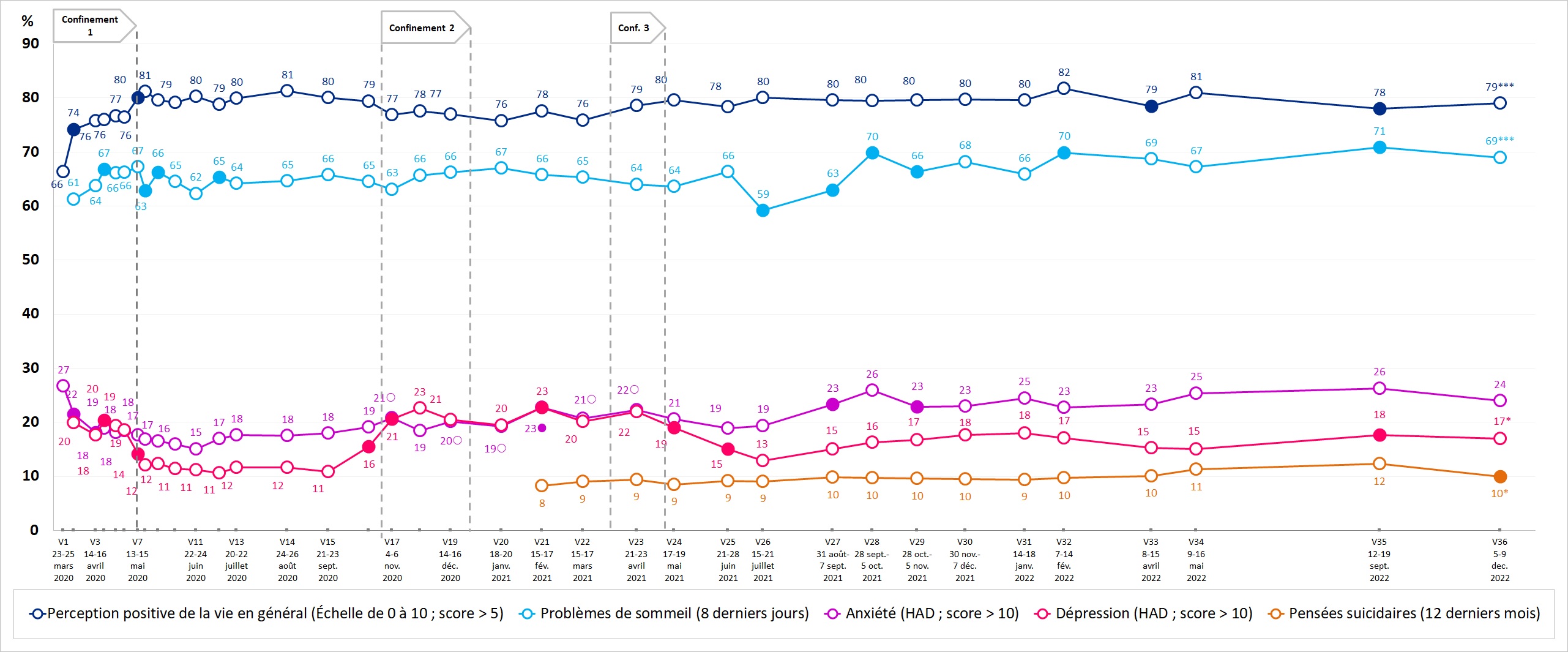
Results of Wave 37 of the CoviPrev survey (September 11–18, 2023)

  • 79% of French people report having a positive outlook on life in general [Trend stable compared to the previous wave, comparable to the same period in 2022]

  • 16% of French people show signs of depression [Trend stable compared to the previous wave, comparable to the same period in 2022]

  • 23% of French people show signs of anxiety [Trend stable compared to the previous wave, down 3 points compared to the same period in 2022]

  • 71% of French people report sleep problems over the past 8 days [Stable trend compared to the previous wave, comparable to the same period in 2022]

  • 10% of French people have had suicidal thoughts over the past year [Trend stable compared to the previous survey, down 2 percentage points compared to the same period in 2022]

Download:

Figure. Prevalence and trends in mental health indicators and sleep problems (weighted %). CoviPrev Survey, mainland France, September 2023

Figure. Prévalences et évolutions des indicateurs de santé mentale et des problèmes de sommeil (% pondérés). Enquête CoviPrev, France métropolitaine, septembre 2023
Notes. Changes were tested among samples that were comparable in terms of gender, age, socioeconomic status, urban area size, and region of residence. When a mark (circle) is filled in, the proportion is significantly different from that of the previous wave, adjusted Wald test, p<0.05. When the last proportion in the series is marked with an asterisk, that proportion is significantly different from that of the first point in the series (wave 1 or 2 depending on the indicator), adjusted Wald test, *: p<0.05; **: p<0.01; ***: p<0.001. HAD: Hospital Anxiety and Depression Scale

Implementation of preventive measures during the COVID-19 pandemic

The results presented here are from Wave 38 (August 30–September 9, 2024).

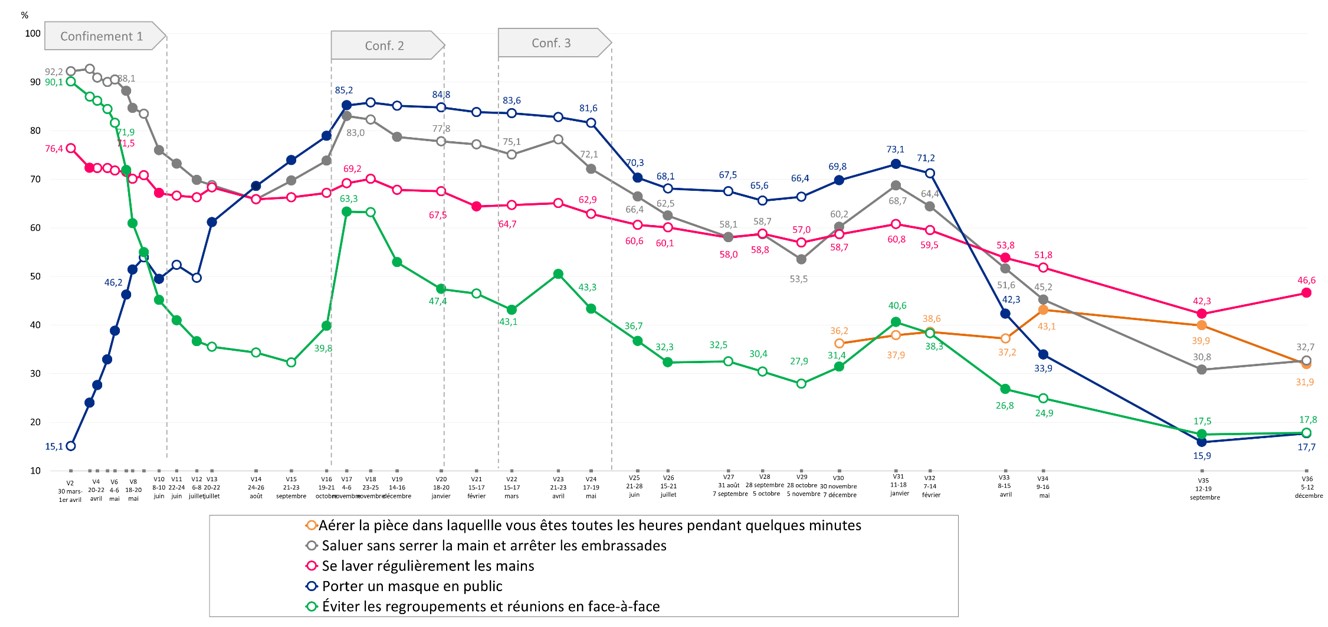
  • 29% of CoviPrev respondents reported wearing a mask often (16%) or always (13%) when experiencing symptoms, in the presence of vulnerable people, or in crowded places.

  • 43% of participants reported never wearing a mask when experiencing symptoms, in the presence of vulnerable people, or in crowded places.

  • 7% never wash their hands with soap or hand sanitizer.

Download:

Figure - Reported rates of consistent adherence to preventive measures and trends (weighted percentages). CoviPrev Survey (Wave 36, December 5–12, 2022), mainland France

Figure - Fréquences de l'adoption systématique déclarée des mesures de prévention et évolutions (% pondérés). Enquête CoviPrev (vague 36, 5-12 décembre 2022), France métropolitaine
Reading notes. Changes were tested across samples that were comparable in terms of gender, age, socioeconomic status, urban area size, and region of residence. When a mark (circle) is filled in, the proportion is significantly different from that of the previous wave (adjusted Wald test, p < 0.05).

Acceptance of COVID-19 vaccination among the general public

The results presented cover Wave 38 (August 30–September 9, 2024).

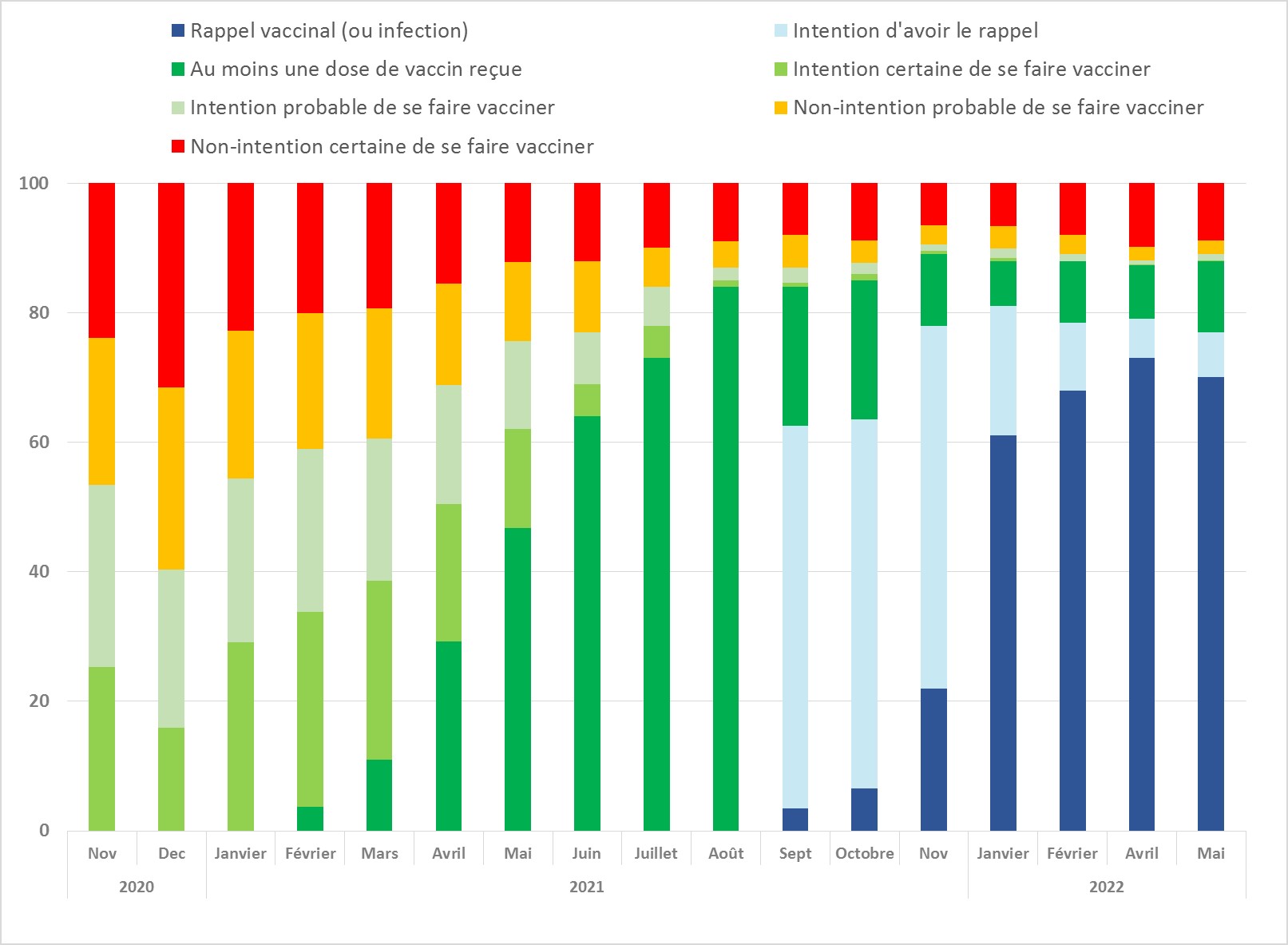
  • 59% of participants eligible for the new dose of the COVID-19 vaccine intend to get vaccinated this fall.

  • 50% (stable) of participants at risk of severe influenza due to their age (≥65 years) or health status (comorbidities, obesity) report wanting to receive both the flu and COVID-19 vaccines.

  • 23% (stable) of participants at risk of severe illness report that they do not intend to receive either the flu or the COVID-19 vaccine this fall.

Download:

Trends in COVID-19 vaccination and intentions to get vaccinated (weighted percentages). CoviPrev Survey (Wave 34), Metropolitan France

Évolution de la vaccination et des intentions de se faire vacciner contre la COVID-19 (% pondérés). Enquête CoviPrev (vague 33), France métropolitaine

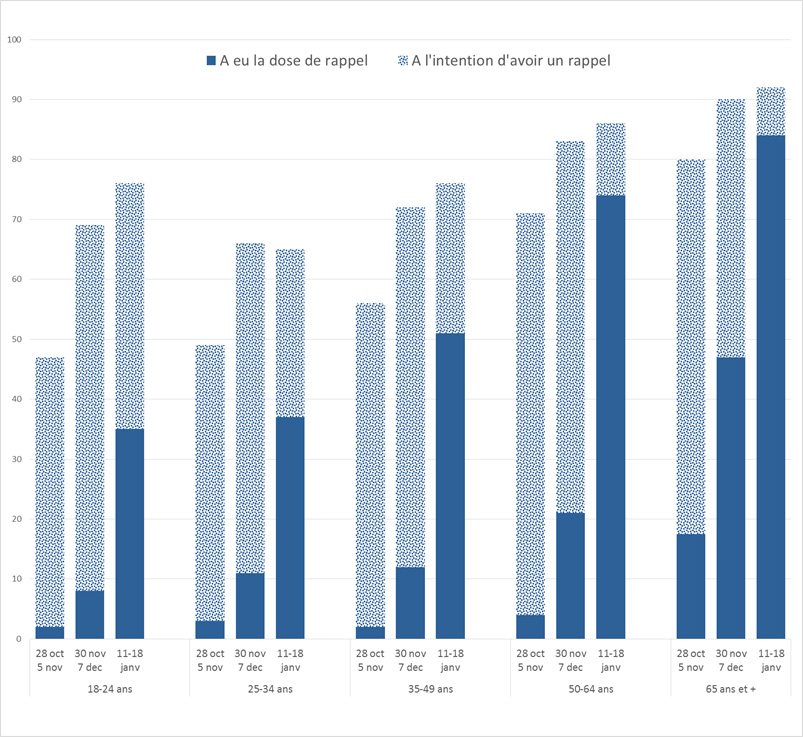
Trends in COVID-19 booster shot uptake (booster shot received and intention to get one) by age group (weighted %). CoviPrev Survey (Wave 31), mainland France.

Évolution de l’adhésion vaccinale à la dose de rappel contre la Covid-19 (dose de rappel reçue et intentions de le faire) selon les classes d’âge (% pondérés). Enquête CoviPrev (vague 31), France métropolitaine.

Changes in tobacco and alcohol use during the lockdown

The analyses presented focus on reported changes in tobacco and alcohol consumption levels during the lockdown.

Changes in tobacco use

Among the smokers surveyed (n=422):

  • 27% report that their tobacco use has increased since the lockdown

  • 55% said it remained stable

  • 19% reported that it had decreased

Almost all individuals reporting an increase in consumption were already smokers before the lockdown (94%). The average increase in the number of cigarettes smoked by daily smokers is 5 cigarettes per day.

The reasons cited by smokers reporting an increase in consumption were, in order (n=104, multiple responses allowed):

  • boredom, lack of activity (74%)

  • stress (48%)

  • pleasure (10%)

The increase in tobacco use was most frequently cited by:

  • people aged 25–34 (41%)

  • people working from home (37%)

  • women (31%)

Increased tobacco use rises with anxiety levels and is more common in cases of probable or confirmed depression.

Changes in alcohol use

Among the alcohol users surveyed (n=1,344):

  • 11% report that their alcohol consumption has increased since the lockdown

  • 65% said it has remained stable

  • 24% said it had decreased

The reasons cited by alcohol consumers who reported an increase in their consumption were, in order:

  • pleasure (45%)

  • boredom, lack of activity (32%)

  • stress (15%)

51% reported increasing the frequency of their drinking, 10% the number of drinks consumed on drinking days, and 23% both factors (note that the detailed data are inconsistent for 15% of respondents).

The increase in alcohol consumption is most frequently cited by:

  • those under 50 (between 14% and 17% depending on age group)

  • people living in a city with more than 100,000 inhabitants (13%)

  • Parents of children under 16 (18%)

Increased alcohol consumption is associated with a higher risk of anxiety and depression.

Changes in weight and eating habits during lockdown

The analyses presented focus on reported changes in weight, snacking, “home cooking,” access to food, and attention paid to food budgets.

Changes in weight

Among all respondents (n=2010):

  • 27% reported gaining weight

  • 11% reported losing weight

  • 62% reported that their weight remained stable

Weight gain was mentioned more frequently:

  • in cases of very difficult financial situations (36%)

  • by parents (34%)

  • by those under 40 (31%)

  • by those eating larger portions (66%) and snacking more between meals (60%) than usual

  • in cases of depression (42%), sleep problems (36%), and high levels of anxiety (37%)

Weight loss is mentioned more frequently:

  • by those under 40 (14%)

  • by those eating smaller portions (33%) and snacking less (25%) than usual

  • in cases of high anxiety (14%)

Changes in snacking

Among all respondents (n=2010):

  • 22% report snacking between meals more than usual

  • 17% less than usual

  • 61% have not changed their habits

Changes in "cooking homemade meals"

Among all respondents (n=2010):

  • 37% say they cook homemade meals more often than usual

  • 4% less than usual

  • 59% have not changed anything

Changes in the availability of food products

Among all respondents (n=2010):

  • 57% say they find the foods they want in stores less often than usual

  • 3% more than usual

  • 40% as much as before

Changes in attention paid to the food budget

Among all respondents (n=2010):

  • 23% are paying more attention than usual to their food budget

  • 14% pay less attention than usual

  • 63% have not changed anything

Snacking between meals more than usual, finding fewer of the desired foods in stores than usual, and paying more attention than usual to one’s food budget are more frequently mentioned by those under 40, parents, women, and those in very difficult financial situations.
This is also the case for people with depressive disorders, sleep problems, and anxiety.

Changes in physical activity and sedentary behavior during and after lockdown

Key indicators of physical activity levels and sedentary behavior among the French population during Wave 24 (May 17–19, 2021), one year after the strict lockdown:

  • 1 in 2 adults reported insufficient physical activity, below recommendations [No change since Wave 6 during the strict lockdown, indicating a persistent decline in adult physical activity over time despite the easing of restrictions]

  • One in five adults reported high levels of sedentary behavior, spending more than 7 hours a day sitting [a 12-point decrease compared to the strict lockdown period (Wave 6); this decrease was observed only among those reporting continued professional activity, excluding people working remotely, for whom no change in daily time spent sitting was noted]

Learn more: Changes in physical activity and sedentary behavior levels among the French population one year after the strict lockdown of 2020

The analyses presented focus on reported prevalence and trends in physical activity, time spent sitting, and time spent in front of a screen during lockdown (n=2000).

Physical activity

Among all respondents:

  • 57.6% engaged in less than the recommended 30 minutes of physical activity per day1 during lockdown. This was more common among women, those aged 25–49, those with lower levels of education, parents of children aged 16 or younger, and people living in urban areas.

Compared to their pre-lockdown habits:

  • 47.4% of people reported a decrease in their overall physical activity

  • 58.9% reported a decrease in walking

  • 37.1% reported a decrease in sports activity

Regarding sports activities, 17.9% nevertheless reported an increase in their participation, which grew over the course of the lockdown period (15.4% of respondents between April 14 and 16).

Among those who engaged in sports (n=1,170), 32.7% used apps, videos, or television more than usual to do so.

Sedentary behavior

Time spent sitting:

  • During lockdown, the average time spent sitting was 6 hours and 19 minutes per day

  • One-third of respondents (33.4%) reported spending more than 7 hours sitting per day, most frequently among those aged 18–24, those who worked from home during lockdown, and those living in urban areas

  • An increase in time spent sitting was also reported by 61.4% of respondents.

Breaking sedentary habits:

  • 44.7% reported getting up several times an hour, with the recommendation during lockdown being to do so at least every half hour2

  • 55.3% stood up less often, particularly those aged 18–34, those with higher education, people who worked from home during lockdown, and people living in urban areas

Screen time during leisure time:

  • The average time spent in front of a screen during leisure time was 5 hours per day

  • 23.0% of respondents reported spending 7 hours or more per day on screens, most frequently among those aged 18–24, those with lower levels of education, those who did not work during lockdown, and those living in urban areas

  • An increase in screen time during leisure time was reported by 59.0% of respondents

Mental health, physical activity, and sedentary behavior

Reduced physical activity, high amounts of time spent sitting, infrequent breaks from sedentary behavior, and time spent in front of a screen for leisure were reported more frequently by:

  • anxious individuals

  • people with depressive disorders

  • people with sleep problems

1 Physical activity includes activities performed at work, at home, or in the garden, for transportation, or during sports or leisure activities.
2 Opinion of the French Agency for Food, Environmental and Occupational Health & Safety regarding the assessment of risks associated with reduced physical activity and increased sedentary behavior during lockdown. Maisons-Alfort, 2020. 22 p.


3 Questions for Enguerrand du Roscoat, Head of the Mental Health Unit, Department of Prevention and Health Promotion at Santé publique France

Why is mental health so important during lockdown?

Mental health, particularly anxiety disorders, is identified in international publications as a major risk associated with the pandemic (fear of the disease for oneself and one’s loved ones) and with living conditions during lockdown (crowded living spaces, social isolation, loss of income, frustration, etc.). It is therefore a priority to maintain a minimum level of well-being and to prevent the development of mental health disorders in the population in the short term, in order to limit the strain on the healthcare system—and particularly on hospitals and emergency rooms—caused by an influx of people presenting with symptoms of acute anxiety or stress. Finally, a decline in mental health could lead to the adoption of unhealthy lifestyle habits (alcohol and other psychoactive substance use, nutrition, sleep, etc.), contribute to an increase in violence (particularly domestic violence), or add to the economic burden (work absences, etc.).

What specific information are you seeking?

We aim to assess the state of well-being and the prevalence of mental health disorders (particularly anxiety and depression) within the population, to identify the most vulnerable segments of the population, and to monitor their progress to ensure that inequalities do not widen during the lockdown period.

What concrete actions will follow the survey?

Analyzing the data collected after each wave, along with trends over time, will allow us to better address needs. Identifying the most vulnerable populations and the factors associated with well-being, distress, or mental health disorders will help us better guide and target prevention efforts.

Mental Health and Coronavirus Campaign: 'Talking about it is the first step towa...

COVID-19: Taking Care of Your Mental Health During the Pandemic

The coronavirus pandemic and the lockdown are affecting our daily lives and our physical and mental health. How can you take care of your mental health during the COVID-19 pandemic? Find...

Stay informed about the COVID-19 pandemic in France and around the world

Updates, Q&As, expert interviews... everything you need to know about the novel coronavirus (SARS-CoV-2) and COVID-19 in France and around the world