



The disease
Mental Distress and Burnout
According to the World Health Organization (WHO), mental health is not merely the absence of mental disorders. It is defined as follows: "A state of well-being in which every individual realizes his or her own potential, can cope with the normal stresses of life, can work productively and successfully, and is able to make a contribution to his or her community." Mental health is an essential component of health, which the WHO defines as a “state of complete physical, mental, and social well-being.” In 2005, this concept was expanded to include three dimensions:
Positive mental health: well-being, psychological resources, and an individual’s capacity to function effectively in their social roles;
Psychological distress: a state of unwellness most often manifested by anxiety and depressive symptoms in response to stressful situations and by existential difficulties, without necessarily indicating a mental disorder;
Mental disorders: fall more specifically within the field of psychiatry, correspond to the pathologies described in psychiatric textbooks, and are the subject of diagnostic classifications upon which clinical research and psychiatric epidemiology are based.
The concept of psychosocial risks (or occupational psychosocial exposure) in the workplace emerged in the late 1970s in the epidemiological literature. It encompasses occupational risks that affect both the physical and mental health of workers (depressive disorders, musculoskeletal disorders, cardiovascular diseases, etc.).
These risks are defined by the Report of the Expert Panel on Monitoring Psychosocial Risks at Work (2011) as “risks to mental, physical, and social health arising from employment conditions and organizational and relational factors that may interact with mental functioning.”
For Santé publique France, the challenge is to monitor psychological distress and burnout through several approaches:
Describing the prevalence of mental health disorders among employed workers by occupation and industry sector.
Describing the associations between psychosocial occupational exposures and mental health disorders.
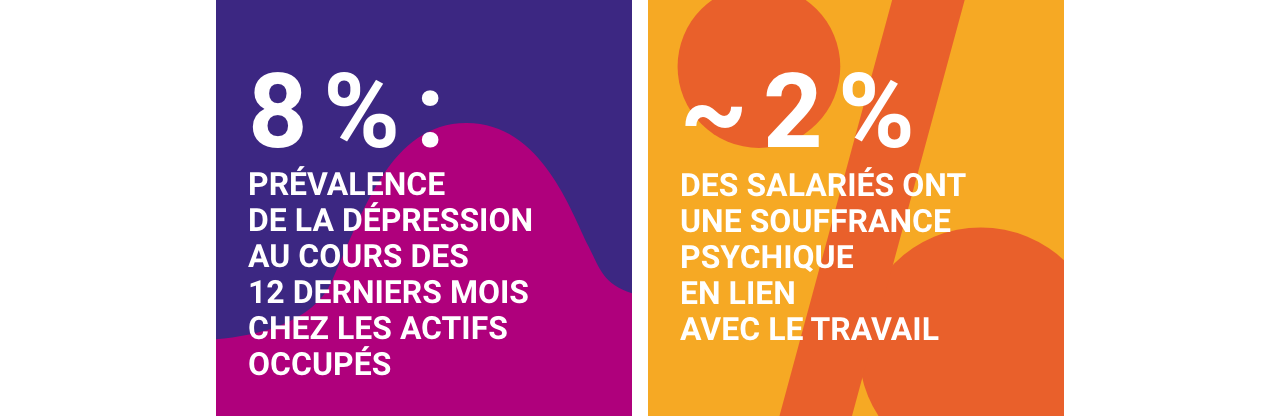
Describe the prevalence of work-related psychological distress in order to provide the data necessary for public prevention policies.
Key statistics on mental distress and burnout
Psychosocial workplace stressors
In recent decades, new organizational structures, the emphasis on performance, competition among individuals, the weakening of work communities, and job insecurity—all linked to changes in the world of work and corporate restructuring—have placed increasing strain on individuals. It has been proven that there are links between psychosocial workplace exposures and impaired mental health. Particular attention is therefore being paid to work-related psychological distress.
Mental health disorders
Work-related mental health disorders manifest in a wide variety of forms: depressive symptoms, sleep disorders, depressive and anxiety-depressive syndromes, burnout (occupational exhaustion syndrome), suicide attempts, and suicides… They are the subject of a growing number of epidemiological studies
Serious consequences
The consequences of psychiatric disorders are significant: disability, premature death, reduced quality of life, discrimination, and social exclusion. In France, as in most other European countries, psychiatric disorders are the leading cause of disability. They are also responsible for 35 to 45% of absenteeism from work.
Prevention, a public health objective
The prevention of psychosocial risks and burnout are notably among the objectives outlined in the third Occupational Health Plan 2016–2020.
The work of Santé publique France on suicide mortality among members of the Mutualité sociale agricole (MSA) is included in the MSA National Suicide Prevention Plan.
Learn more
In relation to

Suicides and suicide attempts
thematic dossier
France has one of the highest suicide rates in Europe. Suicide is preventable, and its prevention must be a priority. Effective prevention measures are available.












