




The disease
Rubella, a disease that is often mild but poses risks during pregnancy
Rubella is an acute, contagious viral infection caused by the rubella virus (Togavirus family). Rubella is generally a mild illness, but infection during the first few months of pregnancy can lead to fetal death or congenital rubella syndrome (the eyes, ears, circulatory system, and central nervous system of the fetus are the organs most commonly affected).
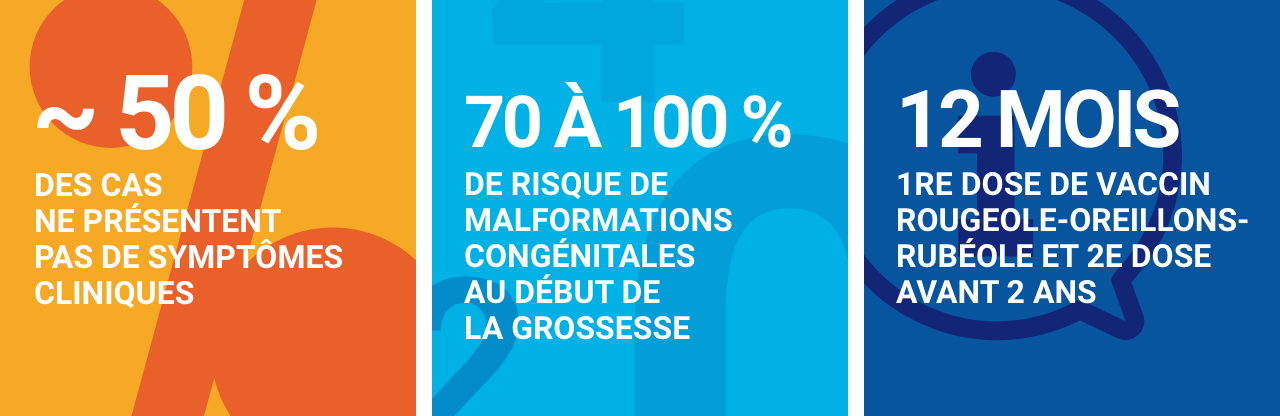
If the virus crosses the placenta during the first few months of pregnancy, the risk of congenital malformations is very high (70–100%) when maternal primary infection occurs before the 11th week of gestation; it ranges from 15 to 80% between the 12th and 18th weeks of amenorrhea and drops to nearly zero after this period. Transplacental transmission of the virus can cause fetal death or congenital rubella.
Since the main risk of rubella occurs during pregnancy, the goal is therefore to prevent any risk of infection during this period.
Key Facts About Rubella
Human-to-human transmission
Humans are the only known hosts. The rubella virus is transmitted through direct human-to-human contact via nasopharyngeal secretions emitted by infected individuals. Indirect transmission is possible through objects and surfaces recently contaminated with nasopharyngeal secretions. The urine of an infected infant may be a source of transmission in cases of congenital rubella.
The contagious period extends approximately from 7 days before the rash appears to 14 days after, but contagiousness is highest 5 days before and up to 6 days after. Children with congenital rubella shed the virus for several months.
A biologically confirmed diagnosis
The diagnosis of rubella can only be confirmed through laboratory testing, and serology must be interpreted in light of the clinical context and vaccination history. In the presence of a rash or following exposure, laboratory confirmation relies on:
the detection of specific IgM (whether or not associated with IgG)
seroconversion or a significant increase in IgG or total antibody titers in two samples taken 10 days apart
detection of viral RNA by PCR.
Interpreting IgM results is challenging due to the possibility of false positives.
Detection of viral RNA by PCR is only feasible in specialized laboratories (particularly in the context of prenatal diagnosis). Similarly, IgG avidity testing—which allows for dating the primary infection and thus differentiating a primary infection from a reinfection in the presence of IgM—is performed only at the CNR.
Vaccine Prevention
For infants and children, the vaccination schedule calls for the administration of a first dose of the measles-mumps-rubella (MMR) vaccine at 12 months and a second dose between 16 and 18 months. This two-dose vaccination is mandatory for all children born on or after January 1, 2018. A catch-up vaccination (to complete the two-dose trivalent vaccine series) is recommended for individuals over 24 months of age born on or after 1980.
Women of childbearing age born before 1980 must receive one dose of the trivalent vaccine. Pre- and post-vaccination serology tests are unnecessary. If serology results confirming the woman’s immunity to rubella are available, vaccination is unnecessary. There is no need to revaccinate women who have received two doses of the vaccine, regardless of the serology result.
For women with negative or unknown prenatal serology (mandatory IgG screening since 1992), vaccination is recommended immediately after childbirth (live vaccine contraindicated during pregnancy).
There is no recommendation to exclude a rubella case from a community setting. However, information must be provided to staff and individuals frequenting that community (parents in the case of a school or daycare), and any pregnant woman who has been in contact with the case must be advised to consult her doctor. There is also no French recommendation for post-exposure prophylaxis (vaccine and/or immunoglobulins) around a case, particularly in a pregnant woman, or in situations involving clusters of cases (for the record, immunoglobulins do not have marketing authorization (MA) for this indication). However, verifying and updating the vaccination status of the case’s contacts, in accordance with the current vaccination schedule, are useful measures for the subsequent protection of uninfected individuals who have been in contact with the first case, particularly young girls and women of childbearing age, and especially in group settings (reminder: the vaccine is contraindicated in pregnant women and immunocompromised individuals).
Rare complications
The incubation period ranges from 14 to 23 days, with an average duration of 16 to 18 days.
Rubella is a viral infection that is generally benign, asymptomatic, or paucisymptomatic in about 50% of cases.
When symptomatic, the disease begins with a moderate fever (38.5°C) followed by a fleeting measles-like maculopapular or macular rash that starts on the face and spreads within 24 hours to the trunk and upper limbs. It resolves without sequelae by the third day. The early onset of persistent retroauricular and posterior cervical lymphadenopathy is quite characteristic.
Complications are rare (joint involvement, neurological involvement, thrombocytopenia) and mortality is virtually zero.
However, the severity of the disease is linked to transplacental transmission of the virus if a pregnant woman is infected during the first months of pregnancy: in the case of a primary rubella infection in the mother, the risk of fetal transmission is approximately 90% before 11 weeks of amenorrhea (WA), then decreases to 25% between the 23rd and 26th weeks of amenorrhea, and increases again in the third trimester.
Damage during embryogenesis results in malformations of the central nervous system, the eye, the inner ear, and the cardiovascular system, which may occur in isolation or in various combinations. Fetal pathology is characterized by intrauterine growth restriction, often associated with hepatosplenomegaly, thrombocytopenic purpura, and hemolytic anemia.
Children with congenital rubella syndrome may have hearing loss, eye and heart malformations, and other conditions (diabetes mellitus, thyroid dysfunction, etc.).
See also

Vaccination Information Service
Reference materials
In relation to

Measles
thematic dossier
Measles is one of the most contagious infections, with potentially serious complications, and it can be eradicated worldwide. High vaccination coverage is essential to interrupt the spread of the...

thematic dossier
The First 1,000 Days
The period from conception through the first two years of life is critical for a child’s development and the health of the adult they will become. That is why it is essential to prioritize the...

Vaccination
thematic dossier
Contagious diseases most often affect children at a very young age. Because children are particularly vulnerable, they are a priority target for vaccination programs.











