




Data
Santé publique France monitors epidemiological trends for rubella using data collected by surveillance systems.
Data from mandatory reporting (2019–2021)
Following the implementation of mandatory reporting in late 2018, only three confirmed cases of rubella were reported in 2019—involving two adult males and one incompletely vaccinated infant—and no cases were reported in 2020 or 2021.
A Decrease in the Number of Indigenous Maternal Rubella Infections
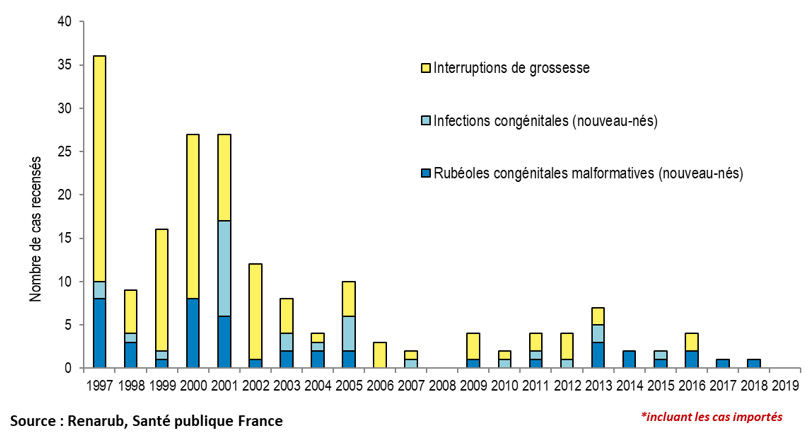
The number of rubella infections diagnosed during pregnancy and recorded by the Rénarub network decreased by 80% between 2001 (39 cases) and 2016 (7 cases, including 4 imported cases). In 2017 and 2018, the annual number of maternal infections was 6 (including 3 imported cases) and 10 cases (including 7 imported cases), respectively. No maternal infections were identified in 2019; the ratio of “number of maternal infections to number of live births” fell from 0.41 per 100,000 in 2017 to zero in 2019.
Between 2006 and 2016, the annual number of pregnancies terminated due to maternal infection recorded by Rénarub was 3 or fewer, the number of congenital infections was 5 or fewer, and the number of newborns with congenital rubella syndrome (CRS) was 3 or fewer. Then, between 2017 and 2019, two cases of CRS (imported) were recorded among the few remaining cases of rubella infection diagnosed during pregnancy.
These latest results indicate an absence of viral circulation throughout the country, in line with the goal of rubella elimination set for 2020 at the European level (WHO Regional Office).
Between 2017 and 2019, the number of laboratories in the Rénarub network decreased from 129 to 102 across the entire country. The effective participation rate of the laboratories surveyed ranged from 64% to 71% (laboratory participation in both survey semesters), with 80% of laboratories participating in at least one survey semester. Over these three years, the return rate of completed forms by clinicians who treated the patients was 98% (176 forms).
Distribution of the number of cases reported by the Rénarub network in mainland France
| 2005 | 2006 | 2007 | 2008 | 2009 | 2010 | 2011 | 2012 | 2013 | 2014 | 2015 | 2016 | 2017 | 2018 | 2019 | |
|---|---|---|---|---|---|---|---|---|---|---|---|---|---|---|---|
| Number of cases reported by laboratories (IgM+)* | 110 | 118 | 75 | 65 | 144 | 123 | 140 | 149 | 151 | 92 * | 89 | 105 | 122 | 96 | 107 |
| Excluded cases | 94 | 111 | 70 | 63 | 137 | 119 | 132 | 136 | 139 | 86 | 88 | 98 | 116 | 86 | 107 |
| Possible primary or reinfection | 5 | 7 | 4 | 7 | 14 | 6 | 5 | 6 | 0 | 1 | 2 | 4 | 2 | 12 | 0 |
| Lost track of, files not returned | 9 | 26 | 4 | 31 | 47 | 23 | 12 | 17 | 2 | 2 | 6 | 5 | 11 | 8 | 4 |
| Others** | 80 | 78 | 62 | 25 | 76 | 90 | 115 | 113 | 137 | 83 | 80 | 89 | 103 | 66 | 103 |
| Confirmed and probable maternal rubella infections | 16 | 7 | 5 | 2 | 7 | 4 | 8 | 13 | 12 | 6 | 1 | 7ⱡ | 6ⱡ | 10ⱡ | 0 |
| Confirmed primary infections | 11(c) | 3 | 4 | 1 | 5 | 2 | 5 | 12 | 10 | 3 | 1 | 5 | 4 | 8 | 0 |
| Confirmed re-infections | 1 | 0 | 0 | 0 | 0 | 0 | 0 | 0 | 1 | 0 | 0 | 0 | 1 | 1 | 0 |
| Confirmed infections | 1 | 0 | 0 | 0 | 0 | 0 | 0 | 0 | 0 | 0 | 0 | 0 | 0 | 1 | 0 |
| Probable primary infections | 2 | 2 | 1 | 0 | 1 | 1 | 3 | 0 | 1 | 3 | 0 | 0 | 1 | 0 | 0 |
| Probable re-infections | 1 | 1 | 0 | 1 | 1 | 1 | 0 | 1 | 0 | 0 | 0 | 2 | 0 | 0 | 0 |
| Probable infections | 0 | 1 | 0 | 0 | 0 | 0 | 0 | 0 | 0 | 0 | 0 | 0 | 0 | 0 | 0 |
| Number of congenital infections | 9 | 0 | 2 | 0 | 2 | 1 | 2 | 3 | 5 | 2 | 1 | 0 | 0 | 0 | 0 |
| Congenital rubella syndrome (newborns) | 2 | 0 | 0 | 0 | 1 | 0 | 1 | 0 | 3 | 2 | 1 | 0 | 0 | 0 | 0 |
| Teratogenic rubella (termination of pregnancy) | 0 | 0 | 0 | 0 | 1 | 0 | 0 | 0 | 0 | 0 | 0 | 0 | 0 | 0 | 0 |
| Non-teratogenic rubella infection or unknown clinical status (newborns or fetuses) | 7 | 0 | 2 | 0 | 0 | 1 | 1 | 3 | 2 | 0 | 0 | 0 | 0 | 0 | 0 |
(c) twin
pregnancy *Starting in 2014, the decline in the number of initial cases can be explained in part by the “screening” now performed by the CNR upon receipt of these cases, but also by a decrease in laboratory participation (-7% compared to 2013)
**including Absence of pregnancy, Rubella immunity prior to pregnancy, vaccination during pregnancy
ⱡBetween 2016 and 2019, the Rénarub network enabled the detection of cases of primary infection or confirmed maternal infection (PIC or IC, respectively) imported from Algeria (9), Morocco (1), Armenia (1), or sub-Saharan Africa (3: Gabon, Ivory Coast, Madagascar): 4 PICs in 2016 (including 2 with RCM), three PICs in 2017 (including 1 with RCM), 6 PICs (including 1 RCM) and 1 IC in 2018, none in 2019.
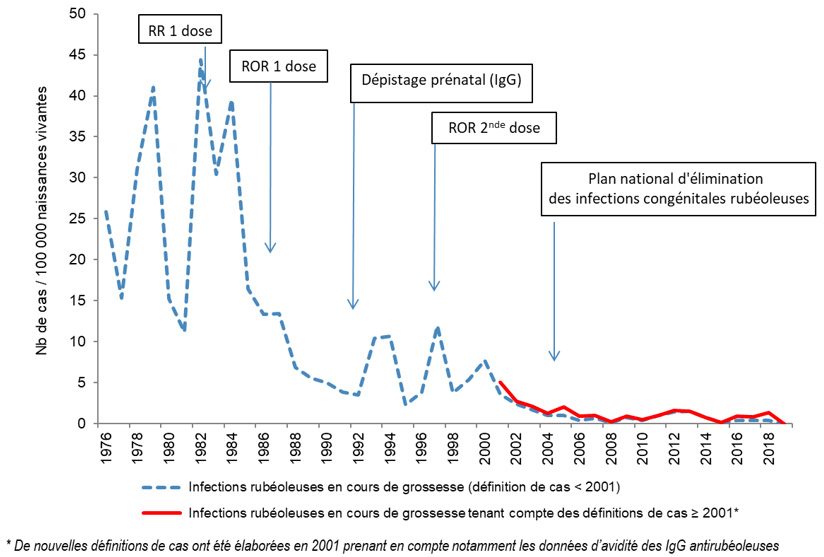
Trends in the ratio of rubella infections among pregnant women to live births – Metropolitan France, 1976–2019 (MMR = trivalent measles-mumps-rubella vaccine)
Trends in the number of maternal infections leading to pregnancy terminations or the birth of children with congenital rubella syndrome – 1997 to 2019
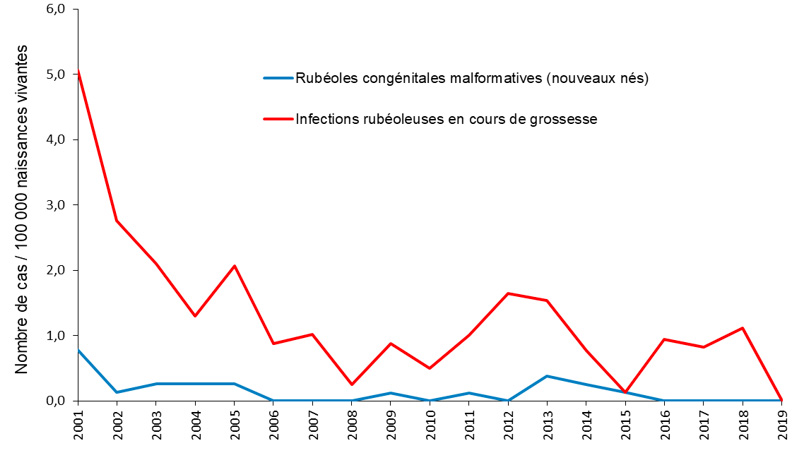
The ratio of "newborns with congenital rubella syndrome (CRS) reported by Rénarub to the number of live births (LB)" in mainland France was 0.0 per 100,000 in 2019.
Trends in the ratio of rubella infections among pregnant women to cases of congenital rubella syndrome among live births – Metropolitan France, 2001–2019
No residual indigenous circulation of the rubella virus
Data collected through the Rénarub network during its final years of operation support the absence of residual circulation of the rubella virus, reflecting a high level of immunity among women of childbearing age due to catch-up vaccination.
The level of susceptibility to the virus was estimated at 3.1% among women aged 18 to 32 in mainland France in the seroprevalence survey conducted among blood donors in 2013. However, susceptibility was higher among men (7.8%), and vaccination coverage levels in France remain inconsistent across departments, which could still allow for localized outbreaks of viral circulation.
The actual number of maternal infections may be underestimated within the Rénarub network, primarily due to a lack of diagnosis in pregnant women, as rubella infections are frequently asymptomatic or atypical.
An increase in two-dose vaccination coverage
The "two-dose" MMR vaccination coverage at 24 months has increased in recent years, rising from 60.9% to 83.4% between 2010 and 2018.
European and global surveillance data
In relation to

Measles
thematic dossier
Measles is one of the most contagious infections, with potentially serious complications, and it can be eradicated worldwide. High vaccination coverage is essential to interrupt the spread of the...

thematic dossier
The First 1,000 Days
The period from conception through the first two years of life is critical for a child’s development and the health of the adult they will become. That is why it is essential to prioritize the...

Vaccination
thematic dossier
Contagious diseases most often affect children at a very young age. Because children are particularly vulnerable, they are a priority target for vaccination programs.











