


December 1 – World AIDS Day: Let’s all get involved – PACA
cp_journee_mondiale_sida_paca.pdf
Download (PDF - 230.94 KB)
Press Contact
Phone: 04 13 55 83 70
Email: ars-paca-communication@ars.sante.fr
To mark World AIDS Day, observed every December 1, the Provence-Alpes-Côte d’Azur Regional Health Agency (ARS) and Santé publique France Paca-Corse are presenting the latest regional indicators: stabilization in new HIV infections, a decline in the number of people unaware of their HIV status, and an increase in testing. These encouraging results underscore the importance of maintaining active prevention efforts and ensuring easy access to testing.
Stabilization of HIV Infections in the Provence-Alpes-Côte d’Azur Region: The Importance of Early Testing
In 2024, the Provence-Alpes-Côte d’Azur region recorded 333 new HIV diagnoses, a level stable compared to 2023 (353).
According to Santé publique France, 217 people were newly infected, a figure that has also remained stable since 2022.
Number of new HIV diagnoses (crude and adjusted figures), Provence-Alpes-Côte d’Azur, 2014–2024
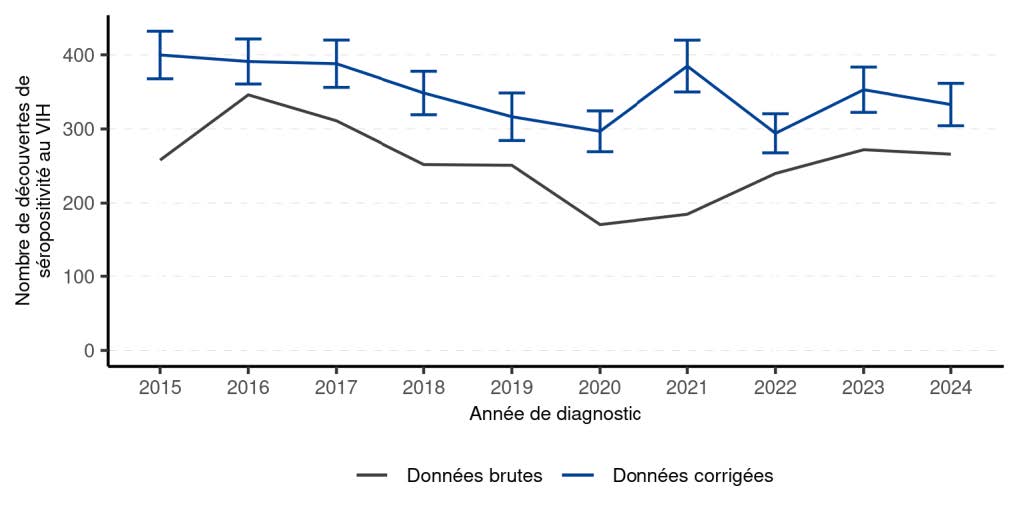
Furthermore, in 2024, 619 people were living with HIV without knowing their status, a decrease from 2023 (663), confirming the importance of early testing.
Transmission through heterosexual intercourse is now the most common route of infection, surpassing transmission through sex between men, which has historically been predominant in the region.
Screening: A Key Tool for Early Intervention
Testing remains the only way to know one’s status regarding sexually transmitted infections. A delayed diagnosis results in a missed opportunity for care (treatment and follow-up) and increases the risk of transmission.
These efforts are fully aligned with the international targets set by UNAIDS at 95% to end the HIV epidemic by 2030.
In the Provence-Alpes-Côte d’Azur region, since 2023, the results have been particularly encouraging and deserve to be highlighted, while continuing these efforts:
96% of people living with HIV know their HIV status;
97% are receiving antiretroviral treatment;
97% have an undetectable viral load, a sign that the virus is under control and can no longer be transmitted.
These figures demonstrate the effectiveness of the measures in place and the collective commitment to meeting and exceeding global targets.
The regional service offering is extensive:
CeGIDD and facilities authorized to perform rapid diagnostic tests (RDTs),
Testing without a prescription or appointment at all laboratories, fully covered since January 2022,
Since September 2024, the “Mon Test IST” program has allowed those under 26 to access expanded testing (gonorrhea, chlamydia, syphilis, hepatitis B).
Testing activity remains very high in the Provence-Alpes-Côte d’Azur region, with 788,000 HIV tests performed in 2024. Over-the-counter
laboratory testing is growing in popularity: 140,700 tests in 2024, compared to 65,800 in 2023.
Prevention: maintaining a high level of vigilance
The use of condoms, whether male or female, remains an essential tool for preventing HIV and sexually transmitted infections (STIs).
However, their use during first sexual intercourse has been declining for several years,1 particularly among younger people.
Since January 1, 2023, condoms have been available free of charge at pharmacies for those under 26.
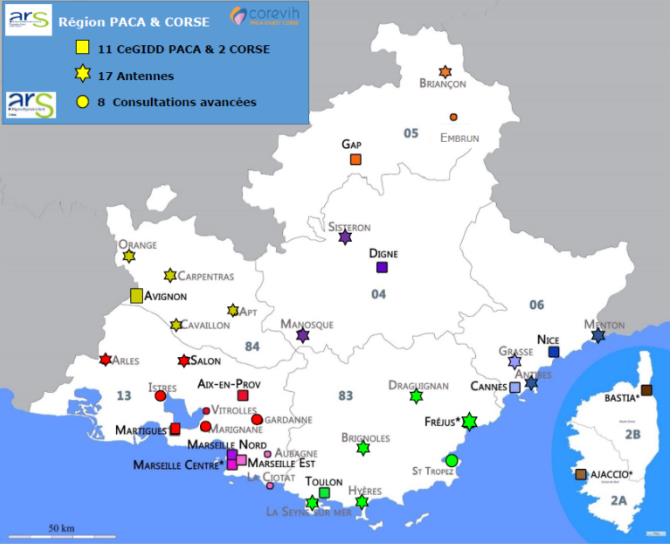
A Map of the Free Centers for Information, Screening, and Diagnosis of Human Immunodeficiency Virus Infections, Viral Hepatitis, and Sexually Transmitted Infections (CeGIDD) in the Provence-Alpes-Côte d'Azur and Corsica regions
Sexual health: a priority area of the 2023–2028 Regional Health Plan
The Provence-Alpes-Côte d’Azur Regional Health Agency is strengthening its efforts in the area of sexual health around four priorities:
preventing HIV and STIs by tailoring tools to each target audience (condoms, testing, preventive or post-exposure treatments).
Educating young people about sexuality, sexual health, and interpersonal relationships.
informing the general public, particularly through the annual “Sexual Health Month: Let’s Talk About It” campaign.
Improving access to care for the most vulnerable populations (migrants, unaccompanied minors, people in situations of prostitution, etc.).
In addition, the two former COREVIHs have been merged into a single regional CORESS to strengthen coordination, harmonization, and the effectiveness of sexual health initiatives across the entire region.
Other surveillance indicators
Screening and diagnosis of Chlamydia trachomatis, gonorrhea, and syphilis infections have been steadily increasing since 2018.
The rate of gonorrhea infections is rising sharply:
among men aged 15 to 49,
among women aged 15 to 25.
Chlamydia infections remain particularly high among women aged 15 to 49.
For more information:
QuestionSexualite.fr—a national information website validated by experts, featuring an interactive map of testing and sexual health centers.
Our latest news

news
Call for Nominations for the Renewal of the Scientific Advisory Board of the...

news
Growing Up with Screens. A special report in *La Santé en action* No. 474,...

news












