



Diseases
A disease is considered work-related if it is the direct result of a worker’s exposure to a hazard (physical, chemical, or biological) or arises from the conditions under which the worker performs their job. A distinction is made between compensable occupational diseases, on the one hand, and work-related diseases, on the other.
In France, the compensation system for occupational diseases is administered by the Social Security schemes and funded by employers. Consequently, it covers only employees. Compensation is based on the presumption of occupational origin if the disease is included in a restrictive list (tables of occupational diseases) and if all the conditions listed in these tables are met. In addition, since 1993, a supplementary system has been in place that allows for the recognition as occupational of conditions that do not meet all the criteria in the tables or are not listed in the tables under certain conditions. To be recognized under this framework, individual cases are reviewed by Regional Committees for the Recognition of Occupational Diseases (CRRMP), which determine the link between the onset of the disease and working conditions.
Statistics on recognized and compensated occupational diseases are regularly produced by the Social Security systems. Numerous studies show that these statistics fall far short of reflecting the reality of the health impact of occupational risks, for various reasons, including significant underreporting of these conditions.
The concept of an occupational disease (MCP), defined as any disease that may be of occupational origin but is not recognized as an occupational disease by a Social Security system, was introduced by the legislature as early as 1919, with a view to both preventing occupational diseases and gaining a better understanding of occupational pathology, as well as expanding or revising the lists of recognized diseases.
Key statistics on occupational diseases
A requirement established by law
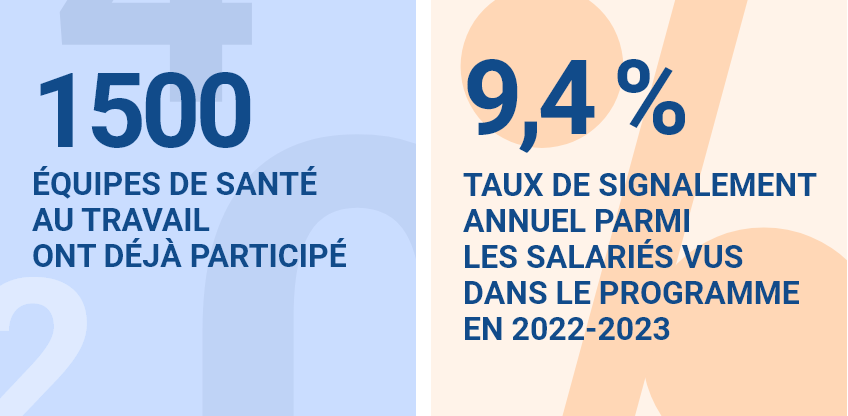
Although reporting such cases is a legal obligation for all medical doctors (Article L461-6 of the Social Security Code), in the absence of an implementing decree organizing the reporting of information and the centralization of data, few doctors reported MCPs, and the few reports that were made were only partially utilized.
As part of its mission to conduct epidemiological surveillance of occupational risks, the Health, Environment, and Work Directorate of Santé publique France has been implementing, since 2002, in partnership with the Occupational Health Inspection and the Regional Health Observatories of participating regions, a surveillance system based on this legislative framework. The Public Health Policy Act of August 9, 2004, supports this framework by entrusting Santé publique France with the mission of implementing a tool to centralize and analyze statistics on diseases presumed to be of occupational origin.
Links
Contacts
National Coordinator:
Juliette Chatelot, MCP Program Coordinator
Email: mcp@santepubliquefrance.fr
Regional contacts:
Antilles (Martinique / Guadeloupe)
Dr. Guillaume Anoma, Deets
Christina Goudou, ORSAG
Natacha Neller, OSM
Brittany
Dr. Thomas Bonnet, Dreets
Patricia Bedague, ORS
Centre-Val-de-Loire
Dr. Bernard Arnaudo, Dreets
Claire Cherbonnet, ORS
Grand-Est
Dr. Martine Léonard, Dreets
Dr. Stéphanie Scarfone, Dreets
Emilie Boiselet, Dreets
Nadia Honoré, ORS
Hauts-de-France
Dr. Jean-François Verquin, Dreets
Cécile Gauthiez, ORS
Nouvelle-Aquitaine
Dr. Florence Fernet, Dreets
Dr. Nadine Renaudie, Dreets
Julie Debarre, ORS
Audrey Rouchaud, ORS
Reunion
Emmanuelle Rachou, ORS
Hélène Mignon-Racault, ORS
Occitanie
Dr. James Alves, Dreets
Dr. Nathalie Bernal-Thomas, Dreets
Dr. Marie-Ange Chancelier, Dreets
Patrice Poinat, ORS
Pays de la Loire
Dr. Véronique Mennetrier, Dreets
Marie-Christine Bournot, ORS
Provence-Alpes-Côte d'Azur
Dr. Irène Sari-Minodier, Dreets
Virginie Gigonzac, ORS
In relation to

Musculoskeletal disorders
thematic dossier
Musculoskeletal disorders primarily manifest as pain and functional impairment of varying severity, often occurring on a daily basis and caused or exacerbated by work

Mental distress and burnout
thematic dossier
Mental health can be affected by certain psychosocial workplace exposures, leading to conditions such as burnout, depression, and suicidal behavior.












