




The disease
Neurodegenerative diseases
Dementia manifests as a progressive decline in memory and cognitive function, as well as behavioral disturbances. These disturbances lead to a gradual loss of independence. To date, dementia is an irreversible process for which no cure is available.
Its etiology remains poorly understood, but the processes involved in its onset can be classified into two categories (which coexist in most cases):
neurodegenerative processes, primarily involved in Alzheimer’s disease, which itself accounts for nearly 70% of all cases of dementia;
vascular lesions, which account for approximately 20 to 30% of cases and are exacerbated by vascular risk factors such as high blood pressure or diabetes.
Other causes of dementia, such as frontotemporal dementia, Lewy body dementia, and dementias secondary to certain diseases, are much rarer.
In this context, Santé publique France’s priorities are:
to ensure the epidemiological surveillance of Alzheimer’s disease and other dementias: prevalence, incidence, temporal trends, and geographic distribution;
to study the prognostic factors of the disease (mortality, associated morbidities, frequency and reasons for hospitalizations);
informing public authorities and healthcare professionals.
Key Statistics on Alzheimer's Disease
Identified risk factors
Age is the primary risk factor for Alzheimer’s disease and other forms of dementia.
Cardiovascular risk factors, particularly high blood pressure, diabetes, and high cholesterol, play a significant role.
Genetic susceptibility factors have also been linked to a higher risk, even in sporadic forms.
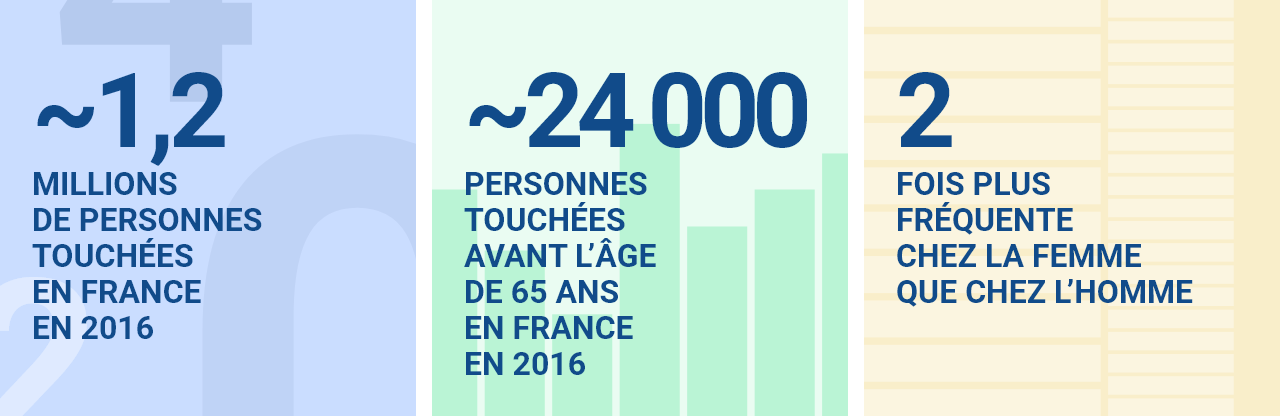
Conversely, a high level of education, a strong social network, engaging in leisure activities, and regular physical exercise are believed to be protective factors. Numerous studies suggest a higher risk among women than among men of comparable age. This could be explained by the fact that, in most studies conducted to date, women belonged to generations whose average duration of education was shorter than that of men.
Symptoms that progress irreversibly
a progressive decline in memory and cognitive function,
behavioral disturbances,
a gradual loss of independence,
Dementia is a major cause of dependency, institutionalization, and hospitalization among older adults.
No curative treatment
To date, there is no curative treatment for dementia. Four medications are available on the market. Their effects are modest and primarily address short-term cognitive impairments, without halting the progression of the disease. These medications are no longer covered by insurance. The French National Authority for Health (HAS) has determined that they no longer have a place in the therapeutic strategy due to the lack of clinically relevant efficacy and the risks of adverse effects.
Non-pharmacological treatments should be prioritized: it is important to optimize physical health, nutrition, cognitive activities, and well-being; to screen for and treat physical and mental comorbidities; and to inform and support family members, caregivers, and healthcare providers.
A significant burden for the person with the disease and their loved ones
Alzheimer’s disease and other dementias are a major cause of dependency, institutionalization, and hospitalization.
They have a significant impact on the quality of life of those affected, as well as on that of their loved ones and caregivers, for whom they can be particularly challenging.
Links
View the list of our partners' websites











