



Pertussis resurgence in France: preventive measures are essential to avoid severe cases and deaths among infants
Following a call for heightened vigilance in April 2024 due to a resurgence of whooping cough in Europe and France, Santé publique France has confirmed the start of a new epidemic cycle this year.

Whooping cough
thematic dossier
Whooping cough is a highly contagious bacterial respiratory infection with a prolonged course; a vaccine is available to prevent the disease and, in particular, to prevent its transmission to...
Following an initial alert at the European level, Santé publique France reported last April a resurgence of whooping cough in France since the beginning of 2024. The latest data published on June 2, 2024, confirm the resurgence of the disease in France, with more cases already reported in the first five months of the year than in all of 2023. This sharp increase in the number of cases and reports of clusters in recent weeks confirms the intensification of community transmission of the bacterium announced in the first quarter of 2024. At the European level, the ECDC recorded 25,130 cases of pertussis in 2023, compared to 32,037 cases between January 1 and March 31, 2024.
This bacterial infection, caused primarily by the bacterium Bordetella pertussis, is highly contagious—more so than chickenpox and as much as measles—and is transmitted through the air, particularly through contact with an infected person who is coughing. Transmission occurs mainly within families or in group settings. Infants too young to be vaccinated (those under 2 months of age) are the most affected by severe cases, hospitalizations, and deaths.
Santé publique France emphasizes the importance of preventive measures and vaccination to protect those at risk of severe illness and calls for heightened vigilance in the coming months. Multi-source epidemiological monitoring of the outbreak and this new wave will help determine its scope and duration, which cannot be predicted at this time.
An increase in the circulation of the bacterium in France
In France, the various pertussis surveillance indicators tracked by Santé publique France confirm the resurgence of the disease across the country. While in the first quarter of 2024, a few regions reported clusters of cases, the entire country is now affected, with significant increases across all surveillance networks.
RENACOQ Network (hospital-based pertussis surveillance system)
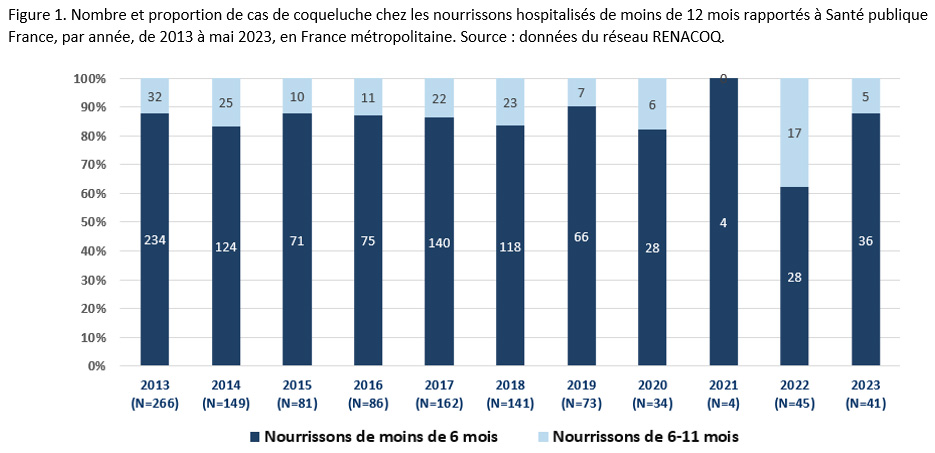
Since the last pertussis outbreak in 2017–2018, when 162 cases were reported, the number of cases has steadily declined, reaching 34 cases in 2022 and 4 cases in 2021 among infants under 12 months of age, followed by a slight increase in 2022 and 2023 with 45 and 41 cases, respectively. With 46 cases in the first 5 months of 2024 (unconsolidated data), the network has already recorded more cases than in the entire year of 2023. Furthermore, data analyzed for the 2013–2023 period show that, among the 1,082 infants hospitalized in RENACOQ network hospitals, 85% were under 6 months of age (n=924) and 59% were under 2 months of age and therefore ineligible for vaccination (n=643) (Figure 1).
3-Labos Network (network of specialized clinical laboratories Cerba and Eurofins-Biomnis)
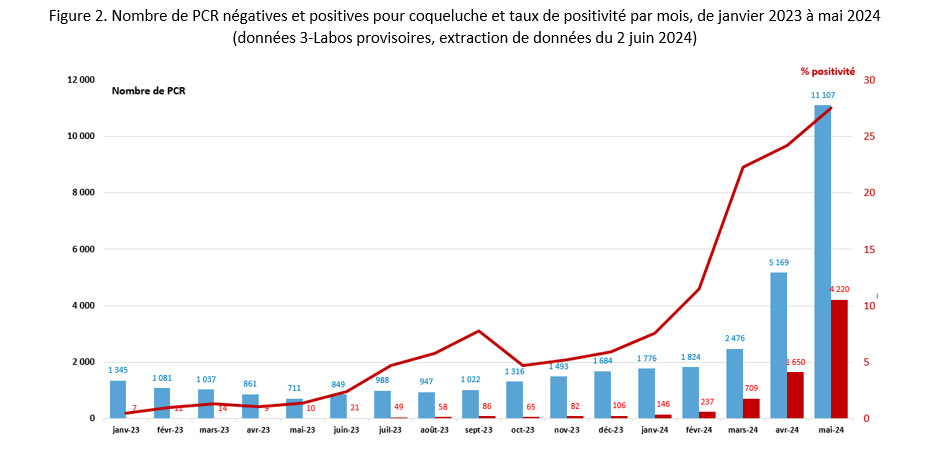
Laboratory data show an increase in the number of PCR tests performed. In January 2024, 1,922 PCR tests were performed, compared to over 15,000 in May 2024, with the number of tests increasing fivefold between March and May 2024. The positivity rate is also on the rise, with 27.5% of PCR tests testing positive (unconsolidated data) in May 2024, compared to 7.6% last January. In the first five months of 2024, 3Labos data already show 6,962 positive PCR tests (provisional data), compared to 518 for the entire year of 2023 (Figure 2).
OSCOUR Network (Organization for Coordinated Emergency Surveillance)
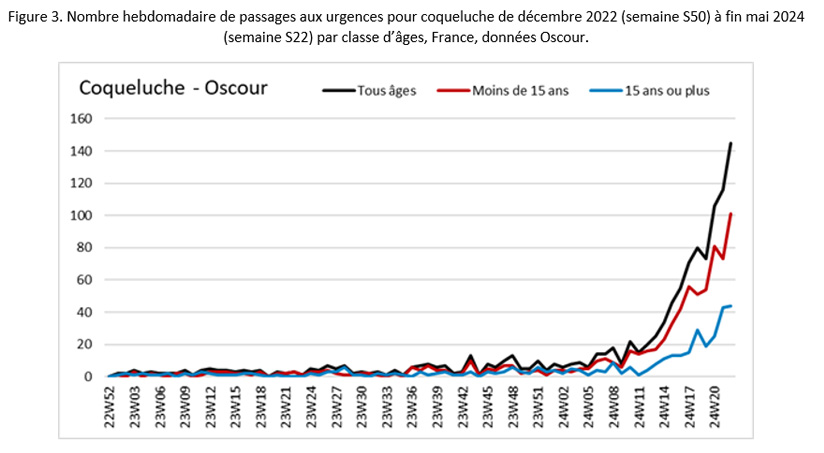
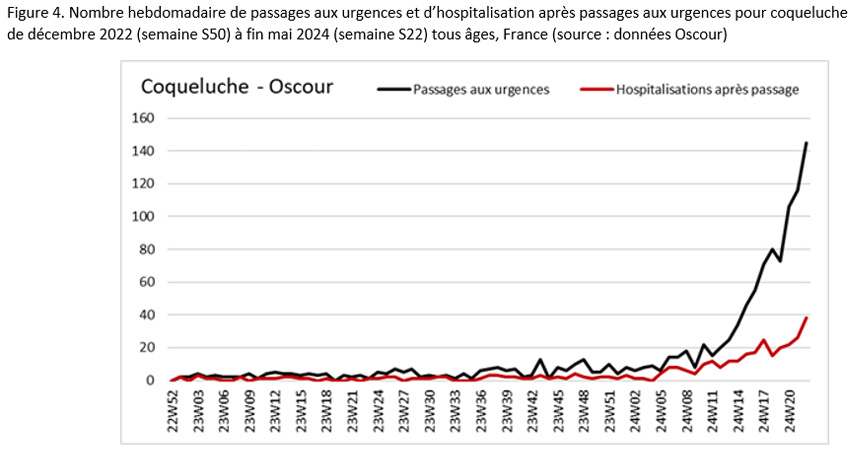
The weekly number of emergency department visits for pertussis increased sevenfold between weeks 11 and 22 (Figure 3). Data by age group show that the increases are primarily driven by children (under 15 years of age). The number of hospitalizations for pertussis following an emergency department visit also increased sevenfold between weeks 11 and 22 (Figure 4).
SOS Doctors Network
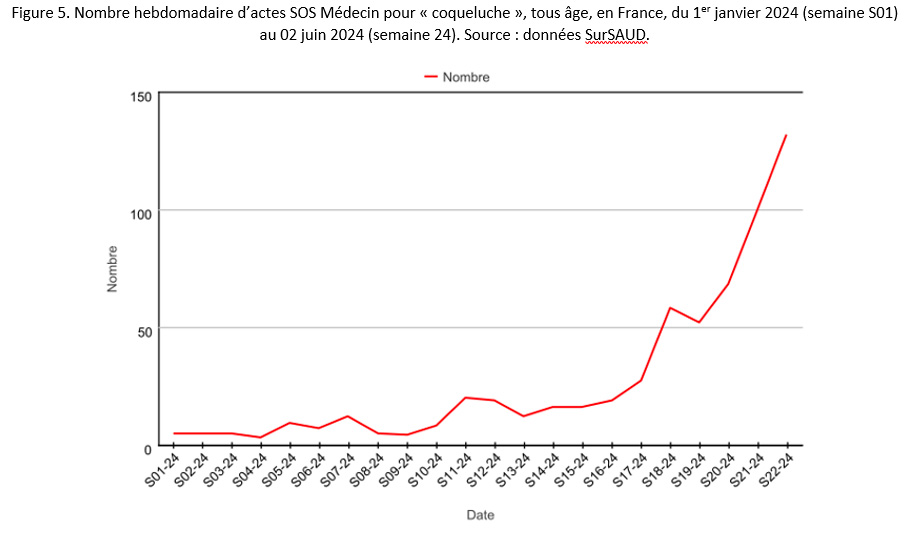
The number of consultations and procedures for pertussis increased sevenfold between weeks 10 and 24 (Figure 5).
Sentinelles Network
A sharp increase in the number of pertussis consultations has been observed in primary care since the beginning of 2024 compared to previous years.
National Reference Center
On the microbiological front, the National Pertussis Reference Center also confirms a significant increase in activity.
Regarding clusters of cases, data analysis shows that the majority of clusters occur within families or in educational settings (preschools, elementary schools, middle schools, and high schools), with most cases involving individuals who are not up to date on their vaccinations.
Cases in children who are fully vaccinated according to current recommendations occur mainly among children in the final year of preschool or in elementary school just before their 6-year-old booster shot. This phenomenon is not unexpected and is linked to the duration of protection provided by acellular pertussis vaccines.
The importance of early care for patients and their families, as well as the reporting of healthcare-associated infections and clusters of cases
Pertussis is not a reportable disease, but cases must be reported to the Regional Health Agency in two specific situations:
as part of the reporting of nosocomial infections, or
when clusters of cases occur (two or more cases), whether within families or in community settings.
Measures must be taken regarding the patient and their contacts, particularly for at-risk individuals and in high-risk settings (maternity wards, daycare centers, healthcare facilities, etc.), such as isolation and the initiation of antibiotic treatment for sick individuals, antibiotic prophylaxis for unvaccinated contacts, and updating the vaccination status of the exposed population. It is also recommended to obtain laboratory confirmation for at least the first identified case and to send a specimen, bacterial isolate, or DNA extracted from the specimen to the National Reference Center for Pertussis to confirm, in particular, the species.
Learn more:
Guidelines for managing one or more cases of pertussis (HCSP)
Reporting and monitoring of cases(Santé publique France)
Vaccination and mask-wearing are essential for preventing whooping cough
France’s pertussis vaccination policy aims to reduce severe cases, hospitalizations, and deaths related to pertussis, which primarily occur in infants under 6 months of age. It is based on three complementary strategies:
mandatory vaccination with a primary series of two doses administered two months apart—that is, at 2 months (8 weeks) and 4 months—followed by a booster dose at 11 months, and the administration of booster doses at 6 years, 11–13 years of age and through adulthood (up to age 25, with the option to catch up through age 39);
vaccination of pregnant women, recommended starting in the second trimester of pregnancy, with priority given to the period between 20 and 36 weeks of amenorrhea;
if the mother was not vaccinated during pregnancy, vaccination of the mother postpartum and of individuals likely to be in close contact with the infant during the first 6 months of life (a strategy known as “cocooning”).
Individuals at risk of severe forms of pertussis include, in addition to infants not protected by vaccination, those with chronic respiratory diseases (asthma, chronic obstructive pulmonary disease, etc.), immunocompromised individuals, and pregnant women. It is therefore reiterated that vaccination is recommended for:
immunocompromised individuals,
healthcare professionals (including those in nursing homes for the elderly (EHPAD)),
people working in close and repeated contact with infants under 6 months of age,
students in medical and paramedical programs,
early childhood professionals, including child care providers and those who regularly babysit.
Learn more about vaccination: Pertussis | Vaccination Info Service (vaccination-info-service.fr)
Wearing a mask: an effective barrier
As with any respiratory infection outbreak, it is important to emphasize that among the effective preventive measures, wearing a mask is strongly recommended. For people with symptoms of a respiratory infection (cold, sore throat, cough, fever), regardless of the cause; wearing a mask remains mandatory, particularly in the presence of vulnerable individuals, in healthcare and long-term care facilities, in enclosed spaces, and on public transportation. Indeed, it provides individual protection against infection and the risk of developing a severe form of the disease, but also serves as collective protection, helping to reduce the risk of transmission within the population and of infecting those at risk of severe illness.

depliant/flyer
22 October 2026
Whooping Cough. Pregnant Women. 5 Good Reasons to Get Vaccinated

Vaccination Information Service
What are vaccines for? How do they work? At what age should children be vaccinated? Vaccination-info-service.fr answers the most frequently asked questions about vaccination. A separate...

Vaccination
thematic dossier
Contagious diseases most often affect children at a very young age. Because children are particularly vulnerable, they are a priority target for vaccination programs.












