



Pertussis Outbreak in Europe: Call for Increased Vigilance in France
Santé publique France has released updated pertussis surveillance data from the RENACOQ network in France for 2022 and 2023, and reports an increase in the circulation of the disease across the country since the beginning of 2024.

Whooping cough
thematic dossier
Whooping cough is a highly contagious bacterial respiratory infection with a prolonged course; a vaccine is available to prevent the disease and, in particular, to prevent its transmission to...
Whooping cough is a highly contagious bacterial infection that spreads mainly within families or in communities through contact with an infected person who is coughing. Although the number of whooping cough cases has dropped significantly since the introduction of the vaccine, the bacteria continue to circulate. Infants too young to be vaccinated and adolescents and adults who have lost their vaccine-induced immunity are the most affected populations. Beyond our borders, Europe is currently experiencing a resurgence of pertussis cases, with major outbreaks in Croatia, Denmark, and the United Kingdom, and significant increases in Belgium, Spain, and Germany. In France, since the beginning of 2024, about twenty clusters have been reported to Santé publique France across eight regions, compared to just two clusters in a single region (Île-de-France) for the entire year of 2023. Given this sharp increase in the number of reported clusters, Santé publique France remains vigilant and reiterates the importance of vaccination to protect those at risk of severe illness.
A resurgence of pertussis is beginning in France
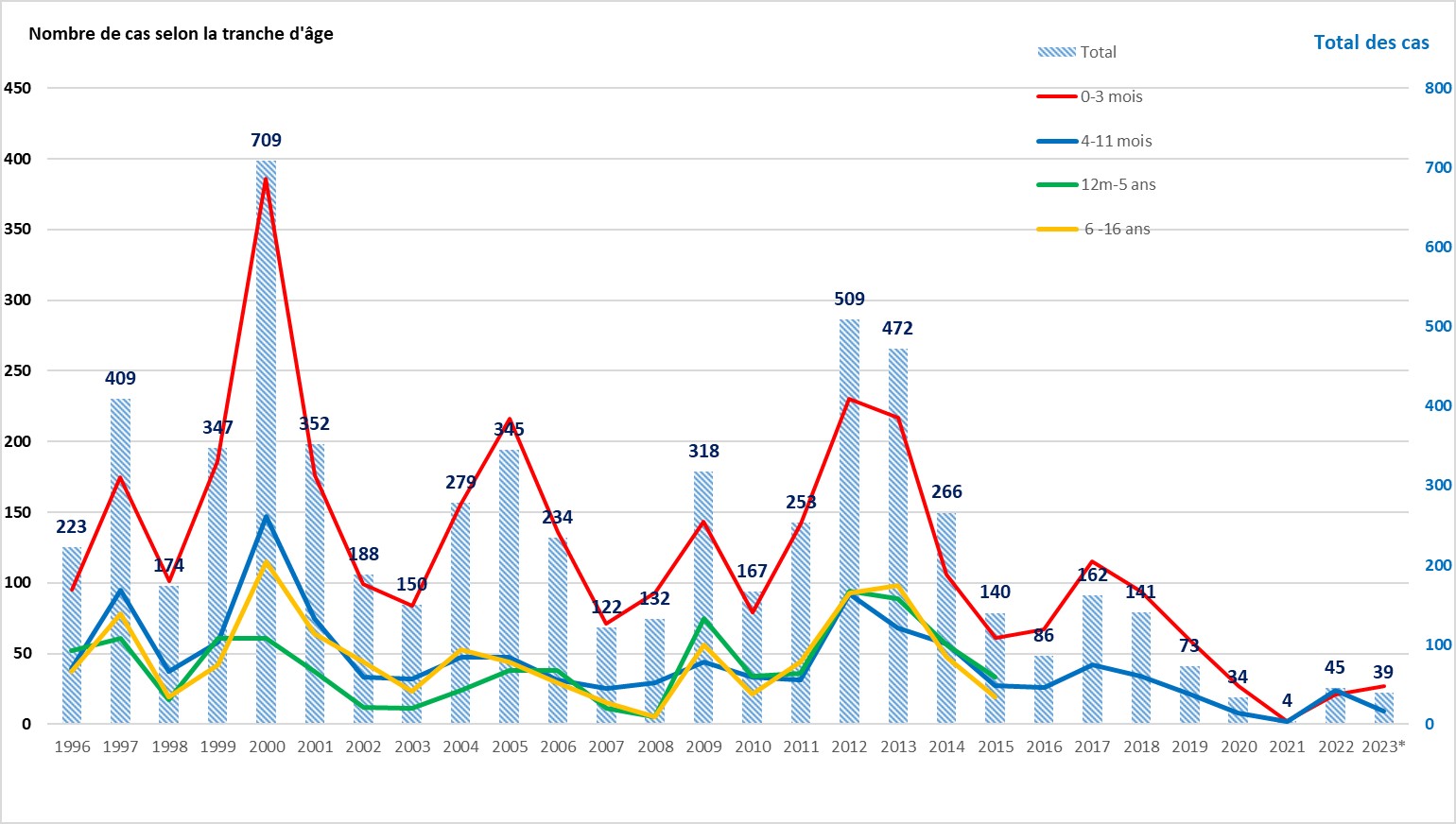
Pertussis occurs in cycles of resurgence every 3 to 5 years. In France, surveillance data from the RENACOQ network (the hospital-based pertussis surveillance network) have shown six epidemic peaks in recent years: 1997, 2000, 2005, 2009, 2012–2013, and 2017–2018. Since the last peak in pertussis (162 reported cases), the number of cases has steadily declined, reaching 34 cases in 2020 and 4 cases in 2021 among infants under 12 months of age. The same trend is observed in data from the Sentinelles network (the research and surveillance network for primary care, general medicine, and pediatrics in metropolitan France), which reported 1 case per year in the general population over the same period. Although a resurgence of the disease might have been expected in France in 2021–2022, the exceptional circumstances and public health measures implemented in response to the COVID-19 pandemic likely reduced the transmission of pertussis.
Data published today, from the latest surveillance report, indicate a more significant resurgence of pertussis circulation in mainland France in recent months. Thus, the RENACOQ network (which has been monitoring hospitalized infants under 12 months of age since 2016) reported 45 cases in 2022 and 39 cases in 2023 (unconsolidated data). Regarding clusters in 2023, only two clusters were reported to Santé publique France between October and December, involving 18 pertussis cases in the Île-de-France region: these included intra-family clusters (13 cases), community clusters (4 cases), and a single isolated case with no link to the reported clusters. In the first quarter of 2024, approximately 15 clusters—primarily in community settings (preschools, elementary schools, daycare centers, and nursery schools) but also within families—totaling 70 cases were reported to Santé publique France (unconsolidated data for the current year 2024).
The increase in the number of cases compared to 2023 and the sharp rise in reports of clustered cases indicate a resurgence of the bacterium’s circulation in the community, which could intensify in the coming months. Vigilance remains essential, with a need to raise public awareness of this disease and its prevention methods. To date, the situation in France is not comparable to that of our European neighbors and those across the Atlantic, who have been reporting several hundred cases per week since the last quarter of 2023.
Number of hospitalized pertussis cases among children under 17 years of age (1996–2015) and among infants under 12 months of age (2016–2023), RENACOQ data. (*2023 data, not yet finalized)
The Importance of Reporting and the Measures to Be Taken Regarding the Patient and Those Around Them
Pertussis is not a reportable disease, but cases must be reported to the Regional Health Agency in two specific situations:
as part of the reporting of nosocomial infections, or
when clusters of cases occur (two or more cases), whether within families or in group settings.
In addition, measures must be taken regarding the patient and those around them, particularly for at-risk individuals and in high-risk settings (maternity wards, daycare centers, healthcare facilities, etc.), such as isolating the patient and administering antibiotic treatment to those who are sick, providing antibiotic prophylaxis to unvaccinated contacts, and updating the vaccination status of the exposed population. It is also recommended to obtain laboratory confirmation for at least the first case and to send a specimen, bacterial isolate, or DNA extracted from the specimen to the National Reference Center for Pertussis to confirm the species, among other things.
Learn more:
Guidelines for managing one or more cases of pertussis (HCSP)
Reporting and monitoring of cases(Santé publique France)
Vaccination: The Only Way to Protect Against Whooping Cough
France’s pertussis vaccination policy aims to reduce severe cases, hospitalizations, and deaths related to pertussis, which occur primarily among infants under 6 months of age. It is based on three complementary strategies:
early primary vaccination of infants as soon as they are old enough to be vaccinated, i.e., starting at 2 months of age, and the administration of booster shots at 6 years, 11–13 years, and through adulthood (up to age 25, with the option to catch up until age 39);
vaccination of pregnant women, recommended starting in the second trimester of pregnancy, with a preference for the period between 20 and 36 weeks of amenorrhea;
if the mother was not vaccinated during pregnancy, vaccination of the mother postpartum and of individuals likely to be in close contact with the infant during the first 6 months of life (the so-called “cocooning” strategy).
Individuals at risk for severe forms of pertussis include, in addition to infants not protected by vaccination, those with chronic respiratory diseases (asthma, chronic obstructive pulmonary disease, etc.), immunocompromised individuals, and pregnant women. It is therefore reiterated that vaccination is recommended for immunocompromised individuals, healthcare professionals (including those in nursing homes for the elderly (EHPAD)), people working in close and repeated contact with infants under 6 months of age, students in medical and paramedical programs, early childhood professionals including child care providers, and people who regularly babysit.
Learn more about vaccination: Pertussis | Vaccination Info Service
As European Immunization Week approaches, Santé publique France is providing a range of tools and resources to help people better understand the importance of vaccination and raise public awareness of vaccination recommendations.
Learn more: European Immunization Week

depliant/flyer
16 October 2026
Whooping Cough. Pregnant Women. 5 Good Reasons to Get Vaccinated


Vaccination
thematic dossier
Contagious diseases most often affect children at a very young age. Because children are particularly vulnerable, they are a priority target for vaccination programs.
Vaccination Information Service | Whooping Cough
Who should get vaccinated, and why?












